
Part of our guide to the virtual office in Chicago. More guides on this topic
You can use a virtual address for an LLC. That part is settled, legal, and common.
The question that actually matters is narrower: which virtual addresses get accepted, and by whom. Because four separate gatekeepers will inspect that address, they apply different rules, and an address that satisfies one can be rejected by another.
This guide covers all four.
The four gatekeepers
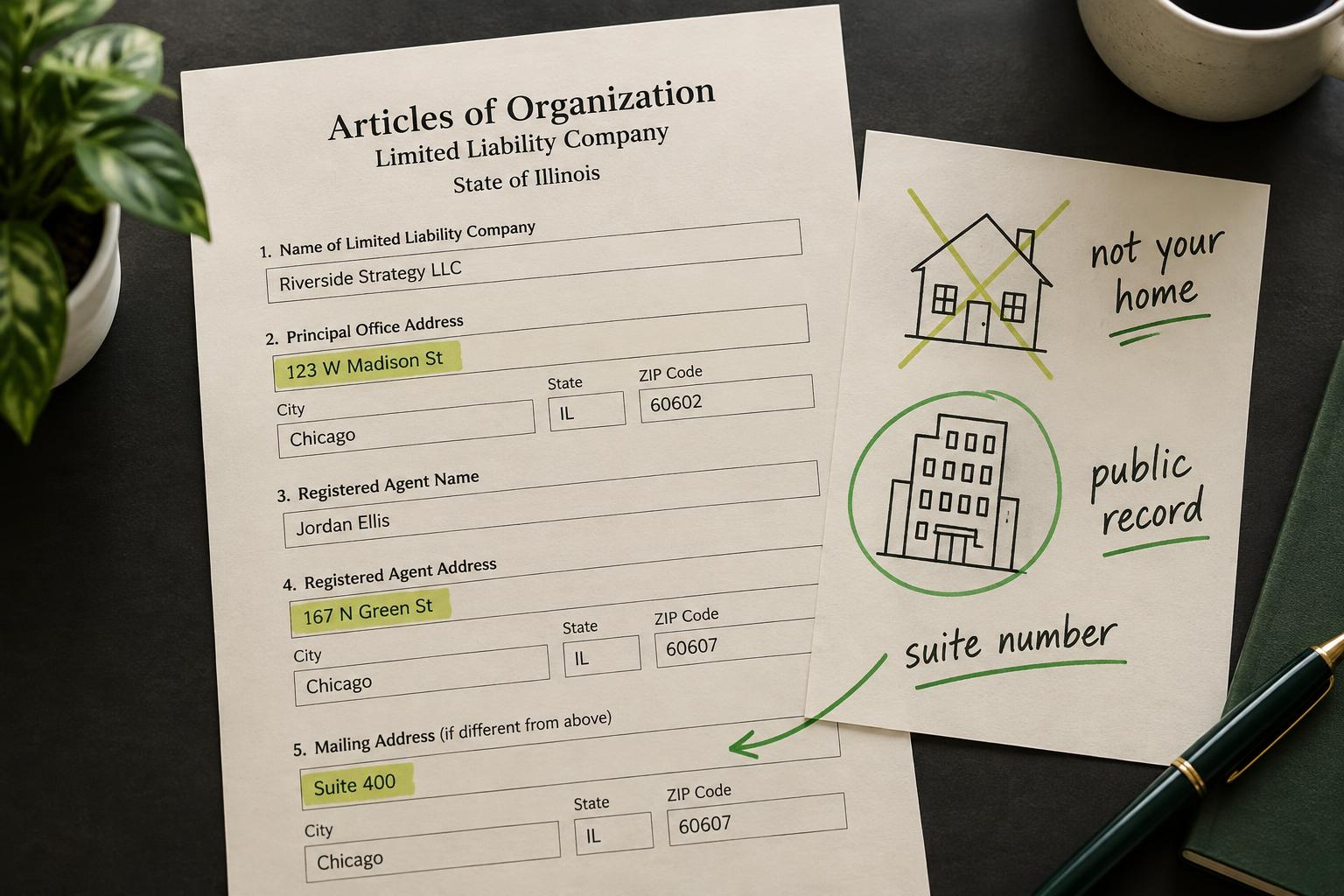
1. Your state. Every state requires a physical street address for your registered agent, and most want one for the principal office too. PO Boxes are rejected outright. In Illinois the agent's address must be a real street address in the state, staffed during business hours. Our form-by-form walkthrough shows where each address appears on the Illinois LLC filing.
2. Your bank. Federal Know Your Customer and Customer Identification Program rules require banks to verify a physical address. Most will accept a commercial virtual address. Nearly all reject PO Boxes, and some flag addresses they recognise as high-volume mail centres.
3. The IRS. The most flexible of the four. It will accept a mailing address including a PO Box for correspondence, but that does not help you with the other three.
4. Google. The strictest, and the one people discover last. Google Business Profile verification generally requires an address where your business genuinely operates, with staff present. Most virtual mailbox addresses are ineligible. An address with a signed agreement and a real presence usually is.
Why this matters: people choose an address to satisfy the state, then discover months later that their bank flagged it or Google refused to verify them. Decide what all four need before you file, because changing it afterwards means an amended state filing, an IRS form, a bank update and starting Google verification from scratch.
What gets rejected, and why
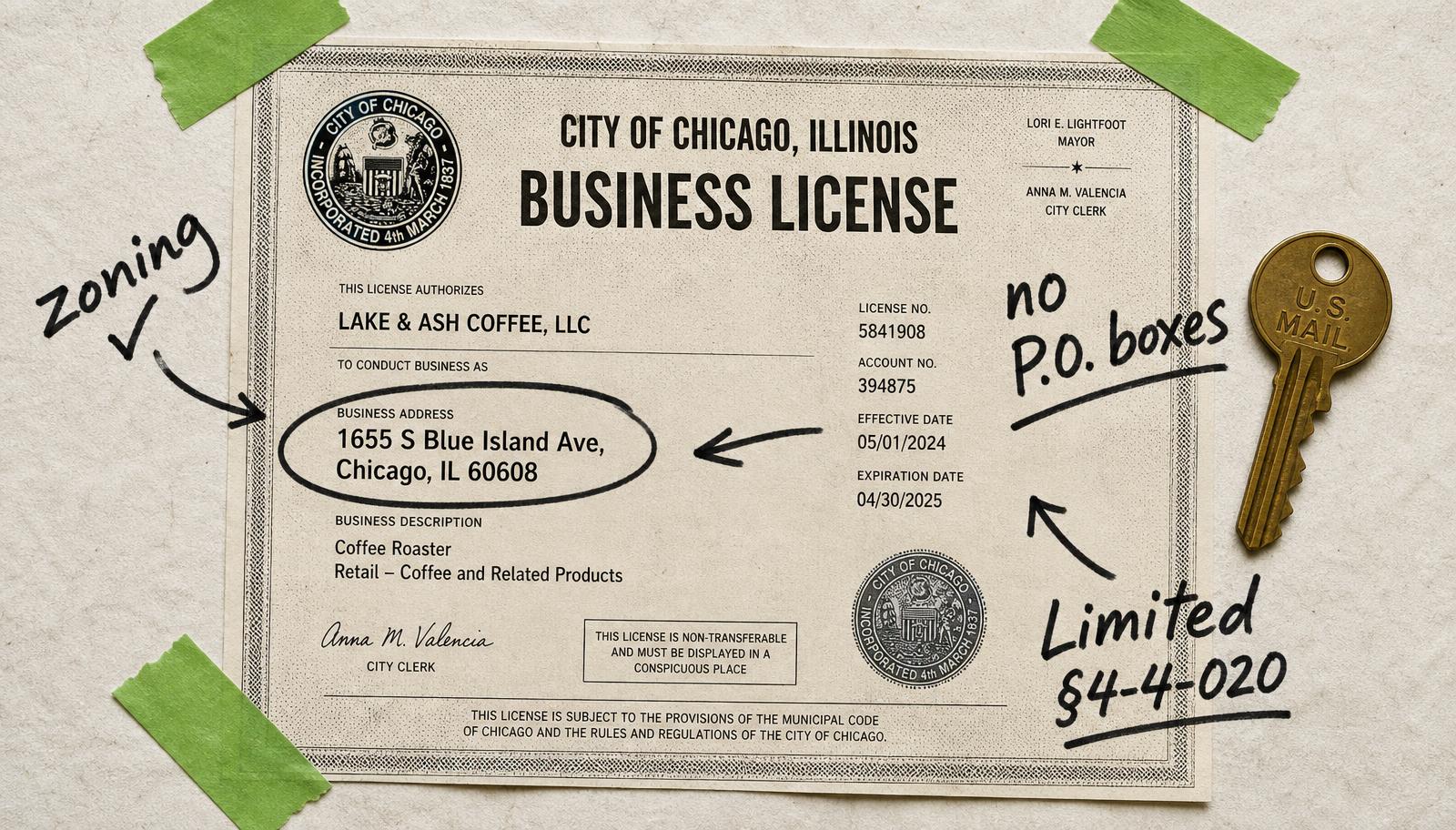
PO Boxes. Rejected by every state for registration and by essentially every bank. A PO Box is a mail slot, not a location.
Your home address. Accepted, but it becomes permanent public record that anyone can search, including anyone who wants to sue you or turn up. It is also where a process server will come.
Addresses flagged as commercial mail receiving agencies. This one is subtle. USPS maintains a database identifying CMRA locations, and some banks and platforms cross-reference it. A mailbox at a shipping store is more likely to be flagged than a suite in a commercial office building. This is the main practical difference between the cheapest virtual addresses and the ones that work everywhere.
Shared suite numbers. If a provider gives hundreds of businesses the identical suite number, Google's systems tend to notice. A unique suite is materially better.
Out-of-state registered agent addresses. Your agent must have an address in the state of formation. An address in another state does not satisfy the requirement, however good it is.
Is there a free virtual address for an LLC?
Not a legitimate one, and this deserves a direct answer because a lot of people search for it.
The costs are real: someone signs for your mail, a building is leased, identity verification is processed, and scans are handled. Services advertising free addresses generally do one of three things: offer a trial that converts to paid, use an address that fails bank or Google checks, or bundle it with a company-formation package where the cost is in the formation fee.
The nearest thing to free is using your home address, and the price you pay is publishing it permanently.
Realistically, a mailbox address runs a few tens of dollars a month, and an address with a signed agreement behind it (the kind that clears all four gatekeepers) runs somewhat more. Our current pricing is published rather than quoted.
Mailbox or virtual office: which one you need
This is the distinction that determines whether your address works, and most providers blur it.
| What you need the address to do | Business mailbox | Virtual office |
|---|---|---|
| Receive mail and packages | Yes | Yes |
| Keep your home address private | Yes | Yes |
| Scanning and forwarding | Yes | Yes |
| Appear on an LLC filing | Sometimes | Yes |
| Satisfy a city business licence | Usually not | Yes |
| Open a business bank account | Usually | Yes |
| Verify a Google Business Profile | Usually not | Yes, with a signed agreement |
| Serve as registered agent address | No | Yes, with agent service |
The dividing line is the agreement. A mailbox is mail service. A virtual office adds a signed agreement documenting your right to use the address, plus room access and member amenities.
If your address only receives mail, take the business mailbox. If it appears on any official document, take the virtual office in Chicago.
How to get one, in the right order
Sequence matters here. Doing it out of order means filing amendments.
1. Choose the address first, before you file anything. Changing it later costs an amendment fee and a round of updates everywhere.
2. Confirm what it is accepted for. Ask directly: can I register my LLC here, use it for a business licence, and verify a Google profile? Get it in writing.
3. Complete USPS Form 1583, notarised, with two forms of ID. One photo, one proving your home address, and not the same document for both. Our Form 1583 guide walks through it. We notarise on site.
4. File your Articles of Organization with the new address for both the principal office and the registered agent. See our Illinois LLC guide for fees and steps.
5. Get your EIN from the IRS. Free, online, minutes.
6. Update everything else: bank, IRS Form 8822-B if the address changes later, website, invoices, Google, directories. Use the identical format everywhere, suite number included. Inconsistent formatting is a common reason Google verification fails.
Founders outside the United States
You do not need to be a US citizen or resident to form a US LLC or to hold a virtual address, and non-resident founders are a meaningful share of this market.
Two things to know. First, you still complete Form 1583, and the ID requirements are the same. A passport works as the photo ID, plus a document showing your residential address wherever that is. Remote online notarisation is usually the practical route.
Second, your registered agent must be in the state of formation, so you will need an agent service regardless of where you live. That is exactly what agent services exist for.
Choosing a provider
Five questions, in order of how often they cause problems:
- Is this a commercial office building? Search the address in Google Maps and look at what a customer would see.
- Do I get a unique suite number? Shared numbers get flagged.
- Is it accepted for LLC registration and business licensing in this state? Vague answers mean no.
- Can I verify a Google Business Profile here? Only true where there is a signed agreement and a real presence.
- What are the per-item fees? Scanning, forwarding and storage charges frequently exceed the monthly rate.
Then one that is easy to overlook: is there a person there? Software can photograph an envelope. It cannot sign for a certified letter, accept service of process, or pick up the phone when a bank calls to verify you.
How this works at our address
We are at 1655 S Blue Island Ave in Pilsen: a real building, ten minutes from the Loop, staffed.
A virtual office here includes a signed agreement documenting your right to use the assigned address, your own suite number, unlimited mail scanning, and meeting room access. Add registered agent service at $95 a year per entity and both statutory requirements are covered at one address.
If all you need is mail, the business mailbox is cheaper and we will tell you so.
Related reading: virtual mailbox complete guide · what a PO Box cannot do · Google Business Profile verification
Frequently asked questions
Can I use a virtual address for my LLC?
Yes, provided it is a real street address rather than a PO Box. States require a physical address for the registered agent and usually the principal office. The practical constraint is not legality but acceptance: whether your bank and Google will also accept it.
Will a bank accept a virtual address?
Usually, when it is a commercial street address. Know Your Customer rules require a verifiable physical address, so PO Boxes are rejected, and some banks flag addresses identified as high-volume mail centres. A suite in a commercial building with a signed agreement is the safest option.
Is there a free virtual address for an LLC?
Not a legitimate one. Offers that appear free are typically trials, bundled into a formation package, or use addresses that fail bank and Google checks. The genuinely free option is your home address, at the cost of publishing it permanently.
Can I use a virtual address as my registered agent address?
Only if the provider offers registered agent service at it. The agent must be a person or company that has agreed to accept legal service on your behalf, at a street address in the state of formation, during business hours. An address alone does not satisfy this. Our registered agent guide for LLC owners explains who qualifies and what it should cost.
Will Google verify a business at a virtual address?
Often not. Google generally requires an address where your business genuinely operates with staff present, and most virtual mailbox addresses are ineligible. Addresses with a signed agreement and a real presence usually can be verified. Ask before you sign up if local search matters to you.
What is the difference between a virtual address and a physical business address?
A virtual address is a physical business address: a real street location you have rights to use, where someone receives your mail. The contrast is with a PO Box, which is a mail slot rather than a location, and which fails on state filings and bank applications.
Can a non-US resident get a virtual address for a US LLC?
Yes. You complete the same Form 1583 with a passport as photo ID plus proof of your residential address, typically using remote online notarisation. You will also need a registered agent in your state of formation.
How do I change my LLC address later?
File an amendment with the Secretary of State, submit IRS Form 8822-B, update your bank, and update your Google profile, website and directory listings. It is manageable but tedious, which is the argument for choosing an address you will not need to change.
Start from what the address has to do
Every gatekeeper is asking a version of the same question: is this a real place with a real connection to your business?
A mailbox answers that for mail. A signed agreement answers it for everything else. Work out which of the four gatekeepers you need to satisfy, then buy the product that clears them all.
Compare plans or tell us what you are filing and we will tell you which one you need, including when it is the cheaper one.
Follow @lobispace
Guides, Chicago business news and studio work, every week.