Part of our guide to the virtual office in Chicago. More guides on this topic
This week an email arrived from a founder in the West Loop who was doing everything right.
She was forming her Illinois LLC herself, straight through the state's website, which we always tell people they can do. She had the form open while she wrote to us. And her questions were so precise, and so exactly the questions everyone has at that screen, that we asked if we could answer them in public.
Three questions, lightly trimmed:
1. *If I use your virtual office as the LLC's principal place of business, what is the official address I enter?*
2. *I will be listed as the LLC's member and manager. Can I use the same business address there too, instead of my home address?*
3. *For the registered agent line, what exact legal name and registered office address do I enter?*
Behind all three is one goal she named plainly: she did not want her residential address on the public Illinois filing.
She is right to care. Here is why, and then the answers.
Everything on that form is public, forever
The Articles of Organization you file to create an Illinois LLC become a public record the day the state approves them. Every address on the form is visible to anyone who runs your company through the state's business entity search, which is free, takes seconds, and never requires a login. Marketers pull those addresses in bulk the day new filings appear. So do process servers, and so does anyone with a grievance and a browser.
Amending an address later means a state filing and a fee, and the old record does not disappear. The practical rule is simple: decide what the public should see before you file, because the form is not the place to figure it out.
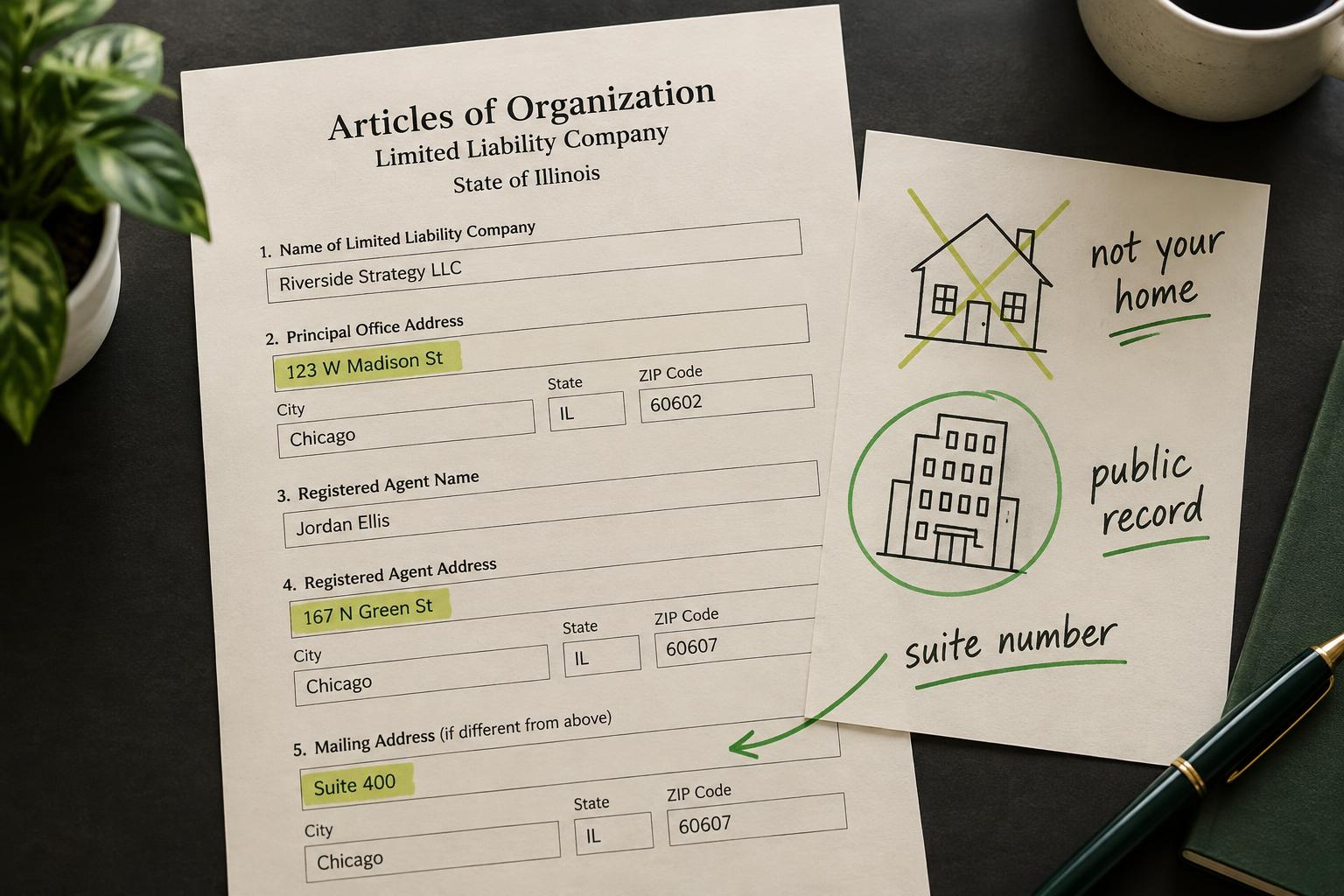
An Illinois LLC filing asks for an address in three different places, and they are three different jobs.
Address one: the principal place of business
This is the address of record for the company itself. It goes on the public filing, and it is also what you will write on the bank application, the city license, and most of what follows.
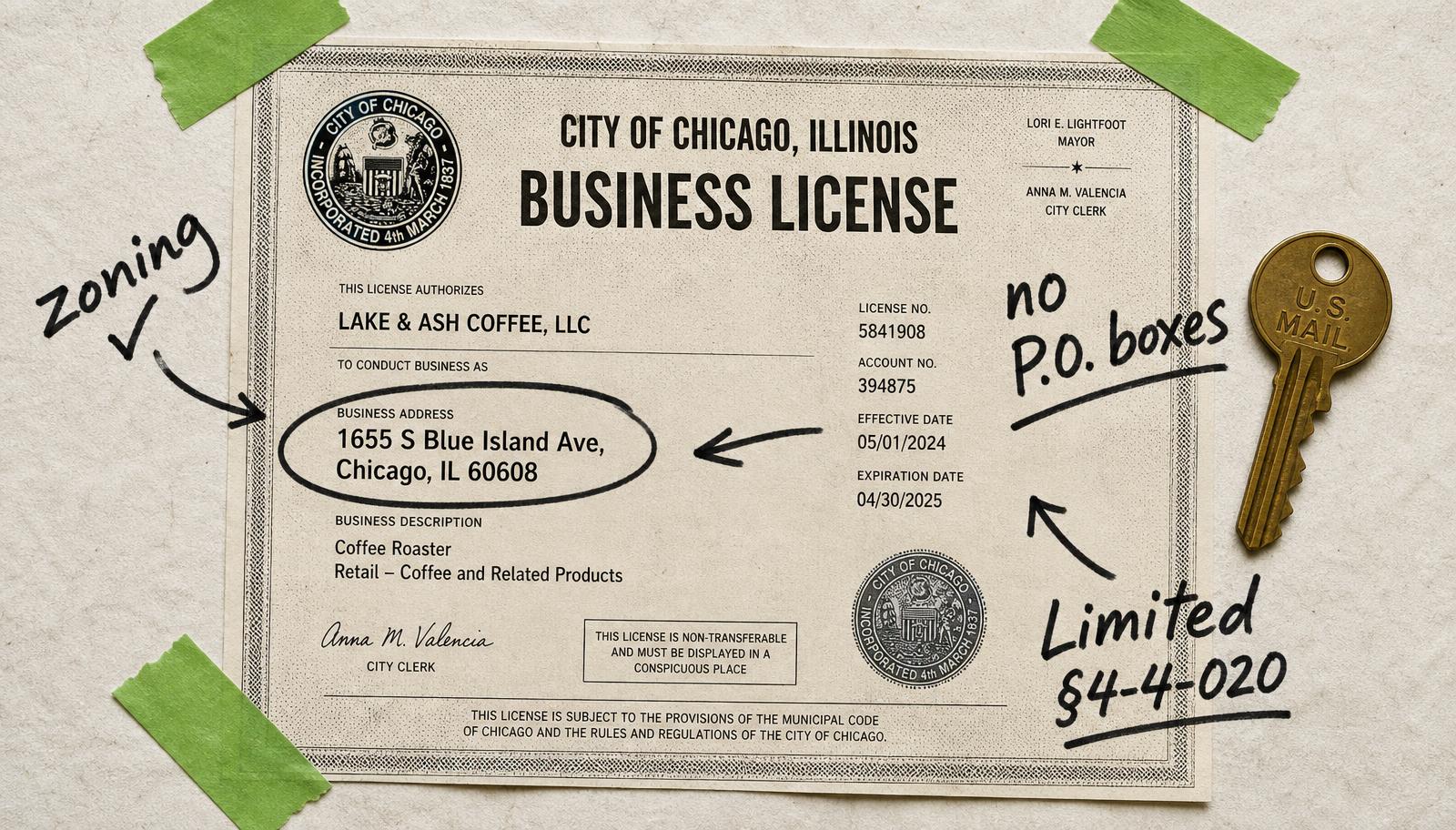
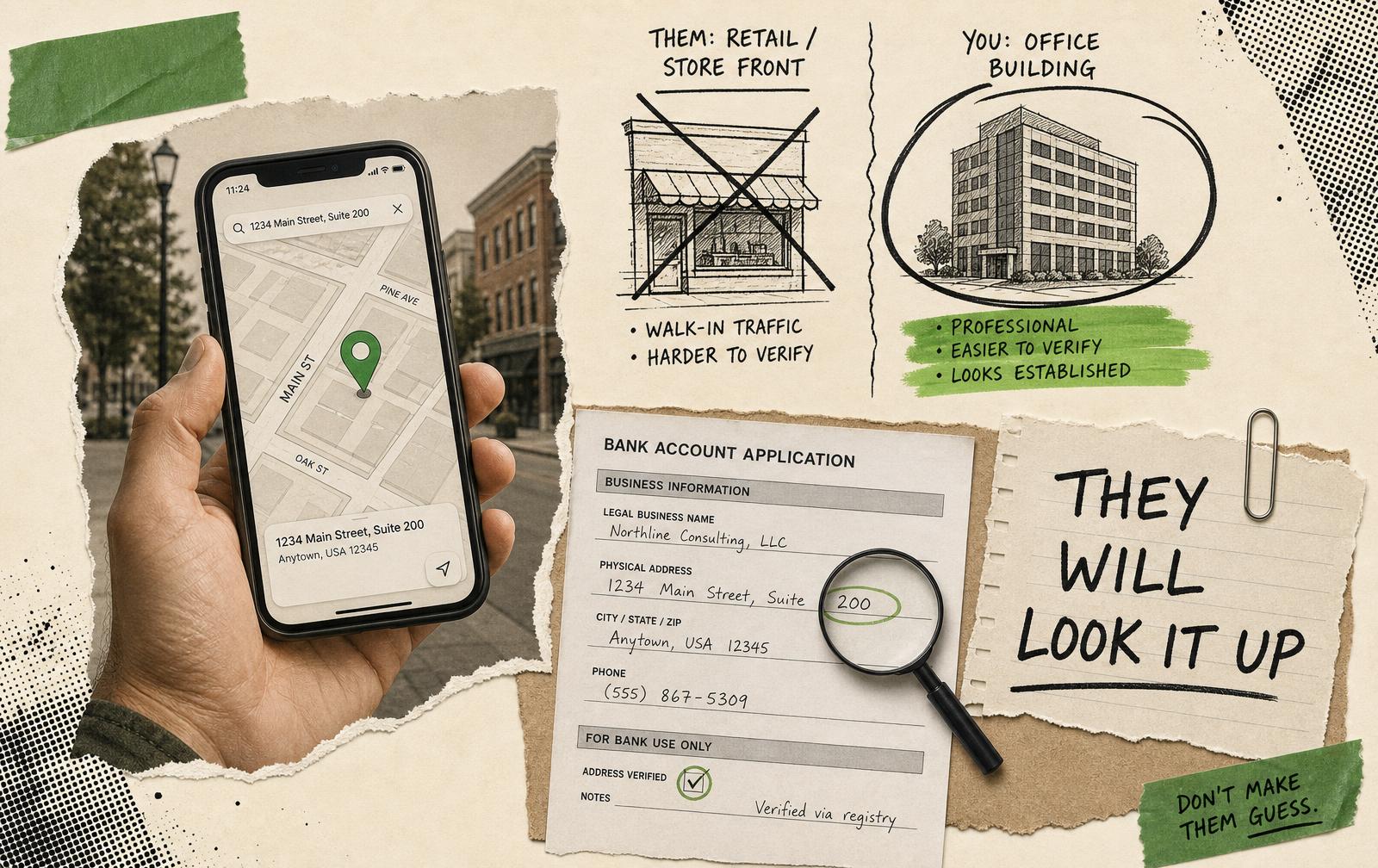
Illinois accepts a real commercial street address here, including a virtual office address, provided you genuinely have the right to use it. That last part is what banks and the city check: not whether the address exists, but whether you have an agreement that puts your business there.
For our members the answer to question one is concrete: 1655 S Blue Island Ave, Suite [your assigned number], Chicago, IL 60608. The suite number is assigned when you sign up, it is yours alone, and the signed agreement that comes with a virtual office in Chicago documents your right to use the address. Each agency, bank and platform sets its own acceptance requirements. We operate a staffed workspace with a front desk, which is what an address verification finds when someone checks.
A business mailbox is the lighter version: real address, mail handled, but without the signed agreement included with a virtual office. If the address is going on a state filing, the virtual office is the right tool. We wrote more about what makes an address survive scrutiny in our guide to virtual business addresses.
Address two: the members and managers
Here is the line that catches people. The form asks for the name and address of each manager, or each member with management authority. This is the one founders fill in on autopilot with their home address, and it is the most common way a home address ends up on a public filing by accident.
The form is asking for a business address for each person listed. Your business address. Which means the answer to question two is yes: the same suite that serves as the company's principal place of business can be the listed address for you as its member and manager. One address, used consistently, everywhere.
Consistency is not just tidiness. Banks and licensing reviewers compare documents, and every mismatch between your filing, your application, and your agreement is a question you will be asked to explain. One address that matches everywhere is the quiet mark of a company with its paperwork in order.
Address three: the registered agent
The registered agent line is different from the other two, and treating it differently is the professional move.
The registered agent is the person or company designated to receive legal documents: lawsuits, state notices, service of process. The form wants the agent's exact legal name and an Illinois street address for the registered office. No P.O. boxes, and one detail from the form itself that surprises people: the registered office address field is limited to 30 characters, including spaces. Long suite lines get truncated whether you planned it or not.
You have three choices for who goes on that line. Yourself, which is legal and free, and puts your address on the record with the added feature that a process server may arrive wherever you listed. A commercial agent. Or a person you trust who is reliably at an Illinois address during business hours. We wrote the honest version of that decision in can I be my own registered agent in Illinois.
Two things worth knowing from the front desk:
The agent address and the business address do not have to match, and often should not. The registered office is where legal papers land. The business address is where the company lives. Plenty of well-run companies deliberately keep those separate, and Illinois is entirely comfortable with that arrangement.
If we are your agent, we give you the exact two lines to enter, character for character, so the 30-character field and the legal-name question stop being your problem. Our registered agent service is $95 a year per entity, and it includes same-day scans of anything served plus free annual report reminders. And if you want to file first and decide later, that works too: agents can be changed with a $25 state filing, and members sometimes start as their own agent and switch to us at their first renewal.
The chicken-and-egg question nobody warns you about
There is a sequencing puzzle hiding in all of this. You need the address before you file, but the company does not exist until you file. So which comes first?
The address does, and there is a standard way to do it: sign up for the address as yourself, with the company name noted as *in formation*. Once the state approves the LLC, the agreement is updated to the company's official name. This is ordinary practice, our agreements are written for it, and it means your filing goes to the state complete on day one instead of listing a temporary address you will pay to amend later.
One honest caveat: each agency, bank and platform sets its own address rules. Confirm the premises and documentation your activity needs directly with the receiving organization before filing.
The fifteen-minute compliance step that makes the mail legal
One more piece, because it surprises people who think the address is just a line on a form. For us to receive mail on your company's behalf, USPS requires Form 1583, completed with two forms of ID and notarized. It is a fraud-prevention rule, it applies to every legitimate mail-receiving business in the country, and a provider who skips it is telling you something.
At our building the notary is on site, the whole thing takes about fifteen minutes, and your suite number is assigned at signup so you have it in hand for the state filing. The step-by-step, including which IDs the form actually accepts, is in our Form 1583 guide.
The order of operations, start to finish
1. Pick the address, sign up as yourself with the company noted as in formation, get your suite number.
2. Complete Form 1583 with our notary, fifteen minutes.
3. File the Articles of Organization: suite address as principal place of business, the same address for you as manager, and your chosen agent's exact name and address on the agent line. The full walkthrough, with every fee, is in how to set up an LLC in Illinois.
4. Once approved, we update the agreement to the company's official name, and you take the stamped articles and the signed agreement to the bank.
Or hand us the filing itself through our Illinois formation service and do steps one through four in one conversation. We are not a law firm and this is not legal advice, so anything that reads like a judgment call about your situation deserves an attorney. The addresses, the agent line, and the mail, we handle every week.
The short version
Illinois asks for an address three times, publishes all three forever, and never requires any of them to be your home. A founder who sets up the business address first, files with one consistent address, and puts a staffed agent on the agent line has solved privacy, banking, and compliance in a single decision.
That email from the West Loop ended with a tour request, which is our favorite kind of question. The building is open. Come look at your address before you file it.