Part of our guide to the virtual office in Chicago. More guides on this topic
The appointment gets booked for Tuesday. The owner brings a driver's license and a printout of the LLC filing, sits down, and forty minutes later walks out without an account. The second member wasn't there, the operating agreement was still a draft, and the address on the application was a P.O. Box.
Nothing about that Tuesday was unusual. Banks are running a federally mandated identity check, not a customer-service exercise, and they'd rather stop the process than open an account they can't document.
So here's the list, in the order a banker asks for it.
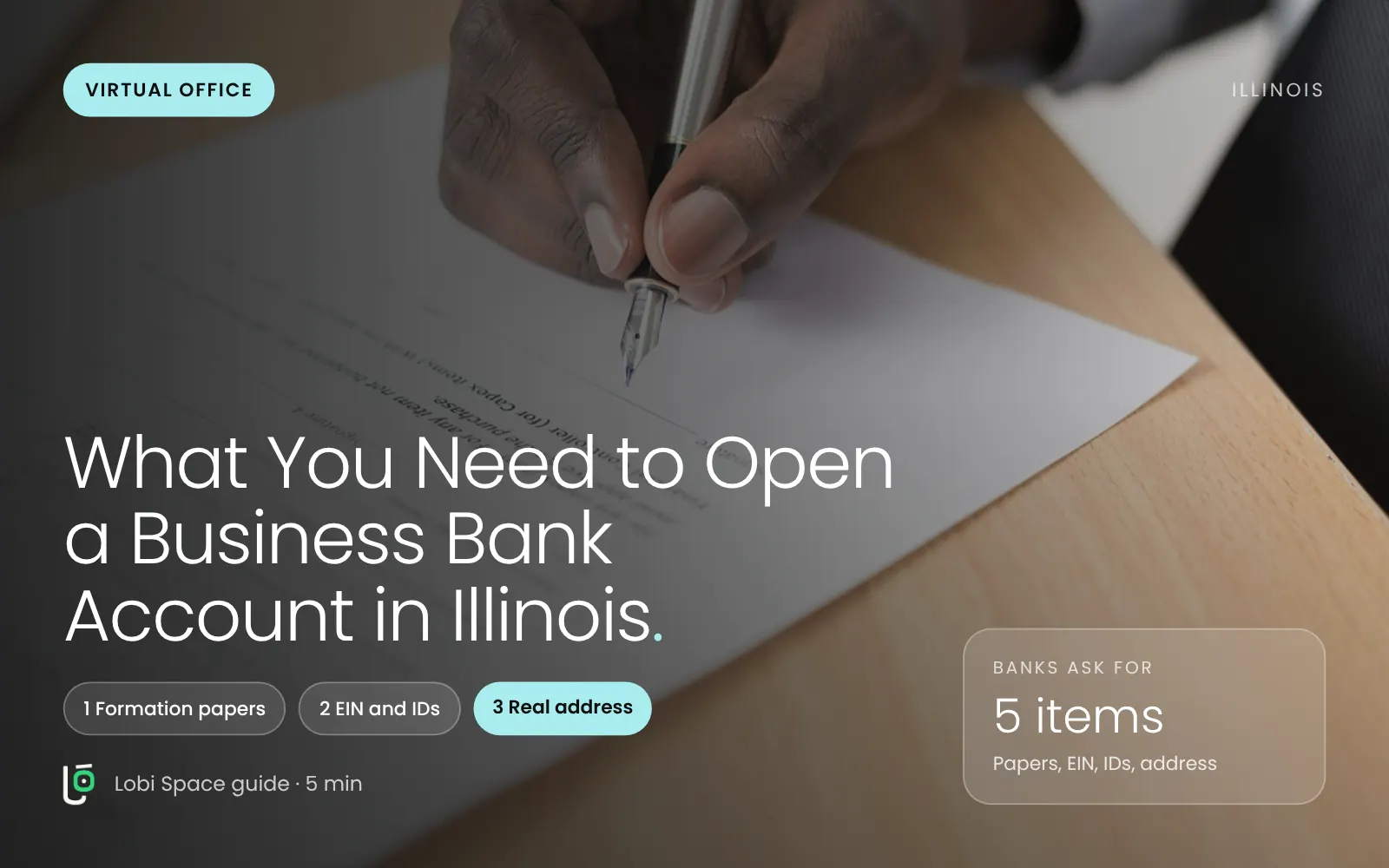
The core documents every bank will want
Your formation documents. Articles of Organization for an LLC, Articles of Incorporation for a corporation: the stamped version the state returned to you, not the one you drafted. This is the document that proves the company exists and, just as importantly, who it belongs to.
Your operating agreement or bylaws. For an LLC, the operating agreement naming each member or managing member and their ownership; for a corporation, the bylaws and share structure. Banks read this to answer one question: who is allowed to move money. If your operating agreement is still a template you never finished, finish it before the appointment.
Your EIN confirmation letter. The IRS notice with the number on it. A single-member LLC using a Social Security number can sometimes open an account, but an EIN is free, takes minutes, and prevents a second trip.
Government-issued photo ID for every owner on the account. Not just yours. Most banks want every member listed and present at opening, and under federal beneficial-ownership rules they'll collect identity details for anyone owning a significant stake. If your partner lives in another state, ask the bank before the appointment how they handle it: some allow remote verification, others don't.
Your business address. This is where applications die. Banks want a physical commercial street address, and a P.O. Box won't clear the check. The address should also match what's on your formation filing and your business license, because mismatched addresses across documents is exactly the pattern their compliance software flags.
Why this matters: every item above is a document you can produce in advance. The address is the one that can't be fixed in the lobby, which is why it strands the most people.
The address problem, specifically
A business bank account is a federal identity file with your company's name on it. The bank has to be able to say where your business is. A mail slot, a forwarding service, or a P.O. Box doesn't answer that question, and a home address answers it in a way that puts your residence on record with a lender, in a database, and sometimes on public filings.
What clears it is a real commercial street address with documentation proving you have the right to use it. That's the practical difference between a mailbox and a virtual office in Chicago at a staffed building: the agreement is the paperwork the banker asks for, and the building is the answer to "where is this business located?"
We've watched members do this both ways for a decade. The ones who arrive with a signed agreement in the company's name, formation documents that match it, and every owner in the room open accounts on the first visit. The ones who don't come back a second Tuesday.
If you formed in Delaware or Texas: the step most owners miss
This one catches people constantly, and it catches them at the bank.
Say you formed your LLC in Delaware because a founder friend told you to, or in Texas because you used to live there. Now you're operating in Illinois. Illinois treats your company as a foreign entity, which here means "formed elsewhere," not "foreign country." Before you can lawfully transact business in Illinois, the state requires you to register for the privilege.
For an LLC, that's Form LLC-45.5, Application for Admission to Transact Business, filed with the Illinois Secretary of State for $150. It must be accompanied by a Certificate of Good Standing from your home state, authenticated within the previous 60 days. Corporations file their own equivalent. You'll also name an Illinois registered agent with an Illinois street address as part of that filing, because the state needs somewhere in Illinois to deliver legal papers.
Two practical notes. First, that 60-day window on the good-standing certificate is real: order it close to your filing date, not months ahead. Second, the forms live at ilsos.gov. If you were told to look on CyberDrive Illinois, that was the state's old web address; it was retired in November 2021 and now redirects to ilsos.gov. Plenty of guides still say "cyberdrive," which is a decent signal for how old the guide is.
An Illinois bank can absolutely open an account for a Delaware LLC. But when they see Illinois operations, an Illinois address, and no Illinois registration, the application slows down or stops. Do the admission filing first.
The honest take on Illinois filings
Illinois used to be genuinely painful. The filings were time-consuming, the forms were complex, and the process felt designed to make you hire someone.
That's changed more than most owners realize. The state has made incorporating substantially easier with online filing, clearer instructions, and faster turnarounds. The motive is sensible enough: filings generate revenue for the state, and easier formation encourages people to actually start things.
"Business is very difficult to run, start, and operate," says Oliver, Director of New Business at Lobi Space. "Establishing a corporation shouldn't be. However, you must follow certain legal procedures."
That's the right frame for this entire checklist. None of these requirements are arbitrary: the bank needs to know who you are, the state needs to know where to send legal papers, and the paperwork exists to make both answerable. It's a sequence, not an obstacle course. Do it in order and it's an afternoon.
The order that works
1. Form the entity, an Illinois LLC or corporation (our step-by-step guide), or file for admission if you formed elsewhere.
2. Get the EIN from the IRS. Free, online, same day.
3. Finish the operating agreement. Real names, real ownership percentages, real signatures.
4. Lock in the business address: commercial, documented, and the same one you'll use on every filing. Our guide to what actually gets accepted covers the difference.
5. If your activity requires a city business license, confirm its location and document requirements directly with the City.
6. Book the bank appointment and bring everything above, with every owner who needs to sign.
The bottom line: the bank isn't judging your business. It's checking whether your documents agree with each other. Make them agree. Same entity name, same address, same people. Then the account opens on the first try.
If the address is the piece you're missing, that's the one we solve: a real Chicago address with a signed agreement, at a staffed building, accepted by banks, the city, and the state.
Follow @lobispace
Guides, Chicago business news and studio work, every week.