Part of our guide to the office space for rent in Chicago. More guides on this topic
Almost thirty percent of downtown Chicago's office space is sitting empty, and nearly half of that empty space has been empty for more than three years.
If you own an office tower, that sentence is the problem. If you are a business looking for space, that sentence is the opportunity. And this is the strangest, most negotiable, most misunderstood office market Chicago has seen in living memory.
We run a workspace building in Pilsen, which means two things: we watch this market professionally, and we are not neutral about it. You should know both before you read on. What follows is the state of the Chicago office market as of mid-2026: the real vacancy numbers (including where the published figures disagree with each other, and why), what rents actually are once you get past the asking price, why this happened, which neighborhoods are tight and which are desperate, and the arithmetic every small tenant should run before signing anything.
It is long, because the decision is expensive. Skim the headers if you must. But if you are going to commit your business to a lease this year, the hour this takes to read is the cheapest due diligence you will do.
The numbers, as of right now
Start with the scoreboard, then we will explain why the referees disagree.
| Measure | Number | Source, period |
|---|---|---|
| Downtown Chicago office vacancy | 28.0%, down from the 28.6% record | CBRE, Q2 2026, via Crain's |
| Downtown vacancy (alternate measure) | 27.2% | Cushman & Wakefield, Q2 2026 |
| Downtown *direct* vacancy (excludes sublease) | 24.4% | Bradford Allen, Q2 2026 |
| Vacant space downtown | roughly 40 million sq ft, nearly half vacant 3+ years | CBRE data |
| Pre-pandemic downtown vacancy, for scale | 13.8% | CBRE |
| Suburban Chicago vacancy | ~26.1% (down from 26.6% a year ago); availability measures run ~33% | CBRE / The Real Deal, mid-2026 |
| National office vacancy | 21%, an all-time record | Moody's Analytics, Q1 2026 |
| Fulton Market / Far West Loop vacancy | 17.8%, lowest downtown | CBRE, Q1 2026 |
| Fulton Market asking rent | $53.96/sq ft, highest downtown | CBRE, Q1 2026 |
| Chicago Class A/A+ average asking rent | ~$39/sq ft | market data, 2026 |
| Chicago coworking footprint | 342 locations, ~9.2M sq ft; second-largest in the U.S., up 24% in a year | CoworkingCafe |
Three things jump out of that table before any analysis.
First: downtown Chicago's vacancy is a third worse than the national record. The national number (21%, per Moody's) is itself the highest ever recorded in the United States. Chicago's downtown is running seven points above it.
Second: the numbers disagree with each other, and that is not sloppiness. CBRE says 28%. Cushman & Wakefield says 27.2%. Bradford Allen's direct figure is 24.4%. They count differently: whether sublease space counts as vacant, which buildings make the survey, whether a floor being marketed but still under lease is "available" or "vacant." When you tour a building and the broker quotes you a vacancy figure, ask which kind. The gap between "direct vacancy" and "total availability" is where a lot of optimistic marketing lives.
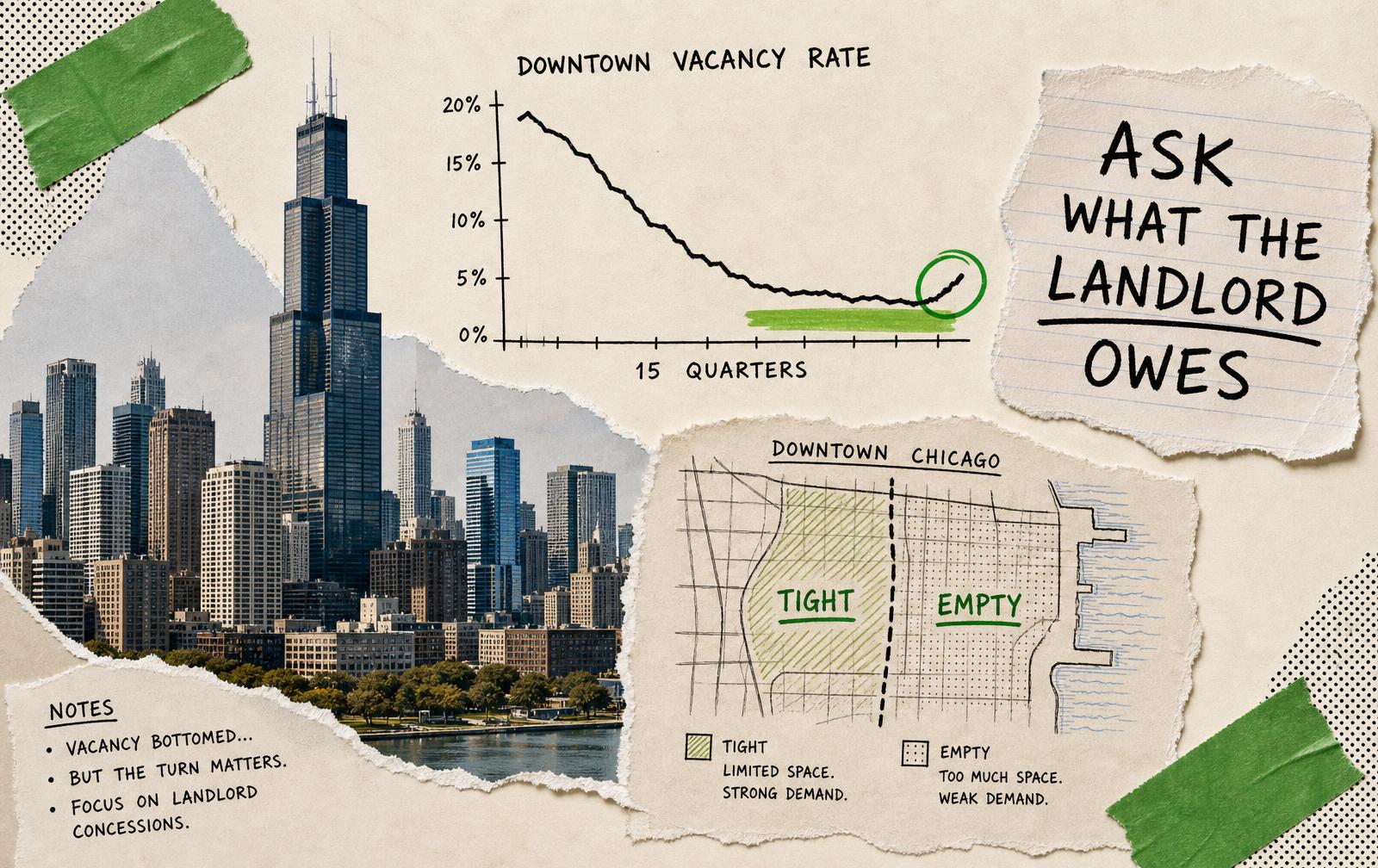
Third: Fulton Market is a different planet. At 17.8% vacancy and $54 asking (by one Transwestern cut of the data, the Fulton Market/Near West Side area runs as low as 10.9%), the hottest submarket is tight and expensive while twenty blocks east, LaSalle Street landlords are handing buildings back to their lenders. There is no single "Chicago office market" anymore. There are two, and they are moving in opposite directions.
The first crack in fifteen quarters
Here is the sentence that makes mid-2026 different from every quarter since the pandemic: downtown vacancy fell in Q2 2026, from 28.6% to 28.0%: the first decline after fifteen consecutive quarters of record highs.
One quarter is not a trend, and 28% is nobody's definition of healthy. But the direction changed, and the supporting numbers say it was not a fluke:
- Direct net absorption swung positive. Bradford Allen recorded +585,646 sq ft of direct absorption in Q2, reversing a negative first quarter. One widely reported cut of the quarter put overall downtown absorption above a million square feet, among the strongest quarterly performances since the pandemic began. (Cushman & Wakefield's broader measure, which includes sublease space, stayed slightly negative for an eleventh straight quarter. Again, the measures disagree, and again, both are true.)
- Sublease inventory is shrinking nationally (down roughly 20% since 2024), which matters because sublease space is the discount inventory that undercuts landlords' direct deals. Less of it means the bottom of the market is slowly firming.
- A new tower might actually get built. Law firm Sidley Austin signed for more than half of a proposed 45-story, 968,000-square-foot tower at 725 W. Randolph in the West Loop, positioning Chicago for its first office groundbreaking in years. Nobody anchors a new tower in a market they expect to die.
- The construction pipeline behind it is empty. The $350 million office building that opened in Fulton Market in February 2026 was described by WBEZ as arriving while the pipeline sits dry. Almost nothing else is coming. Markets stop getting worse when supply stops growing, and supply has stopped growing.
So the honest read: the bleeding slowed, in one quarter, from a record-bad baseline, driven almost entirely by the top of the market. Whether you should care depends entirely on which half of the split market you are shopping in.
Why this happened: four forces, not one
The lazy explanation is "remote work." That is a quarter of the story.
Hybrid attendance settled, and it settled low. It also settled unevenly. Nationally, Class A buildings hit about 75% of their pre-pandemic peak attendance in Q1 2026; Class B and C buildings managed 55%. Employers stopped experimenting and started right-sizing: less space, but better space, in buildings that give employees a reason to make the trip. That single behavioral fact (people will commute for a nice building and will not for a mediocre one) explains most of what follows.
The flight to quality became a stampede. Class B and C leasing keeps shrinking year over year nationally while trophy and Class A space expands its share. In Chicago that translates directly to the split: Fulton Market's new-build stock at 17.8% vacancy and rising rents, while vintage Loop towers absorb the entire downturn. Nearly half of downtown's 40 million vacant square feet has been empty three years or more. That space is not "between tenants." Much of it is functionally obsolete, and the market has quietly decided so.
The debt did what debt does. Buildings bought and financed at 2015–2019 valuations came up for refinancing into a market where their appraised values had collapsed. Some owners wrote checks. Others handed keys to lenders. A building in workout is a building that defers maintenance, loses its property manager, and cannot fund tenant build-outs, which accelerates its decline, which deepens the discount, which is exactly why the cheapest space on the market needs the most careful vetting. More on that in the checklist.
And the exits opened. Chicago chose, faster than most cities, to stop pretending the obsolete stock would re-lease and start converting it. That is the LaSalle Street story, and it deserves its own section, because it changes the ten-year math for everyone.
The LaSalle Street experiment: subtracting supply
The City of Chicago's LaSalle Street Reimagined program is the most aggressive office-to-residential conversion push in the country, and after years of press releases it is now visibly happening:
- 79 W. Monroe broke ground in March 2025: a $64 million conversion creating 117 apartments, 41 of them affordable.
- 135 S. LaSalle, the hulking former bank headquarters, is undergoing a $241 million conversion.
- 19 S. LaSalle received full approval for its conversion in July 2026.
- Negotiations continue on 111 W. Monroe, 208 S. LaSalle and 30 N. LaSalle.
- The proof of concept, 29 S. LaSalle (216 apartments carved out of a 13-story office building), has been leasing since 2021, and one completed LaSalle conversion hit the sale market in June 2026, which is how you know the model has matured enough to be traded.
Why should an office tenant care about apartment conversions? Because every converted floor is office supply that never comes back. The bottom of the market is not going to recover by re-leasing; it is going to shrink by demolition and conversion. That process puts a slow floor under the whole market. And it means the once-in-a-generation discounts in vintage Loop space have a shelf life. The buildings offering them are either going to stabilize, convert, or close.
The submarket tour: where the leverage actually is
Averages hide everything in a split market, so here is the block-by-block truth.
Fulton Market / Far West Loop: tight, expensive, and not negotiating much. Lowest vacancy downtown (17.8% by CBRE's count, as low as 10.9% on the Transwestern cut), highest rents ($53.96 asking), the only new construction, and the Sidley tower on deck. If your business needs this address (venture-backed, talent-war, client-optics reasons), you will pay for it, and your negotiating leverage is modest. The one lever you do have: the rest of the market. Landlords here know what is happening a mile east.
The Central Loop / LaSalle corridor: maximum leverage, maximum diligence. This is where the 28% lives. Vintage Class B and C towers with motivated, sometimes desperate ownership. Asking rents in the low-to-mid $20s per square foot exist here, with landlords offering generous build-out allowances and months of free rent to anyone credible, because an empty floor pays nothing and a discounted floor pays something. The catch is building health, and it is a real catch: a landlord in a debt workout cannot fund your build-out, staff your lobby, or fix your HVAC. Cheap rent in a dying building is not cheap.
River North / West Loop core: the sensible middle. Better bones than the old Loop stock, cheaper than Fulton Market, and enough vacancy to negotiate seriously. For a professional-services firm of 10–50 people that wants downtown presence without trophy pricing, this band is where most of the good 2026 deals are getting signed.
Michigan Avenue and East Loop: quietly struggling. Retail pain upstairs from office pain. Deals exist; foot-traffic-dependent businesses should study the block, not the building.
The suburbs: worse on paper, turning first in places. Suburban vacancy ended 2025 at a record 32.9% on Colliers' availability measure and set another record in Q1 2026. Then, by CBRE's count, it ticked *down* to 26.1% from 26.6% by mid-2026, the first improvement since 2019, as companies expanded into higher-quality suburban buildings. Same flight-to-quality physics, smaller buildings. If your workforce lives in the suburbs, the leverage is enormous and the parking is free.
The neighborhoods: the category the reports skip. Brokerage reports track the CBD and the suburbs and mostly ignore everything between: Pilsen, Bridgeport, Logan Square, Avondale, the near South and West Sides. That is where we operate (at 1655 S Blue Island Ave) and where a growing share of small businesses have concluded they never needed a tower at all. Ten minutes from the Loop, parking included, at a fraction of downtown cost. Neighborhood commercial space rarely makes the vacancy statistics, which is precisely why the deals there depend on walking the blocks rather than reading the reports.
What rents actually are (asking versus reality)
The published numbers: Chicago Class A and A+ space averages around $39 per square foot asking, with the realistic Class A range running $31–45 depending on submarket and Fulton Market's premium stock touching $54. Class B and C in the Loop asks meaningfully less, commonly in the $20s.
Now the parts the averages do not tell you.
Asking is not effective. Landlords have spent four years protecting their asking rents (because appraisals and loan covenants depend on them) while giving the difference back in concessions: months of free rent and tenant-improvement allowances that, in this market, remain historically generous. Two leases at the same $38 asking can differ by 20% or more in real cost once you spread the free months and the build-out money across the term. Always compare net effective rent: the all-in cost divided by the months you actually pay for. Never the asking number.
Gross versus net changes everything. A $28 "triple net" (NNN) rent plus taxes, insurance and common-area charges can cost more than a $38 gross rent that includes them. Chicago's downtown towers carry heavy tax loads that pass straight through to NNN tenants. Ask for the full operating-expense history, not the base rent.
Sublease space is the discount rack. Companies stuck with space they cannot use will sublet it at steep discounts, furnished, with term flexibility a landlord would never offer. The inventory is shrinking (down about 20% nationally since 2024), but in Chicago it is still real, and for a two-year horizon it is frequently the best per-dollar space in the city. The trade-offs: you inherit the original lease's terms, your tenancy dies if the sublandlord's does, and the fit-out is whatever they left behind.
And the denominator is shrinking. The old rule of thumb was 150–250 square feet per employee. Hybrid teams now commonly plan for far less through desk-sharing, which means the honest comparison between two spaces is cost per *person accommodated*, not cost per square foot. A smaller, better-designed space frequently beats a bigger, cheaper one on the only number that matters.
The small-tenant math: when a lease is the wrong product entirely
Everything above assumes you should sign a traditional office lease. For teams of one to six people, in 2026, that assumption deserves an audit. And we will show the arithmetic even though (disclosure, again) we sell the alternative.
Take a real scenario: a four-person firm considering 1,000 square feet in a decent West Loop building at $35 gross.
| Traditional 1,000 sq ft lease | Flex private office (e.g. ours) | |
|---|---|---|
| Base cost | ~$2,900/mo | From $595/mo (1–4 person suite) |
| Furniture | $5,000–15,000 upfront | Included |
| Build-out beyond allowance | Varies, rarely zero | None |
| Internet, utilities, cleaning | $300–600/mo | Included |
| Meeting rooms | Build one inside your 1,000 sq ft | Included / bookable |
| Commitment | 3–5 years personal guarantee, typically | Month-to-month to 12 months |
| Exit if headcount changes | Sublease it yourself | Give notice |
The traditional lease starts making sense again somewhere around six to ten people, when per-desk flex pricing crosses over and control of your own space starts paying for its overhead. Below that line, in a market where Chicago's flex inventory grew 24% in a single year to 342 locations (the fastest growth of any major U.S. market, per CoworkingCafe), signing a five-year lease for a four-person team is usually a landlord's win, not yours.
There is also a compliance wrinkle worth knowing: if what you mainly need is a documented business address, you may not need to rent square footage at all. A virtual office with a signed agreement provides the documentation, mail handling and member access for $75 a month, and you can buy meeting rooms and day offices by the hour when a client actually visits. A surprising number of "we need an office" conversations, walked backward, turn out to be "we need an address and a conference room eight hours a month."
The last six months, month by month
Because "the market is turning" is an abstraction, here is what actually happened, in order:
February 2026. The $350 million, 535,000-square-foot office development opens in Fulton Market. And WBEZ frames it as the end of an era rather than a beginning, because the construction pipeline behind it is empty. The last big delivery of the cycle lands in the one submarket that did not need rescuing.
March–April 2026. The bad-news peak. Q1 numbers post downtown vacancy at a record 28.6% (the fifteenth consecutive record quarter, per CBRE via Crain's), and suburban vacancy sets its own record on the availability measure. Moody's Analytics announces the national rate hit 21%, the highest ever recorded in the United States. If you are hunting for the bottom of this cycle on a chart, this is the neighborhood.
May–June 2026. The conversion economy matures. A completed LaSalle Street office-to-apartment conversion is listed for sale (meaning converted buildings are now a tradeable asset class, not an experiment), and investors publicly shop for more distressed Loop offices to convert. Distress, in other words, found its buyers.
July 2026. The turn prints. Q2 data shows downtown vacancy declining for the first time in fifteen quarters (28.6% to 28.0%), with direct absorption swinging positive by more than half a million square feet. The suburbs post their first vacancy improvement since 2019. The 19 S. LaSalle conversion clears full approval the same month. And the Sidley Austin anchor deal at 725 W. Randolph points to the first new office tower groundbreaking in years.
August 2026, where we sit now. One good quarter after fifteen bad ones. The honest characterization is not "recovery." It is that the market stopped digging. Supply is frozen, the worst stock is exiting through conversions, and demand found its floor at the top of the quality ladder. For tenants, this is close to peak leverage: the desperation discounts still exist, but the direction of travel just changed underneath them.
Renewing versus relocating: the negotiation nobody prepares for
Roughly half the leases signed this year will be renewals, and renewing tenants systematically leave money on the table, because the landlord knows moving is expensive, and prices your inertia into the offer.
The counterweight is simple: make the market bid for you, even if you intend to stay.
- Start 12 to 18 months out. Start at six months and you have no credible alternative; the landlord knows a build-out elsewhere cannot finish in time. Time is the whole negotiation.
- Tour competing buildings and get real proposals. Not for theater. Brokers can smell a bluff. A signed-quality proposal from the building across the street converts directly into free months and TI dollars at your current address.
- Ask for the new-tenant package. Landlords routinely offer relocating tenants concessions they never volunteer at renewal. The phrase "match what you are offering new tenants" does more work than any other sentence in the conversation.
- Reprice the whole lease, not just the rate. A renewal in 2026 should revisit term length, contraction rights, and operating-expense caps: clauses that were non-negotiable when you signed in 2019 and are absolutely negotiable at 28% vacancy.
- Check your own building's health first. If your landlord is in the trade press for debt trouble, your renewal negotiation is also a due-diligence exercise. The discount that keeps you in a failing building is not a discount.
And if you are small enough that the renewal is for 2,000 square feet or less: run the flex math from the previous section before renewing at all. The strongest negotiating position is genuinely not needing the lease.
The tenant's checklist: seven questions before you sign
1. "What is the net effective rent?" Total cost over the full term, minus free months, minus TI value, divided by paid months. Compare only this number across buildings.
2. "Gross or net? And show me two years of operating-expense pass-throughs." Taxes in Chicago towers are not a rounding error.
3. "Who owns this building, and how is the debt?" Ask directly; then check the trade press (Crain's and The Real Deal cover Chicago distress by name). A landlord in workout cannot fund your build-out or staff your lobby. This is the single most skipped question in the cheap half of the market, and the one that bites hardest.
4. "What is this building's actual occupancy (direct, not counting subleases being marketed)?" An 80%-occupied building feels alive at 6pm. A 45%-occupied one does not, and its café, gym and security desk are on borrowed time.
5. "What happens if we shrink or grow?" Expansion rights, contraction options, early-exit clauses. In this market you can get flexibility written in; five years ago you could not.
6. "Is there sublease space in this building or the one next door?" If yes, that is your pricing benchmark and your negotiating lever, whether or not you take it.
7. "What does my team's commute actually look like?" The attendance data is unambiguous: people show up to buildings that are easy to reach and pleasant to be in. That is 75% in the best buildings versus 55% in the rest. An office your team will not come to is a storage unit with your logo on the door.
Where we sit, honestly
We are a Pilsen operator with furnished private offices from $595 a month, a virtual office product, meeting rooms and a podcast studio, ten minutes from the Loop with free parking. We wrote this because our members ask us these questions weekly, and because most of what is published about this market is written by people selling towers to institutions, not space to actual small businesses.
So take the bias into account, and take this too: if you are a fifty-person firm that needs a Fulton Market address, we are not your answer and this article told you the honest numbers anyway. If you are a one-to-six-person business anywhere near the South or West Sides, run the math in the table above before you sign anything downtown. That is the whole pitch.
Frequently asked questions
Is downtown Chicago dying?
No. It is splitting. Fulton Market is at 17.8% vacancy with the city's highest rents and a new tower on deck, while the vintage LaSalle corridor empties into apartment conversions. The downtown that emerges will be smaller, newer and more residential. "Dying" and "shrinking to its healthy core" look similar in one quarter's statistics and completely different over a decade.
Should I wait for rents to fall further?
Asking rents have barely moved through the entire downturn. Landlords protect the printed number and negotiate everything else. What changes is the concession package, and concessions are at historic highs *now*, while vacancy just declined for the first time in fifteen quarters and the construction pipeline is empty. Waiting bets that a market which just stopped worsening will resume worsening. Negotiate hard now instead.
Is a cheap Class B lease in the Loop a trap?
It can be the best deal in the city or a slow-motion problem, and the difference is the landlord's balance sheet, not the space. A stable owner using low rent to fill floors is a genuine bargain. An owner in a debt workout cannot fund your build-out, and services decay around you. Ask question three on the checklist before you fall in love with the price.
Why are rents not falling if a third of offices are empty?
Because the empty third is mostly space nobody wants at any price (obsolete B/C stock that competes with nothing) while the space people do want stays scarce. And because landlords' loans are underwritten against asking rents, they cut deals through free months and build-out money rather than the printed rate. The market clears through concessions, invisibly.
Are the suburbs a better deal than downtown?
The leverage is comparable and the trend is friendlier: suburban vacancy ticked down to 26.1% by mid-2026, the first improvement since 2019. The real question is your team's commute map, because the attendance data says proximity beats prestige. If your people live in Naperville, a discounted Loop tower is a daily tax on all of them.
How much space do we actually need?
Old rule: 150–250 sq ft per employee. Hybrid teams with desk-sharing commonly run far leaner, and the honest metric is cost per person accommodated, not per square foot. Count the maximum number of people present on your busiest regular day (not your headcount) and size to that.
Do we even need an office?
Sometimes the true requirement, walked backward, is a documented business address plus a good room eight hours a month. A virtual office with a signed agreement may fit that need, not $2,900. If daily collaboration is real for you, a small furnished suite beats both a lease and a kitchen table. Buy the thing you actually need; this market will sell you either at a discount.
The bottom line
Chicago's office market in mid-2026 is the best tenant's market in modern memory and the most dangerous one to navigate casually: record vacancy and record concessions on one side, distressed buildings and a two-tier market on the other, with the first genuine signs of a bottom forming underneath.
The playbook: compare net effective rent only, interrogate the landlord's debt before the landlord's lobby, benchmark against sublease space, size to your busiest day rather than your org chart. And if you are small, run the flex-versus-lease math before you assume you need a lease at all.
If Pilsen is a fit, come see the building. If it is not, take the checklist anyway. It works in anyone's building.
*Sources: CBRE Q1–Q2 2026 Chicago figures via Crain's Chicago Business; Cushman & Wakefield Chicago CBD MarketBeat Q2 2026; Bradford Allen Q2 2026 Downtown Report; Moody's Analytics Q1 2026 national vacancy; Transwestern submarket data; Colliers Chicago suburban reports; The Real Deal Chicago; WBEZ/Chicago Sun-Times on the Fulton Market pipeline; City of Chicago LaSalle Street Reimagined announcements; Chicago YIMBY conversion approvals; CoworkingCafe national coworking reports. Figures as reported for Q1–Q2 2026; vacancy measures differ by methodology as discussed above.*
Follow @lobispace
Guides, Chicago business news and studio work, every week.