Part of our guide to the office space for rent in Chicago. More guides on this topic
"Podcast equipment" gets searched about ninety thousand times a month. Questions about what to actually say on a podcast get a fraction of that. We wrote a whole playbook about why that ratio kills shows. The short version, from Oliver, our Director of New Business: "Having a professional microphone or a professional camera isn't as important these days as having something interesting to talk about. Authenticity is ninety percent of the work."
So why is a studio that owns racks of professional gear writing an equipment guide?
Because if you're going to spend money, you should spend it once, at the right tier, and get back to the part that matters. After 1,200+ productions in our Pilsen studio, we've seen every setup that works and most of the ones that don't. Here's what each budget actually buys, including the tier where we'll tell you, honestly, to stop buying.
Prices are approximate manufacturer prices at the time of writing; they drift, the logic doesn't.
$0: The phone you already own
The setup: your phone, the voice memo app, a quiet closet or a car, and free editing software (Audacity or GarageBand).
Who it's for: anyone at episode zero. If you haven't published five episodes yet, this is your tier, not because you can't afford better, but because you haven't yet proven to yourself that you'll show up for episode six. Most shows die by episode three; a $400 microphone doesn't change that, it just makes the funeral more expensive.
What makes it work: the room, not the device. Soft surfaces eat echo. Record in a closet full of clothes and your phone will beat a $400 mic in an empty kitchen. That one sentence is half of audio engineering.
The honest ceiling: phone audio is fine for a solo show finding its voice. It falls apart with two people in a room and it produces no usable video beyond social clips.
~$100: The "not bad" bar
The setup: a Samson Q2U (about $70) or Audio-Technica ATR2100x (about $100), a pop filter, the earbuds you own, free software.
Who it's for: the solo host who's published a handful of episodes and is ready to sound intentional.
Why these two mics: both plug in by USB today and have an XLR output for the mixer you might own later. They're the rare purchase that survives an upgrade. Both are dynamic mics, which forgive an untreated room far better than the condenser mics YouTube keeps recommending.
The honest ceiling: one voice. The moment you add a co-host or an in-person guest, this tier runs out.
~$500: The interview-capable kit
The setup: a Shure MV7+ (about $279) for a solo host, or two Rode PodMics (about $99 each) into a small podcast recorder like Zoom's PodTrak-class devices (about $150–200) for interviews, plus closed-back headphones and a boom arm.
Who it's for: the show that survived. You're past episode ten, you're booking guests, and audio quality is now part of your credibility.
What this tier really buys: separate tracks. When each voice records to its own channel, one person's cough doesn't ruin the other's sentence, and editing time drops by half. That's the actual upgrade: not "warmth," tracks.
The honest ceiling: audio only. And Edison Research's 2026 Infinite Dial calls podcasting a dual-format medium now: 57% of Americans have both listened and watched. At this tier you're publishing to half the medium.
~$1,500: The single-camera video podcast
The setup: everything from the $500 tier, plus one mirrorless camera (Sony's ZV-E10 line or similar, about $700–1,100), a key light with a softbox (about $100–150), and a tripod.
Who it's for: the show ready to exist where discovery actually happens: YouTube, Shorts, Reels, LinkedIn clips.
What changes: one well-lit camera angle turns every episode into a month of marketing material. Quote cards, clips, proof the show is real. This is the cheapest tier that produces a visible reputation.
The honest ceiling (and read this before you buy): one camera means one angle, which reads as a Zoom call with better lighting. And you've just become a camera operator, lighting tech, and audio engineer who also hosts a show. Every knob you have to think about is attention taken from the guest. This is the tier where the math starts to bend.
$5,000+: The broadcast rig (and where we tell you to stop)
The setup: two to three 4K cameras with lenses, a Rodecaster-class production console (about $700), three or four Shure SM7Bs (about $399 each, plus the preamps they demand), a proper lighting kit, acoustic treatment, and cabling nobody warns you about.
Who it's for: honestly? Studios. Agencies. Shows with staff.
Here's the arithmetic nobody selling gear will show you. The rig is $5,000 on a good day. That's before the treated room, before the months of learning to run it, and before the part that never shows up on the invoice: while you're mixing levels and watching focus, you are not hosting. The eye contact, the follow-up question, the moment the guest almost said the real thing: that's what multi-cam production costs you when you run it yourself.
"We've produced shows with very famous guests where the host asked very boring questions," Oliver says. "It simply will not go anywhere." A distracted host asks boring questions. The $5,000 tier, self-operated, manufactures distracted hosts.
The alternative this tier is quietly competing against: renting the whole thing by the hour (cameras, mics, lights, treated room, and the crew and engineer who run it) for less per session than this rig's sales tax. That's exactly what our Pilsen studio is: you walk in and host; the production layer is somebody else's job; the footage comes back edited. Current rates are on the studio page, and if you're comparing every studio in the city first, our guide covers them honestly, competitors included.
Buy your way to the $500 tier. Maybe $1,500 if video is your channel and you like running gear. Past that, rent, unless the studio itself is the business you're building.
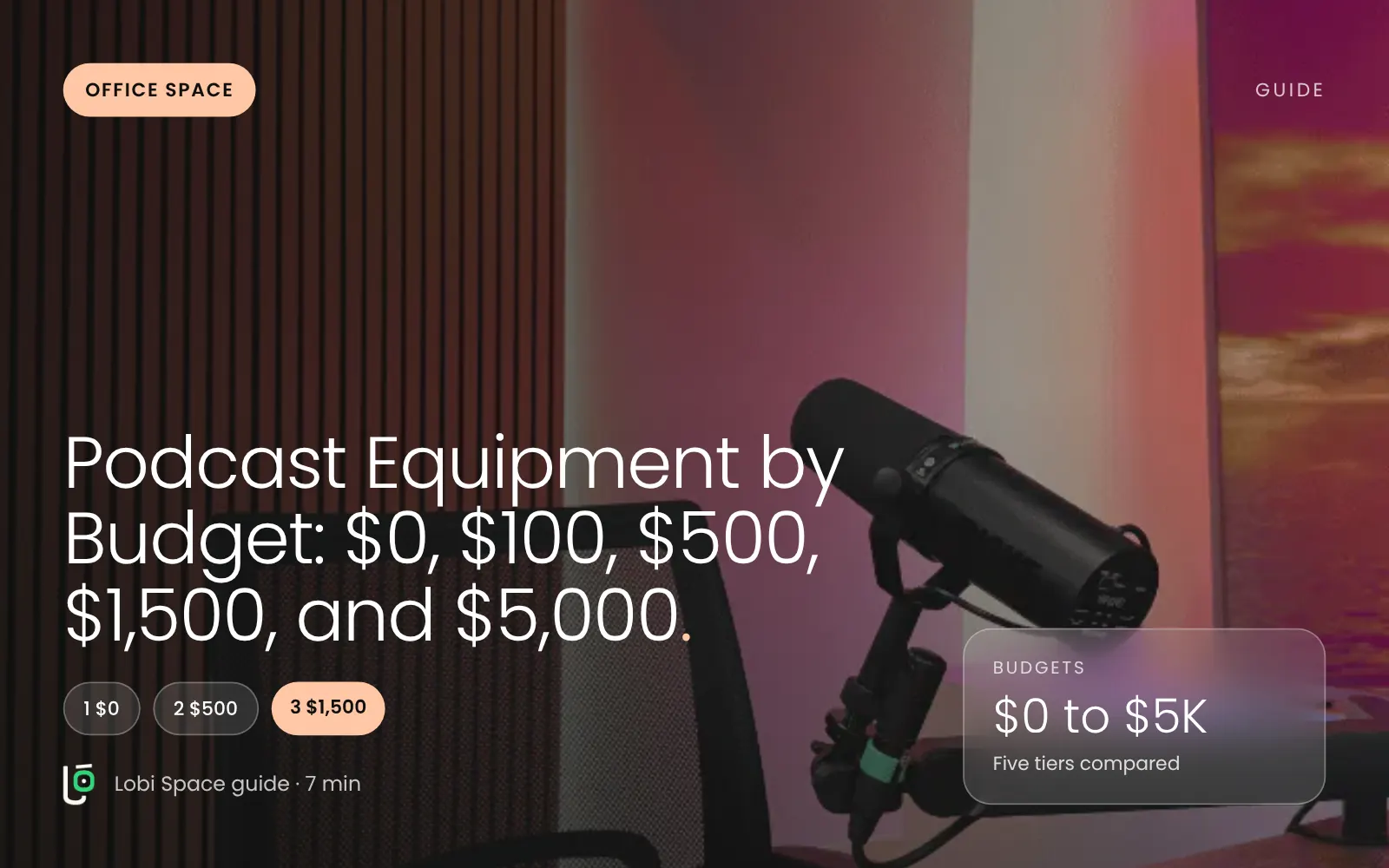
The one-table version
| Budget | What you get | Honest ceiling |
|---|---|---|
| $0 | Phone + quiet closet + free software | Solo audio; proves you'll show up |
| ~$100 | USB/XLR dynamic mic (Q2U, ATR2100x) | One voice |
| ~$500 | MV7+, or 2× PodMic + recorder; separate tracks | Audio only: half the medium |
| ~$1,500 | + mirrorless camera, key light | One angle; you become the crew |
| $5,000+ | Multi-cam, console, SM7Bs, treatment | You're a distracted host; rent this tier instead |
What podcast equipment do I actually need to start?
A phone and a closet full of clothes. We're not being cute. The room matters more than the device, and shipping five episodes matters more than both. Buy the $70–100 mic when you've proven you'll still be publishing next month.
USB or XLR microphone?
At the entry tiers, the answer is both at once: the Q2U and ATR2100x carry both plugs, so today's USB mic becomes tomorrow's mixer input instead of a drawer ornament. Purely USB mics are fine until the day you add a second voice.
Is the Shure SM7B worth it?
It's the broadcast standard for a reason. It's also the most over-recommended mic in podcasting. It needs a serious preamp, a treated room, and an engineer's attention to sound like the videos that sold it to you. In an untreated home office, a $99 PodMic gets embarrassingly close. Buy the SM7B when you have the room it deserves, or use one in a studio that already owns it.
Do I need a camera for my podcast?
The data says video is where podcasting went: Edison's 2026 research found 57% of Americans have both listened and watched, and discovery increasingly happens on YouTube. But "need a camera" and "need to own a camera" are different claims. One session in a multi-cam studio produces more video asset than a year of one-angle desk recordings.
How much does podcast equipment cost in total?
Anywhere from $0 to $5,000+, and the tiers above break down what each step buys. The honest total includes the line nobody itemizes: the hours you spend operating equipment instead of getting better at interviewing. That cost compounds. Gear depreciates; the skill of asking a great question doesn't.
Does acoustic treatment matter more than the microphone?
Usually, yes. Echo is the single most amateur sound there is, and no microphone removes it. Soft room, close mic, mouth six inches away: that free sentence outperforms most $400 purchases.
Follow @lobispace
Guides, Chicago business news and studio work, every week.