Part of our guide to the office space for rent in Chicago. More guides on this topic
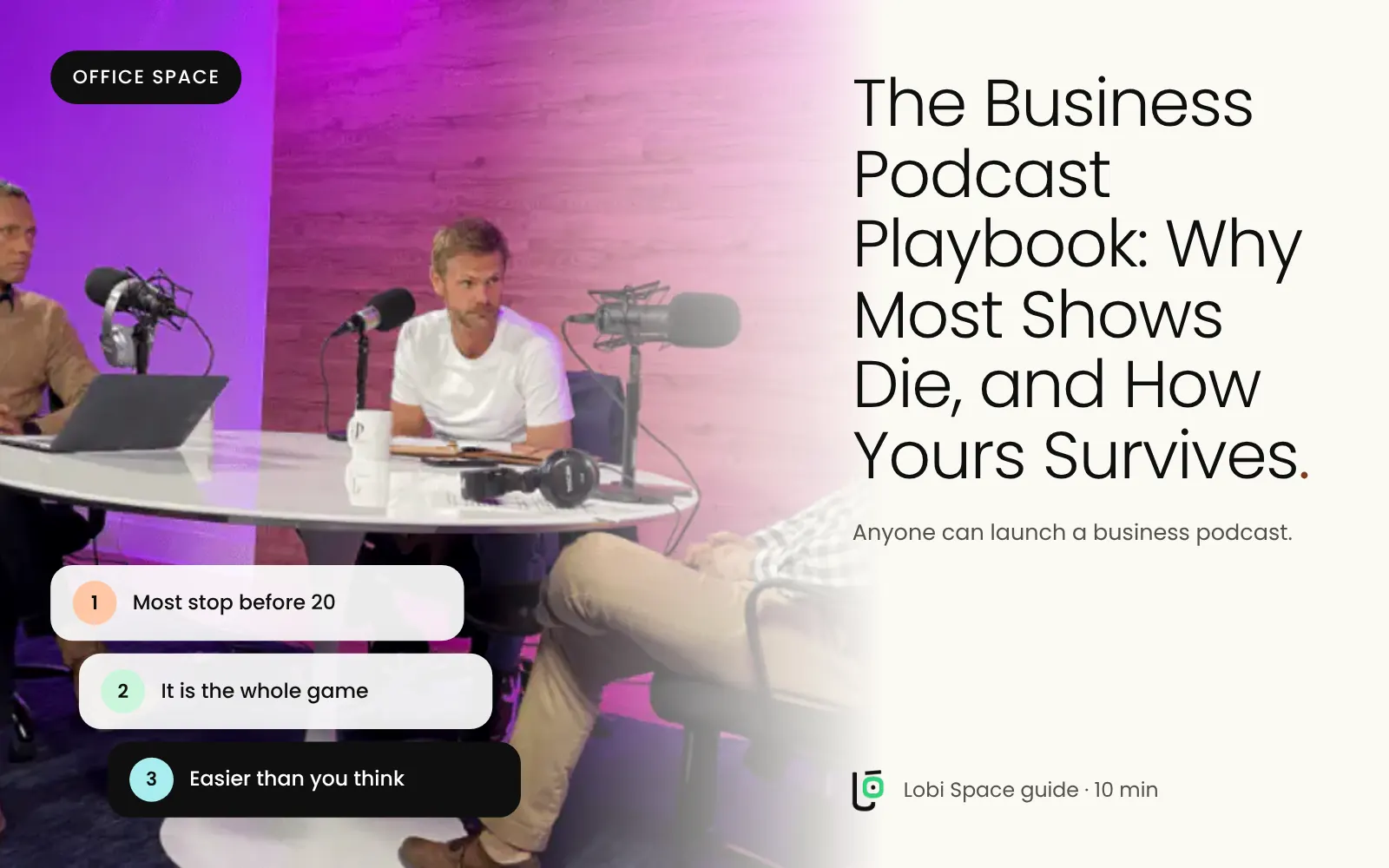
Starting a business podcast is the easiest thing you'll do this year. You can go from idea to published episode in a weekend: a phone, a free hosting account, done.
That's exactly the problem.
Because everyone can start, everyone does. And because everyone does, the launch is worth almost nothing. The market has already priced it in. What the market hasn't priced in is surviving. That's what it still rewards, generously.
We've watched this up close. Over the past five years, more than 1,200 projects have come through our Pilsen studio: solo founders recording their first episode, Inc 500 CEOs recording their two-hundredth, nonprofits, real estate teams, attorneys, artists. The shows that worked had almost nothing in common on the surface: different formats, different budgets, different audiences. Underneath, they shared one thing.
What makes podcasting successful is a strategy for what the show will look like in the coming years, not just a couple of episodes. Podcasting is very easy to launch. The people who survive build credibility through consistency.
Oliver, Director of New Business, Lobi Space
This is the playbook for being one of them.
The numbers nobody reads before launching
How many podcasts are there? Over four million, by most industry counts. Only around one in ten is still actively publishing. A widely cited 2025 Podnews analysis found that the overwhelming majority of shows stop after just three episodes. Industry coaches call it the "seven-episode wall" and "podfade," and the pattern shows up in every dataset that tracks it: most shows die young, quietly, and for the same reasons.
Now the other side of the ledger, from Edison Research's Infinite Dial 2026, the longest-running survey of American audio habits:
- 230 million Americans, 80% of everyone over 12, have listened to a podcast. An all-time high.
- 167 million listen monthly (58%), and 130 million listen weekly. Also all-time highs.
- The heaviest listeners are 35–54-year-olds, at 68% monthly. Which is to say: business decision-makers, clients, customers, referral partners. Your people.
- 57% of Americans have both listened to and watched podcasts. Edison's verdict: "This is a dual-format medium now."
Read those two datasets together and the strategy writes itself. The audience has never been bigger. The graveyard has never been fuller. The gap between them is not talent, budget, or luck. It's the willingness to still be publishing in month eighteen.
Why business podcasts actually die
Not from lack of downloads. Shows die from lack of a reason to continue when the downloads are small. And they are always small at first. That's not failure; that's physics.
"Algorithms, just like humans, have to listen to a show and figure out who to point it to," Oliver says. "Producing one episode, or twenty, isn't enough on its own."
Spotify, Apple, and YouTube recommend shows the way a friend does: after they've spent enough time with you to know who you're for. A catalog of five episodes gives the algorithm nothing to work with. A catalog of fifty, on a consistent schedule, with a clear subject and a defined listener, gives it everything. The recommendation engines aren't ignoring your new show. They're waiting to see if you're serious.
There's one honest exception. "If the show is informational (for your staff, your members, your community) and it's never meant to go public, then twenty episodes is fine. That's a different tool doing a different job," Oliver says. An internal show is a memo with a voice. A public show is a reputation under construction. Know which one you're building before you buy anything.
The overthinking trap (or: why your equipment matters less than you think)
Here's where we're supposed to sell you on professional equipment. We own a studio full of it, so believe us when we say: the gear is not your problem.
"Having a professional microphone or a professional camera isn't as important these days as having something interesting to talk about," Oliver says. "Authenticity is ninety percent of the work."
Search data says "podcast equipment" gets asked about ninety thousand times a month, vastly more than any question about what to say on a podcast. That ratio is exactly backwards, and it kills shows before they launch. Founders spend six weeks comparing microphones and six minutes thinking about their first ten guests. The mic arrives, the excitement fades, episode four never ships.
The honest version of the equipment answer:
- Bad audio does drive listeners away. Nobody sits through a show recorded across a kitchen. But "not bad" is a low bar. A quiet room and any decent microphone clears it.
- Past "not bad," returns collapse. Listeners forgive ordinary production. They do not forgive boring.
- The expensive fix is renting, not owning. If you want broadcast-grade audio and multi-camera video for a season, an hourly studio costs less than the gear's sales tax, and it comes with someone who already knows how to run it.
Spend your obsession budget on the message. The production layer is solved; it's a booking, not a life decision.
Get great at interviewing. It's the whole game.
If a business podcast has a single skill that compounds, it's this one. And almost nobody practices it.
"We've produced shows with very famous guests where the host asked very boring questions," Oliver says. "It simply will not go anywhere. The guest had a lot to say. Nobody asked."
A famous name does not carry an episode. The questions do. Which is good news, because questions are free, and the craft is learnable:
Do the research the guest's other interviews skipped. Read the thing they wrote ten years ago. Find the contradiction between what they said then and what they do now. Every interesting person is carrying at least one story no host has bothered to dig for.
Ask the hard questions. Not gotchas, but the questions the audience is actually thinking. What did that failure cost? Why did you really leave? What does everyone in your industry believe that's wrong? Respectful and hard is the register where the good tape lives.
Know exactly who you're talking to. "Whether it's twenty listeners or two million, you're speaking to your audience," Oliver says. "Find what they really want to know from that particular guest. Then the algorithm takes care of itself."
And don't be shy about the ask. "Interesting people want to be interviewed," he adds. It sounds too simple to be true, and then you test it. A specific, well-researched invitation (here's my show, here's who listens, here's the conversation I want to have with you) gets yeses that generic outreach never will. The guest gets an audience and a thoughtful hour. You get an episode that markets itself. Twenty guests a year is twenty professional relationships you didn't have before, and that pipeline quietly becomes the best business-development tool most founders have ever run.
Video is no longer optional, but it is easier than you think
The Infinite Dial data settled the audio-versus-video argument: listeners flow between formats, YouTube is where new shows get discovered, and a video episode is also a month of marketing (clips for LinkedIn and Reels, quote cards, a searchable archive of you being good at what you do).
That's the real reason to record properly once instead of casually forever. One well-shot conversation becomes: a full episode, an audio feed, ten short clips, and proof that your business is what it claims to be. Visible, screenshot-able proof. A show that looks like a basement production can still succeed on substance. But when the substance is equal, the show that looks credible gets the guest, the sponsor, and the click.
This is the part we built our studio for: walk in, host your conversation, walk out with the footage. You never own a single cable. If you're comparing options around the city, our complete guide to Chicago podcast studios covers everyone, including our competitors, honestly.
The survival system: what the 1,200 projects taught us
Strategy sounds abstract until you turn it into a calendar. The shows that outlast the graveyard tend to run some version of this:
- 1. Define the listener before episode one. One sentence: "This show is for ___ who want ___." If you can't fill it in, you have a hobby, not a strategy. (A hobby is fine. Just don't expect the algorithm to fund it.)
- 2. Plan seasons, not episodes. Ten episodes with a theme, recorded ahead, beats an open-ended weekly promise you'll break by Thanksgiving.
- 3. Batch your recording. Two sessions a month, two episodes per session, and you're eight weeks ahead. That's the entire difference between a schedule and a scramble.
- 4. Publish on a rhythm the algorithm can learn. Weekly or biweekly, but fixed. Consistency is the strategy. Everything else is decoration.
- 5. Make the guest pipeline a habit. One researched invitation a week. That's fifty invitations a year, and interesting people say yes more often than you'd believe.
- 6. Judge the show on a year, not a month. Credibility compounds slowly, then all at once, the same way it does for a business.
None of this requires talent you don't have. It requires deciding, before you start, that the show is a long-term asset of the business: the same category as your reputation, because that's literally what it is.
Where Lobi Space fits (and where it doesn't)
We run a podcast studio in Pilsen built on one belief: any entrepreneur should be able to produce credible video and audio without owning equipment or learning to edit. At a price that doesn't gatekeep it, in a room that doesn't look like a basement.
You host. Our crew and engineer handle the rest, and your footage comes back fast enough to still be relevant. Details and current rates are on the studio page, and if a meeting room or day office is the better fit for what you're making, that's on our on-demand space page.
And where we don't fit: if you're at episode zero, your first move isn't a studio. It's a listener definition, ten researched guest invitations, and a season plan. Do that first (it's free) and when you're ready to look as credible as you sound, book the room.
Frequently asked questions
Is it too late to start a business podcast?
It's too late to start a casual one: the casual era ended when four million shows flooded the directories. It is exactly the right time to start a consistent one, because 90% of your competition will quit by episode three, and the audience (167 million monthly in the US alone) keeps growing. The bar to launch has never been lower. The bar to survive has never been higher. That asymmetry is your opportunity.
How many episodes until a podcast grows?
Stop counting episodes and start counting months of consistency. The recommendation engines reward catalogs and rhythm. Most shows that break through do it well after the point where most hosts quit. Plan for a year. If a year sounds unbearable, podcasting may not be your channel, and knowing that today is cheap.
Do I need expensive equipment to start?
No. And the search data proving how many people obsess over this question is exactly why most shows die. A quiet room and a decent microphone clears the "not bad" bar. When you want broadcast-grade production for a season, rent it by the hour instead of buying it. The message is the product. The gear is a booking.
Audio or video podcast?
Both, from one recording. Edison's 2026 data calls podcasting a dual-format medium: 57% of Americans have both listened and watched. Record with cameras once, and you get the episode, the audio feed, and a month of social clips. Recording audio-only in 2026 is leaving most of the asset on the table.
What makes a good podcast interview?
Research the guest deeper than their last five interviews did, ask the hard questions their audience is actually thinking, and know precisely who you're speaking to: "whether it's twenty listeners or two million." Famous guests with boring questions go nowhere. Unknown guests with great questions get shared.
How much does it cost to start a podcast?
Anywhere from nearly free (phone, quiet room, free host) to a few hundred dollars a session for full production with crew. The honest answer: the cash cost is the small number. The real cost is the discipline to publish for a year. No amount of spending substitutes for it.
Follow @lobispace
Guides, Chicago business news and studio work, every week.