Part of our guide to the virtual office in Chicago. More guides on this topic
The bank will look it up. So will the city licensing department. So will the client deciding whether to send you a contract.
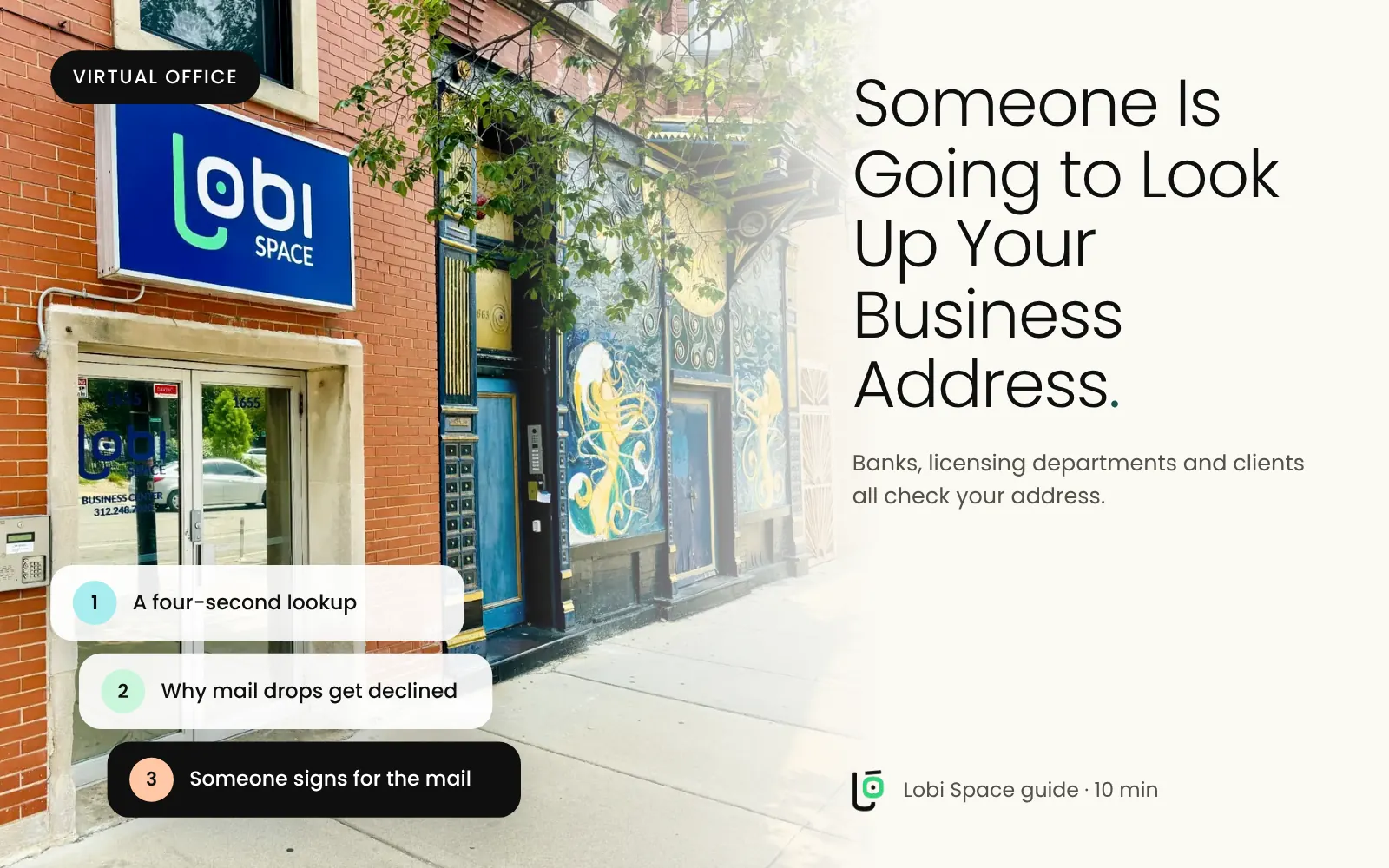
They will type your business address into a map and look at what comes back. That takes about four seconds, and it happens far more often than most founders realize.
We see the aftermath every week. Someone forms an LLC, registers it at whatever address was cheapest, and discovers months later that the bank won't open the account. By then the address is on the state filing, the website, the invoices and the business cards. Changing it means an amended filing, an IRS form, and a round of updates everywhere.
This is a guide to what actually gets checked, why some addresses fail, and what separates an address that holds up from one that quietly damages you.
The four-second check
Type an address into Google Maps and you learn a great deal.
You see whether it's an office building or a strip mall. You see whether a business operates there or whether it's a shipping counter. You see the Street View image: a lobby, or a storefront with parcel signage in the window. You see how many other businesses list the same address.
Your customers do this. Your bank does this. A prospective partner doing diligence does this.
"Someone looks up your address and finds either a real coworking space with a business community, or a printing shop. That's not a small difference. That's whether they trust you."
Patrick P, Founder Lobi Space
The address isn't paperwork. It's a claim about what kind of business you are, and it's a claim anyone can verify in seconds.
Why the bank says no
This is the failure we're asked about most, and it catches people completely off guard.
Banks operate under Know Your Customer and Customer Identification Program rules. They're required to verify a physical address for the business. Not a mailing address, a physical one. That obligation is federal and the compliance departments enforcing it have no incentive to be flexible.
What gets rejected:
- PO Boxes. Almost universally. A PO Box is a numbered slot at a post office, not a location. Which answers a question people search constantly: no, a PO Box is not a physical address, and no amount of formatting makes it one.
- Addresses flagged as high-volume mail centres. This is the one nobody sees coming, and it deserves its own explanation below.
- Addresses shared by hundreds of entities with identical suite numbers.
- Residential addresses, for certain business types and lenders.
The frustrating part is that rejection usually arrives late. The state accepted your filing. The IRS issued your EIN. Everything looked fine. Then the bank ran its check and the application stalled with no useful explanation.
What a CMRA is, and why it matters more than you'd think
Here's the piece of infrastructure almost nobody outside the industry knows about, and it explains most of what goes wrong.
A Commercial Mail Receiving Agency (CMRA) is any business that receives mail on behalf of others: mailbox stores, virtual mailbox providers, shipping shops, and legitimate workspace operators like us. It's a regulated category. USPS maintains a database of them.
Two consequences follow, and they matter enormously.
First: every CMRA must verify your identity. That's the point of USPS Form 1583: the notarized form requiring two forms of ID, one photo and one proving your residential address. It's federal law, not a provider preference. Any service offering to skip it is telling you something important about how it operates.
Second: banks and platforms can cross-reference that database. Some do. An address identified as a high-volume mail-receiving location can be flagged automatically, which is precisely why a mailbox at a shipping store gets rejected where a suite in a commercial office building doesn't.
Both addresses are technically "real." Only one reads as a place where a business operates.
The compliance work you're actually buying
At our building, signing up isn't a checkout flow. It's:
- A completed and notarized Form 1583
- Two forms of identification, verified (the same document can't do both jobs)
- A phone conversation with a person before approval
- Approval or refusal, decided by us
That last line is the one worth sitting with. We turn people down. And we terminate members whose use of the address stops matching what they told us.
"One of the biggest challenges a trusted provider has is compliance. We take it seriously: the 1583, the IDs, an actual conversation. We approve members, and we terminate them when we need to."
Patrick P, Founder Lobi Space
That's not us being difficult. It's the entire reason our address still works for the members who use it properly.
The fraud problem nobody advertises
Here's why compliance actually matters, rather than being a box to tick.
A recurring pattern in this industry: someone opens a mailbox, uses it to receive packages (often bought with stolen card details) and abandons the box before anyone connects the dots. No lease, no conversation, no relationship. Just a slot and a monthly fee.
Every one of those incidents damages the address for everyone else using it legitimately. Addresses get flagged. Carriers get suspicious. Banks tighten. The honest small business that registered at the same building inherits a problem it did nothing to create.
This is the unglamorous argument for choosing a provider that vets people: you are sharing an address with whoever they let in. Their standards become your reputation.
The newest problem: nobody's actually watching the door
There's a trend worth understanding before you shop, because it changes what you're buying without changing what the website says.
Technology companies are increasingly selling virtual offices they don't operate. They run the marketing, capture the leads and take the signup. Then they hand fulfilment to whichever local operator has space in that city. The customer thinks they bought from a national brand. The building has never spoken to them.
The vetting suffers in a predictable way. The platform is measured on signups. The operator inherits whatever the platform sends. Nobody owns the decision about who gets an address, because the person collecting the money and the person handling the mail are different companies with different incentives.
"The newest trend is technology companies outsourcing virtual offices: gathering leads, signing them up, and putting everything on the operator. They do not properly vet people."
Patrick P, Founder Lobi Space
The question to ask any provider: who verifies my identity, and do they work in the building? If the answer involves two companies, you've learned something about how carefully the door is watched.
Not every address is the same product
The category flattens three very different things into one word. They are not the same, and the differences show up exactly when the stakes are highest.
| PO Box | Mail drop / shipping store | Workspace with a real address | |
|---|---|---|---|
| Physical street address | No | Yes, technically | Yes |
| What Maps shows | A post office | A retail counter | An office building |
| Accepts all carriers | Limited | Usually | Yes |
| Accepted for LLC filing | No | Sometimes | Yes |
| Accepted for a city licence | No | Usually not | Yes, with a signed agreement |
| Bank account | Generally rejected | Frequently flagged | Generally accepted |
| Google Business Profile | No | Usually not | Yes, with a signed agreement |
| Somewhere to meet a client | No | No | Yes |
| Someone who knows your name | No | No | Yes |
The last two rows are the ones people dismiss when choosing and regret later. An address you can't walk into is an address you can't bring a client to. And eventually, someone wants to meet.
What we actually built
Lobi Space didn't start as a mail service. That matters to how this works.
We opened in 2015 as a shared office in Pilsen: roughly thirty business owners in one building. What we became known for was spacious, affordable office suites in a place where people actually gathered. On a normal day there are fifty to a hundred people in the building.
The mail and virtual office services grew out of that, not the other way round. Which is why the address survives scrutiny: there is a real business operating at 1655 S Blue Island Ave, with staff, suites, meeting rooms, a podcast studio and parking. Look it up and you find a workspace, because that's what it is.
The part that isn't on the invoice
Here's what we didn't plan and now consider the most valuable thing we offer.
Every day, people in this building refer work to each other. An insurance agent sends business to a real estate agent. A staffing company hires the marketer down the hall. Nonprofits book the podcast studio and the meeting rooms to promote their events, then meet three people who can help them.
None of that is a feature we sell. It's what happens when fifty to a hundred people who run businesses occupy the same space regularly instead of renting a slot in a wall.
A mailbox at a shipping store cannot produce that, at any price, ever. It isn't a worse version of this. It's a different product that happens to share a word.
How to check a provider in ten minutes
Whether or not you end up here, run this on anyone you're considering:
1. Put the address into Google Maps and Street View. What would your customer conclude? If the answer is "a shipping store," that's what your bank concludes too.
2. Ask who verifies your identity, and whether they work in the building. Two companies in that answer is a warning.
3. Ask directly: will this address be accepted for an LLC filing, a city business licence, and a bank account? Vague answers mean no. Get it in writing.
4. Ask whether they've ever refused an applicant. A provider who has never turned anyone away isn't vetting anyone.
5. Ask whether you can visit. If you can't walk in, neither can your client.
6. Ask what happens to your mail if the location closes. Continuity is worth asking about before you need it.
Frequently asked questions
Why won't my bank accept my business address?
Banks must verify a physical address under Know Your Customer rules. PO Boxes are rejected outright, addresses flagged in the USPS commercial mail receiving agency database are frequently declined, and suites shared by hundreds of entities raise questions. A leased suite in a commercial office building generally clears.
Is a PO Box a physical address?
No. A PO Box is a numbered compartment inside a post office, not a location where a business operates. States reject it for LLC registration, banks reject it for accounts, and Google won't verify a listing at one.
Can I use a UPS Store address for my LLC?
Sometimes for the filing, but it frequently causes problems later. These locations are registered commercial mail receiving agencies, and banks that cross-reference that database may flag the address. It also shows as a retail shipping counter to anyone who looks it up.
What is a commercial mail receiving agency?
A CMRA is any business that receives mail on behalf of others: mailbox stores, virtual mailbox services, and workspace operators. CMRAs are federally required to verify your identity via a notarized USPS Form 1583 before handling your mail, and USPS maintains a database of these locations.
What makes a business address legitimate?
A real street address at a place your business genuinely has rights to use, with a lease or agreement behind it, a unique suite number, and a provider who verified who you are. The practical test: could a customer walk in, and would what they find match what you claim?
Can I change my business address later?
Yes, but it's tedious: an amended state filing, IRS Form 8822-B, your bank, your Google profile, your website, and every directory listing. That effort is the argument for choosing an address you won't need to change.
The short version
Your address is a claim. It gets verified more often than you think: by banks, by licensing departments, by clients doing quiet diligence before they send money.
An address that's only a mail slot will eventually be treated as one. An address attached to a real building, with a real agreement behind it and a provider who checks who they let in, holds up under every one of those checks.
If you want to see what your address would look like when someone checks it, come see the building. We're at 1655 S Blue Island Ave in Pilsen, and we've been here since 2015.
Compare our virtual office in Chicago and business mailbox plans, or read our guides on USPS Form 1583 and using a virtual address for an LLC.
Follow @lobispace
Guides, Chicago business news and studio work, every week.