
Part of our guide to the registered agent service in Illinois. More guides on this topic
By the Lobi Space compliance team. Current as of October 2026.
If an anonymous LLC guide tells you to file a beneficial ownership report with FinCEN within 90 days of forming, it is out of date. For a company formed in the United States, that federal filing is gone.
That changes what "anonymous LLC" means. There is no federal ownership list to worry about anymore. What is left is the state public record, plus the private parties who will always know who you are. Here is what changed, which states keep owners off the record, and where the limits are.
What changed at FinCEN
The Corporate Transparency Act started requiring most small companies to report their beneficial owners to FinCEN in 2024. In March 2025 FinCEN published an interim rule exempting US companies. In August 2026 it made that permanent.
- US companies are exempt. FinCEN's beneficial ownership page states that US companies no longer have to file beneficial ownership reports. The final rule took effect on August 14, 2026.
- US persons are exempt. Reporting companies no longer report US persons as beneficial owners or company applicants.
- Old data is being deleted. FinCEN said it will delete beneficial ownership information previously reported about US persons.
- Foreign companies still report. Entities formed under foreign law and registered to do business in a US state must still report their foreign beneficial owners, unless an exemption applies.
So for a US owner of a US LLC, there is no federal ownership report to file today. Rules can change again, which is why our Premium formation package includes a FinCEN beneficial ownership review at the time you form.
What "anonymous" means now
An anonymous LLC is a company whose owners are not named on the public filings the state keeps. That is all it means. It is privacy, not secrecy.
A state can expose you in two places:
- The formation filing. The articles or certificate that create the LLC.
- The yearly filing. The annual report, list or information report many states require after that.
A state only keeps owners off the record if both stay clean. And even then, four parties still know who you are: your registered agent, your bank, the IRS and, if it comes to it, a court.
The privacy states, compared
Wyoming and New Mexico are the strongest. Delaware is strong but expensive to keep. Nevada is the weakest of the four, because managers appear on a public list every year.
| State | Named on the formation filing | Yearly filing | State fee to form an LLC | Yearly state cost |
|---|---|---|---|---|
| Wyoming | Agent, addresses and the organizer, no members or managers | Annual report license tax | $100 | From $60 |
| New Mexico | Name, agent, office and whether a manager runs it | No LLC annual report | One time state fee | None for LLCs |
| Delaware | LLC name and registered agent only | No LLC annual report | $110 | $400 tax, due June 1 |
| Nevada | Each initial manager, or each member if member managed | Annual list names every manager or managing member | $425 with the initial list and business license | $350 |
Wyoming
Wyoming's Articles of Organization list the registered agent, the company's mailing and principal office addresses and the organizer. No members, no managers. The catch: Wyoming law requires every company to give its registered agent the name and contact details of a real person who serves as its communications contact, and the agent must produce it on request (W.S. 17-28-104). It is not on the public filing, but the state can reach it. Wyoming also makes a charging order the exclusive remedy for a member's personal judgment creditor, including against a single member LLC (W.S. 17-29-503). That protects the company from a member's personal debts. It does not protect the company's own debts, and it is not a way to put assets out of reach of creditors you already have. Read the Wyoming LLC guide.
New Mexico
New Mexico's articles ask for the LLC's name, its registered office and agent, its principal place of business if different, and whether a manager runs it (NMSA 1978 § 53-19-8). No member or manager names. The LLC Act has no annual report requirement for LLCs, so no yearly filing exposes anyone later. Read the New Mexico LLC guide.
Delaware
Delaware's Certificate of Formation only has to state the LLC's name and its registered agent (6 Del. C. § 18-201), and Delaware LLCs file no annual report. The authorized person who signs the certificate is named on it, so let your agent or filing service sign. The cost is a flat $400 a year, up from $300 starting with the 2026 tax year. Read the Delaware LLC guide.
Nevada, the caveat
Nevada's reputation does not match its forms. The Articles of Organization must name each initial manager, or each initial member if there are no managers, with an address (NRS 86.161), and the initial and annual lists repeat every manager or managing member each year (NRS 86.263). Members of a manager managed LLC are not listed, which is why Nevada owners use nominee managers. The list is a sworn statement, and the statute bars naming anyone with the fraudulent intent of concealing who actually runs the company in furtherance of unlawful conduct. Read the Nevada LLC guide.
States that name owners, plainly
Some states that show up on "privacy state" lists put owners on the record from day one. That is not a flaw. It is just not anonymous.
- Texas. The Certificate of Formation lists every governing person with an address, and the yearly Public Information Report lists the managers. Read the Texas LLC guide.
- Arizona. A member managed LLC lists every member. A manager managed LLC lists every manager and every member with 20% or more (A.R.S. § 29-3201). The Arizona Corporation Commission states that names and addresses on filed documents are public record. Read the Arizona LLC guide.
- Pennsylvania. The Certificate of Organization names organizers only, but every annual report since 2025 names at least one governor and any principal officers. Read the Pennsylvania LLC guide.
- Florida. Managers are optional on the articles, but the annual report records managers and authorized members, and the records are searchable online. Read the Florida LLC guide.
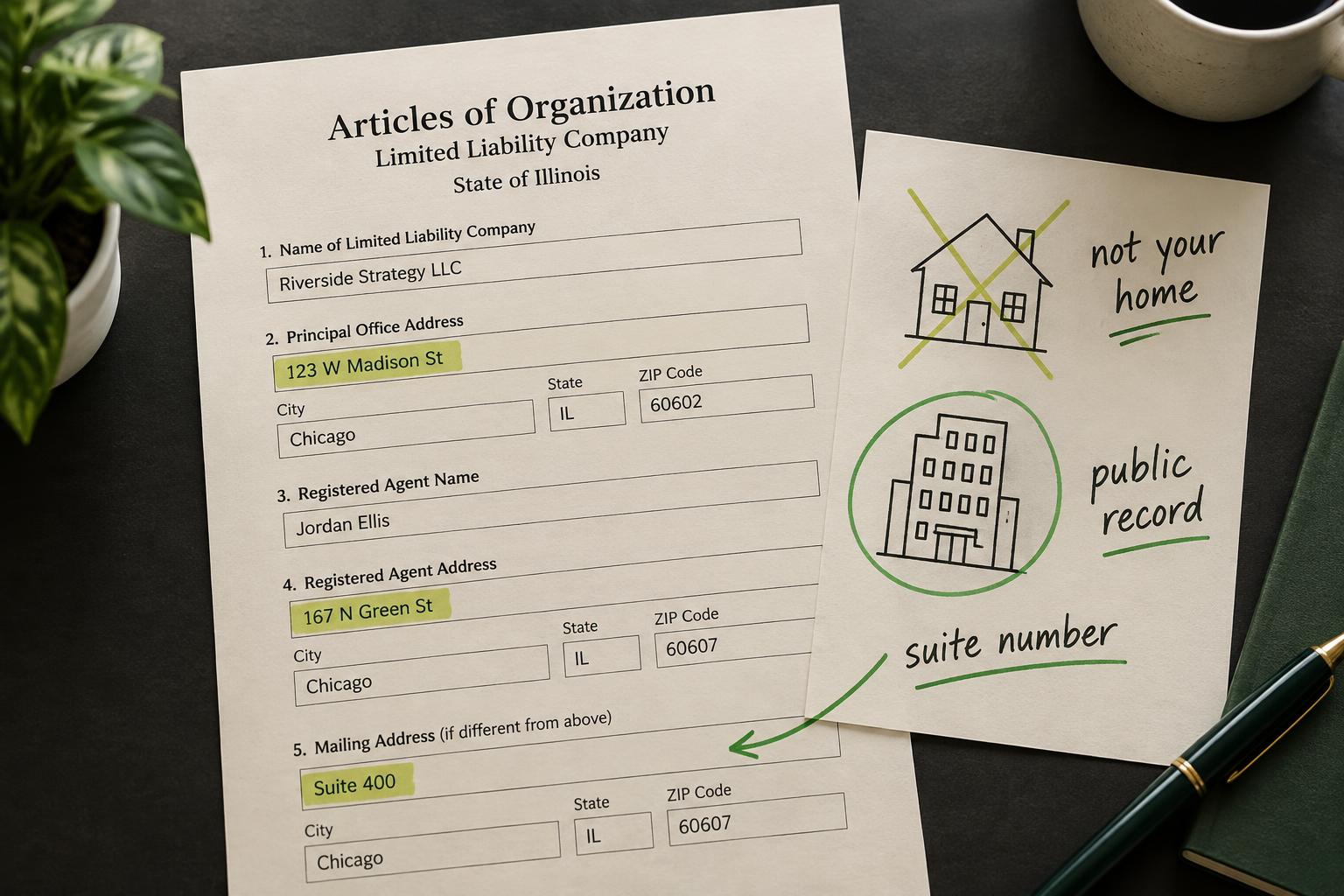
- Illinois. The Articles of Organization list every manager and any member with manager authority (805 ILCS 180/5-5). What you can keep private here is your home address: we wrote a guide on keeping your home address off your Illinois LLC. Start with the Illinois LLC guide.
The out of state myth
Forming in Wyoming or Nevada does not take your business out of the state where you actually work. If your LLC has an office, staff or regular operations at home, it generally has to register there as a foreign LLC, keep a registered agent there, and file that state's reports. You pay both states every year.
In Illinois that means an Application for Admission to Transact Business, $150, plus the $75 Illinois annual report each year, on top of the formation state's costs. California is the sharpest example: the Franchise Tax Board states that every LLC doing business in California, organized there or registered there must pay an $800 annual tax, and the first year exemption only applied to tax years beginning in 2021 through 2023. A Wyoming LLC that does business in California still owes California.
The foreign registration also creates a record in your home state, under your home state's disclosure rules. Privacy in the formation state does not travel with you.
The real limits
State privacy is useful. It keeps your name and home address out of a public business search, away from data brokers and cold callers. It does not do more than that.
- Your registered agent knows. Every state requires one, and in Wyoming the agent keeps a named contact on file.
- Your bank knows. Banks verify who owns and controls a business before they open its account.
- The IRS knows. The EIN application names a responsible party.
- Courts can find out. A judge can order a company to say who owns it.
An anonymous LLC is never a way to avoid taxes, hide assets from creditors or hide who runs a business that breaks the law. Nominee arrangements and asset protection planning are legal questions. Talk to an attorney before you rely on either.
How we help
We prepare and file LLC and corporation formations in all 50 states at your direction, with state fees passed through at cost, and we act as registered agent: Illinois from our Chicago office, and every other state through our partner network. See formation pricing or our registered agent service.
Lobi Space is not a law firm and does not give legal advice. We prepare and file documents at your direction. Whether privacy, a nominee arrangement or a particular state fits your situation is a question for an attorney or CPA.
Frequently asked questions
Do US LLCs still have to file a BOI report with FinCEN?
No. FinCEN's final rule, effective August 14, 2026, permanently exempts US companies and US persons from beneficial ownership reporting, and FinCEN said it will delete previously reported US-person information. Foreign companies registered to do business in a US state may still have to report.
Which states allow anonymous LLCs?
Wyoming and New Mexico are the strongest: no member or manager names on the formation filing or yearly filings. Delaware is also private on the record but costs $400 a year. Nevada is the weakest, because managers or managing members appear on a public list every year.
Is Nevada an anonymous LLC state?
Not on its own. Nevada's articles name each initial manager, or each member if there are no managers, and the annual list repeats every manager or managing member each year. Members of a manager managed LLC are not listed.
Are Texas, Arizona and Pennsylvania privacy states?
No. Texas lists every governing person on the Certificate of Formation and managers on the yearly Public Information Report. Arizona lists members, or managers plus members with 20% or more. Pennsylvania keeps owners off the formation filing but names at least one governor on every annual report.
Can I form in Wyoming to avoid my home state's taxes?
No. If your LLC does business at home, it generally has to register there as a foreign LLC and pay that state's fees and taxes. California, for example, charges its $800 annual LLC tax to LLCs doing business there no matter where they were formed.
Does an anonymous LLC hide me from my bank or the IRS?
No. State privacy only keeps your name off public state filings. Banks verify who owns and controls a business before they open its account, the EIN application names a responsible party, and courts can order a company to disclose its owners.
What is Wyoming charging order protection?
Wyoming law makes a charging order the exclusive remedy for a member's personal judgment creditor, including against a single member LLC. It protects the company from a member's personal debts. It does not protect the company's own debts and is not a way to hide assets from existing creditors.
Does a registered agent make my LLC anonymous?
It keeps your name and address off the registered agent line, which matters because every state requires an agent. It does not remove owner names in states like Nevada, Texas, Arizona or Illinois that require managers or members on the filing.
Sources, checked October 2026: FinCEN beneficial ownership information, FinCEN final rule announcement, August 11, 2026, Federal Register 2026-16576, Wyoming LLC Articles of Organization, Wyoming communications contact form, W.S. 17-28-104, Wyoming LLC Act, W.S. 17-29-503, Wyoming fee schedule, New Mexico LLC Act, Delaware LLC Act § 18-201, Delaware LLC tax instructions, Nevada Revised Statutes chapter 86, Texas Form 205 instructions, Texas formation FAQs, Arizona Revised Statutes § 29-3201, Arizona Corporation Commission FAQs, Pennsylvania annual reports, Florida annual report, Illinois LLC Act 805 ILCS 180/5-5, Illinois LLC fees, 805 ILCS 180/50-10, California Franchise Tax Board, limited liability company.
Follow @lobispace
Guides, Chicago business news and studio work, every week.