Part of our guide to the business mailbox in Chicago. More guides on this topic
Most people meet this term in the worst possible way: a bank or a platform tells them their business address is "a CMRA," declines the application, and offers no further explanation.
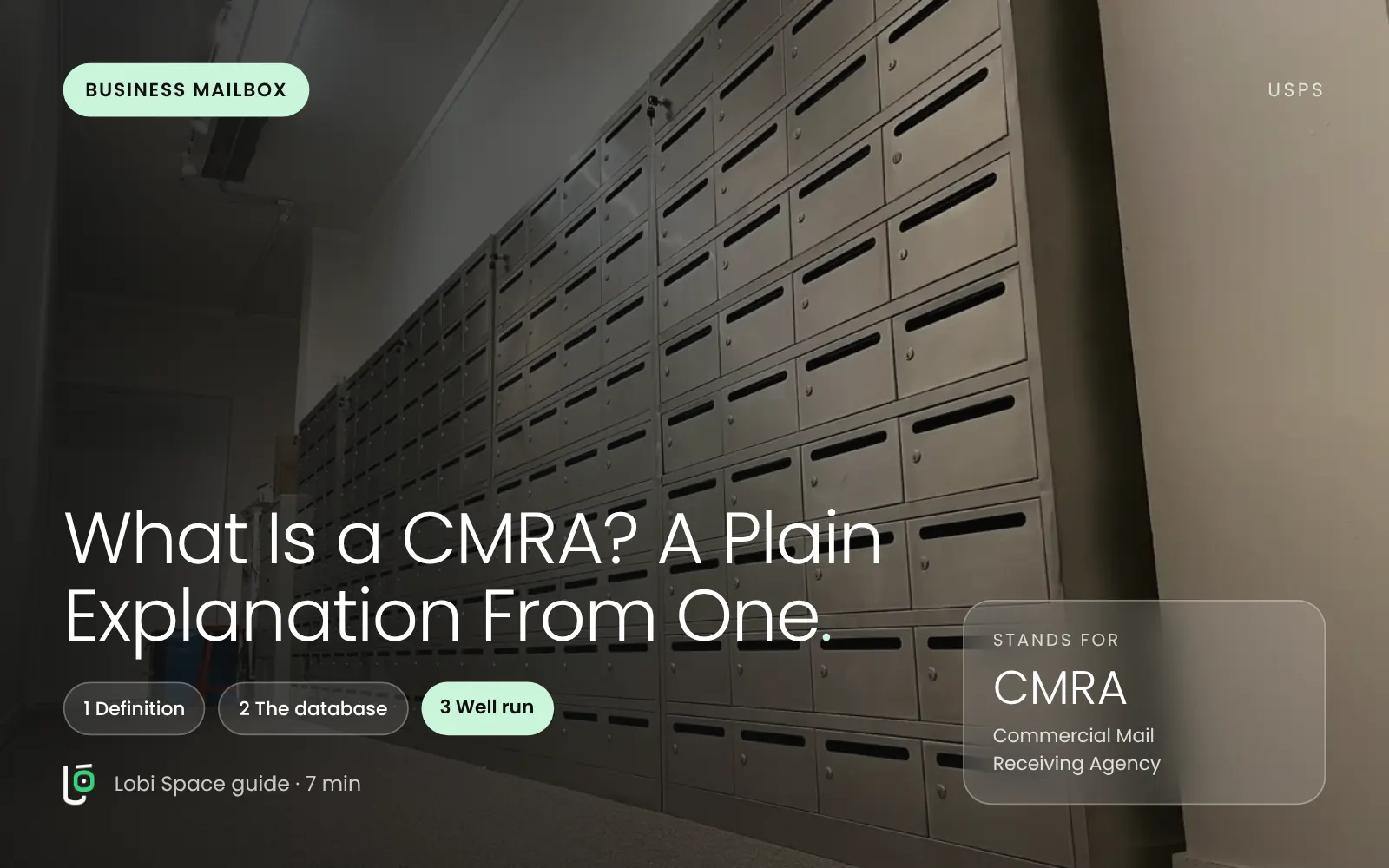
So let's fix that. A Commercial Mail Receiving Agency is any business that receives mail on behalf of someone else. That's the whole definition. If a company accepts your mail and holds it for you, it's a CMRA.
We are one. Lobi Space is a registered CMRA, which means everything below is written from inside the category rather than about it.
The definition, and what it isn't
A CMRA is a private business authorized to receive mail for its customers. Mailbox stores are CMRAs. Virtual mailbox services are CMRAs. Shipping and printing shops that rent boxes are CMRAs. Coworking spaces and virtual office providers that handle member mail (us included) are CMRAs.
What it is not:
- Not a post office. PO Boxes are USPS-operated, not CMRA.
- Not an accusation. CMRA is a category, not a judgment. It describes a function.
- Not inherently a problem. Millions of legitimate businesses use CMRA addresses without issue.
- Not optional to disclose. If a business receives mail for others, it operates as a CMRA whether it markets itself that way or not.
That last point catches people out. Plenty of services advertise a "virtual business address" without using the word CMRA anywhere on the site. The category still applies.
Why USPS regulates this at all
The rules exist because receiving mail for other people is genuinely open to abuse.
If anyone could rent an anonymous slot and start receiving mail under any name, mail fraud becomes trivial. Order goods with stolen card details, have them delivered somewhere untraceable, disappear. The identity requirements exist to make that harder.
So USPS requires every CMRA to verify who its customers are before handling a single item.
Form 1583, and why nobody can skip it
USPS Form 1583 is the mechanism. It authorizes a CMRA to receive mail on your behalf, and it requires:
- Your full legal name and residential address
- Two forms of identification: one photo ID, one confirming your address
- Notarization, in person or through a licensed remote online notary
- Every individual authorized to receive mail listed by name
The same document cannot satisfy both ID requirements, which is the single most common reason applications get delayed.
This is federal, not a provider preference. Any service offering to skip it is either misunderstanding the rules or ignoring them, and both should worry you. The corner they're cutting on your application is the same corner they're cutting on everyone else's.
We wrote a step-by-step guide to completing Form 1583 if you're filling one out now.
The part that actually affects you: the database
Here's the consequence almost nobody explains.
USPS maintains a database identifying CMRA locations. Banks, payment processors, marketplaces and verification services can cross-reference an address against it. Some do this automatically during onboarding.
That's why an address can pass your state filing, get you an EIN, and then fail at the bank with no useful explanation. The state checked whether it was a street address. The bank checked what kind of street address it was.
And here's the honest part most providers won't tell you: this applies to us too. Our address is a CMRA address. So is every legitimate virtual office in the country.
Which raises the obvious question.
If everyone's a CMRA, why do some addresses work?
Because CMRA status isn't the variable. The variable is what the location actually is.
Consider two addresses, both CMRAs:
A mailbox at a shipping store. The address resolves to a retail counter. Street View shows a storefront with parcel signage. The suite number is a box number shared with hundreds of others. There's no lease, because you didn't rent space. You rented a slot.
A suite in a staffed commercial building. The address resolves to an office building. Street View shows a lobby. You have a signed agreement and your own suite number. The business genuinely operates there and so, on paper, do you.
Both are CMRAs. Only one survives the moment a human at a bank looks it up and asks whether a real business could plausibly operate there.
"Being a CMRA isn't the problem. Being only a CMRA is the problem. If mail is the entire thing that happens at the address, that's what it looks like when someone checks," says Patrick P, Founder Lobi Space.
The distinction that matters isn't the regulatory category. It's whether the address describes a place, or just a transaction.
What a well-run CMRA actually does
Compliance work is invisible when it's done properly, so here's what it looks like from the operator's side.
Identity verification that's real. Form 1583 notarized, two IDs checked, names matched across documents. Not a checkbox in a signup flow.
A conversation before approval. We speak to applicants. It sounds old-fashioned. It's also the step where most problems surface, because someone planning to misuse an address tends to answer questions about their business differently than someone who has one.
The willingness to say no. We decline applications, and we terminate members whose use of the address stops matching what they told us. A provider that has never turned anyone away isn't screening anyone.
Records that hold up. CMRAs are required to maintain customer identity records and make them available to postal authorities on request. That obligation is precisely why the identity step can't be skipped.
A real place attached to the mail. Staff, hours, a door that opens.
How to tell whether an address is a CMRA
If you're evaluating an address (yours or someone else's):
- Search the address in Google Maps and look at Street View. A retail shipping counter is unmistakable. So is an office building.
- Count the businesses at that address. Search the street address in quotes. Hundreds of companies at one suite number tells you what kind of location it is.
- Check the suite format. "#1234" or "PMB 1234" usually signals a mailbox. A real suite number usually doesn't run into four digits.
- Ask directly. A legitimate provider will tell you plainly that they're a CMRA and explain what their address is accepted for. Evasiveness is the answer.
- Ask what the address is accepted for, in writing: LLC filing, city business licence, bank account, Google verification. Vague answers mean no.
What this means when you're choosing
If you need an address only to receive mail privately, a CMRA mailbox is fine and cheap. Take it.
If the address will appear on a state filing, a licence application, a bank application or a Google listing, you need a CMRA that's also a genuine place of business. That means a signed agreement behind it and something at the address other than mail.
That's the practical difference, and it's most of what determines whether your address quietly works for years or fails at the worst moment.
Our business mailbox covers the first case. Our virtual office covers the second, because it includes a signed agreement for space in a building we actually operate. We wrote more about what gets checked in Someone Is Going to Look Up Your Business Address.
Frequently asked questions
What does CMRA stand for?
Commercial Mail Receiving Agency: any private business that receives mail on behalf of its customers. Mailbox stores, virtual mailbox services, coworking spaces and virtual office providers all operate as CMRAs.
Is a CMRA address bad?
No. It's a category, not a defect, and millions of legitimate businesses use them. The issue arises when the address is only a mail service, because banks and platforms that cross-reference the USPS CMRA database frequently flag locations that look like pure mail drops.
Is a PO Box a CMRA?
No. PO Boxes are operated by USPS. CMRAs are private businesses. Neither works as a physical business address for state filings or bank applications, but they're different things.
Why do I need Form 1583?
Federal law requires any CMRA to verify your identity before receiving mail for you. Form 1583 is that verification: notarized, with two forms of ID. Any provider offering to skip it isn't following the rules.
Can I use a CMRA address for my LLC?
Sometimes, depending on the state and the specific address. A CMRA that's also a real workspace with a signed agreement is generally accepted for filings and licensing. A mailbox-only address frequently isn't. Confirm in writing before you file.
How do I know if my address is flagged as a CMRA?
Every legitimate mail-receiving service is registered as one, so assume yes if a third party handles your mail. What matters is whether the location also functions as a place of business. Search the address and look at what a bank would see.
Do banks reject all CMRA addresses?
No, but they scrutinize them. Under Know Your Customer rules banks must verify a physical address, and many cross-reference the CMRA database. Addresses that resolve to retail mail counters get declined far more often than leased suites in commercial buildings.
The short version
A CMRA is any business that receives your mail. That includes the good ones and the bad ones, us and the shipping store down the street.
The category won't tell you which is which. What will: whether there's a real place behind the address, whether anyone verified who you are, and whether the provider would turn someone away.
If you want to see what's behind ours, come take a look: 1655 S Blue Island Ave, Pilsen, since 2015.
Follow @lobispace
Guides, Chicago business news and studio work, every week.