Part of our guide to the Business Suite. More guides on this topic
The first big cleaning contract usually comes with a packet. A property manager wants your certificate of insurance. An office wants proof you carry general liability. A homeowner asks, "Are you insured and bonded?"
If the answer is no, the job goes to someone else. This guide covers what cleaning companies carry, what each piece does, what it costs, and the order to set it all up. One of our newest tenants runs a cleaning company out of our building, and these are the questions that come up at the front desk.
The short answer
Most cleaning businesses start with general liability insurance. Clients ask for it by name. Workers' compensation comes the day you hire. A janitorial bond answers the "bonded" question. Tools and equipment coverage protects your gear. Commercial auto matters if a vehicle is part of the job.
| Coverage | What it pays for | When cleaners usually add it |
|---|---|---|
| General liability | Damage to a client's property, injuries to clients or visitors, and the legal defense | Before the first client who asks for a certificate |
| Workers' compensation | Medical bills and lost wages when an employee is hurt on the job | The day you hire, including part-time help in Illinois |
| Janitorial bond | Pays the client back if an employee steals | When commercial clients or homeowners ask if you are bonded |
| Tools and equipment | Your vacuums, floor machines and supplies if they are stolen or damaged | Once your gear would hurt to replace |
| Commercial auto | Accidents in a vehicle used for the business | When you drive to jobs with equipment or a crew |
General liability: the one clients ask for
General liability covers accidents that happen to other people and their things because of your work. ERGO NEXT's general liability page for cleaners gives the plain examples: a cleaning solution that damages flooring, a client or visitor who slips on a wet floor, and the attorney fees and settlements if someone sues.
It does not cover you or your own employees when you get hurt. That is workers' compensation. It also does not cover your own equipment. That is tools and equipment coverage.
When a property manager says "send your COI," this is the policy they mean. A certificate of insurance is a one-page proof of coverage, limits and dates. NEXT says proof of insurance is available right after purchase, and the policy lives in its web and mobile app around the clock.
What it costs
Prices depend on what you clean, where, how many people you employ and your claims history. Two published data points give you a realistic range.
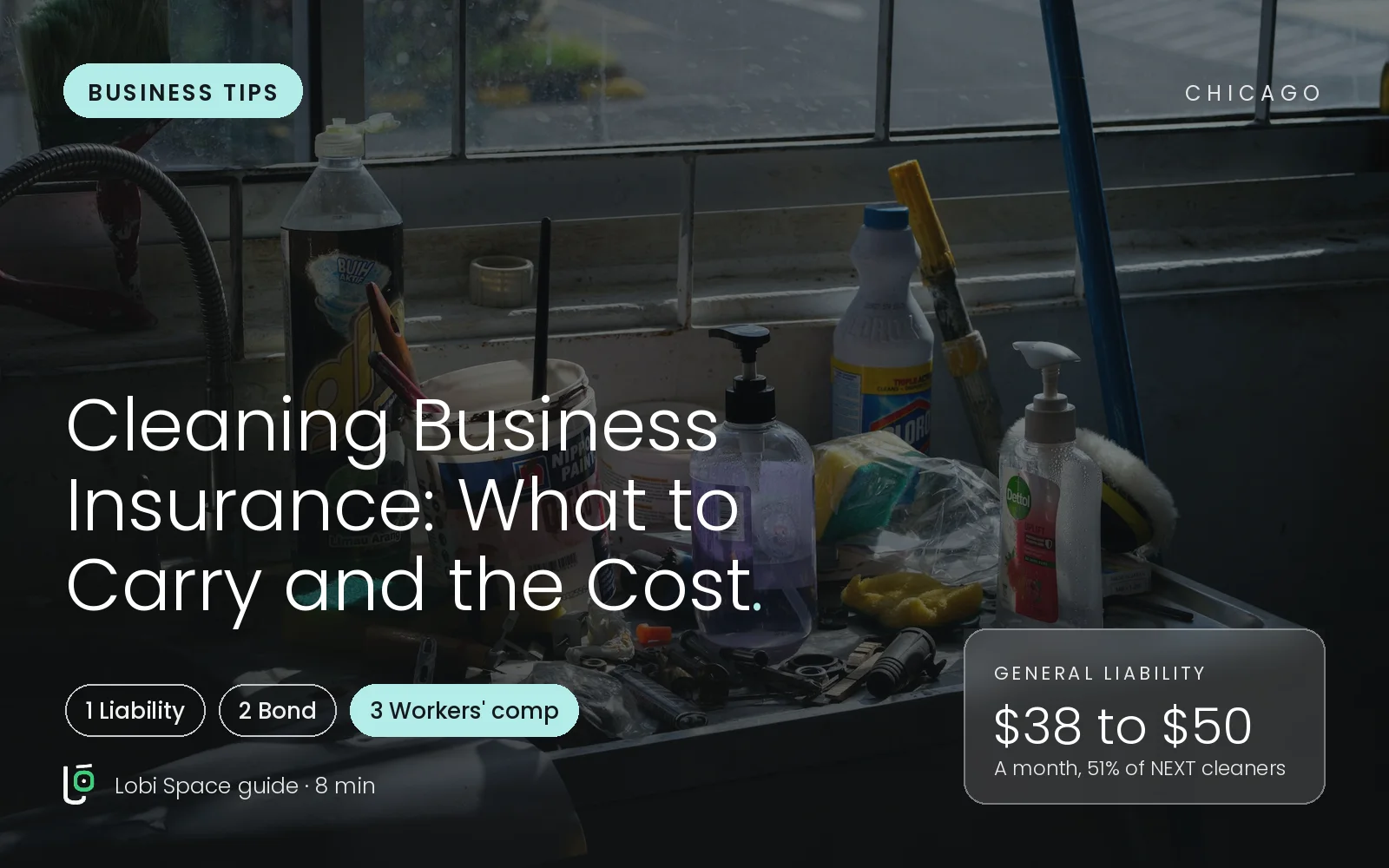
- ERGO NEXT: 51% of its janitorial customers pay $38 to $50 a month for general liability, per NEXT's janitorial insurance cost page. The data comes from NEXT's active customers over the prior 12 months and was updated in October 2026.
- Insureon: house cleaning businesses pay a median of $51 a month, or $608 a year, for general liability, per Insureon's house cleaning cost data, updated September 1, 2026.
Treat both as a range, not a quote. A ten-minute online quote tells you your real number.
Workers' compensation: the one the law requires
In Illinois, workers' compensation is not optional once you have an employee. The Illinois Workers' Compensation Commission says it covers almost everyone hired or employed in the state. One part-time cleaner counts.
Sole proprietors, partners, corporate officers and LLC members may exempt themselves. A true one-person cleaning business can operate without it.
The penalties for skipping it are serious. Per the same IWCC page, an employer that knowingly fails to insure can be fined up to $500 a day, with a $10,000 minimum, and corporate officers can be held personally liable. The Commission can also stop work until you show proof of coverage.
On price, NEXT reports a median of $126 a month for janitorial workers' compensation. Insureon reports $100 a month for house cleaning businesses. Your payroll drives the number.
Bonded and insured: what the bond actually does
"Bonded" is not the same as insured. A janitorial bond pays your client back if one of your employees steals from them. Insureon describes it as protection against dishonest acts by employees.
Two things surprise new owners.
- The bond protects your client, not you. When the bond company pays a claim, your business pays the bond company back.
- It is cheap. Insureon reports house cleaning businesses pay about $9 a month, or $112 a year.
Many commercial clients will not sign without one. If you hire, get bonded before you bid on offices.
Tools, equipment and the vehicle
Your gear is your income. A stolen backpack vacuum or a damaged floor machine stops work. NEXT offers tools and equipment coverage as an add-on to general liability for cleaning businesses, and reports most of those customers pay about $30 a month.
If you drive a crew or equipment between jobs, ask about commercial auto before an adjuster asks you. Personal auto policies often exclude business use.
The paperwork that makes your insurance work
Insurance sits on top of a business. The certificate prints your business name and address. Clients check both. Get these in order and the policy, the invoices and the bank account all match.
1. Form the company
An LLC separates business debts from your personal savings. Insurance pays claims. You want both. Our LLC setup guide walks through the steps, or start with the Launch package, on sale in Illinois for $195, regular $295. It includes the state filing, your EIN and a year of registered agent service.
2. Name a registered agent
Every LLC needs a registered agent at a street address in its state to receive legal papers. Cleaners are out on jobs all day, so missing a lawsuit or a state notice is a real risk. Lobi Space is a registered agent in Illinois at $95 first year, then $125 a year. Order registered agent service and it is set up the same day you check out.
3. Get a business address that is not your home
Your certificate of insurance, invoices, website and Google listing all show an address. For a lot of cleaners that is their apartment. A virtual office in Chicago gives you a real street address with your own suite number from $50 a month, plus mail handling, so clients see a business and your family's address stays private.
4. Get the Chicago license
Most businesses operating in Chicago need a license from the city's Department of Business Affairs and Consumer Protection. The category depends on what you do. Ask the city before you sign a lease or buy a van.
5. Then insure it
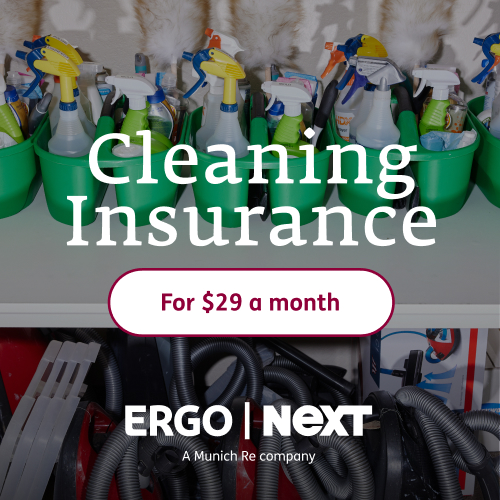
With the company, the agent, the address and the license in place, the quote takes minutes and the certificate is ready the same day. Get a cleaning insurance quote from ERGO NEXT.
Why we list ERGO NEXT
We vet every partner before it goes on our resources page. ERGO NEXT is built only for small business, quotes online without a sales call, and issues certificates digitally. It is owned by ERGO, the primary insurer of Munich Re, and was rated A+ (Superior) by AM Best. We wrote a fuller review of Next Insurance, including what we don't love: some customers report it is hard to reach a person on the phone.
It is not the only option. An independent broker can compare several carriers and is worth a call if you run a large crew, clean medical sites or do post-construction work.
Frequently asked questions
Do I need insurance to start a cleaning business in Illinois?
Illinois requires workers' compensation once you have an employee, and auto liability on any vehicle you drive. General liability is not required by state law for a solo cleaner, but most commercial clients and many homeowners require it before they hire you.
How much is insurance for a small cleaning business?
NEXT reports 51% of its janitorial customers pay $38 to $50 a month for general liability, and Insureon reports a median of $51 a month for house cleaners. Workers' compensation and commercial auto add more once you have employees or a vehicle.
What is the difference between bonded and insured?
Insurance protects your business when you damage property or someone is hurt. A janitorial bond pays your client back if an employee steals, and your business repays the bond company.
Can I get a certificate of insurance the same day?
With online insurers like ERGO NEXT, yes. Proof of insurance is available right after you buy, and you can send certificates to clients from the app.
Does an LLC protect me instead of insurance?
No. An LLC can keep business debts away from your personal assets. It does not pay a claim or a lawsuit. Insurance does. Most cleaning companies carry both.
Paid links. Lobi Space earns a fee when you request a quote through the ERGO NEXT links on this page. You pay nothing extra. Lobi Space is not an insurance agent, and this guide is general information, not insurance advice.
Follow @lobispace
Guides, Chicago business news and studio work, every week.