Part of our guide to the Business Suite. More guides on this topic
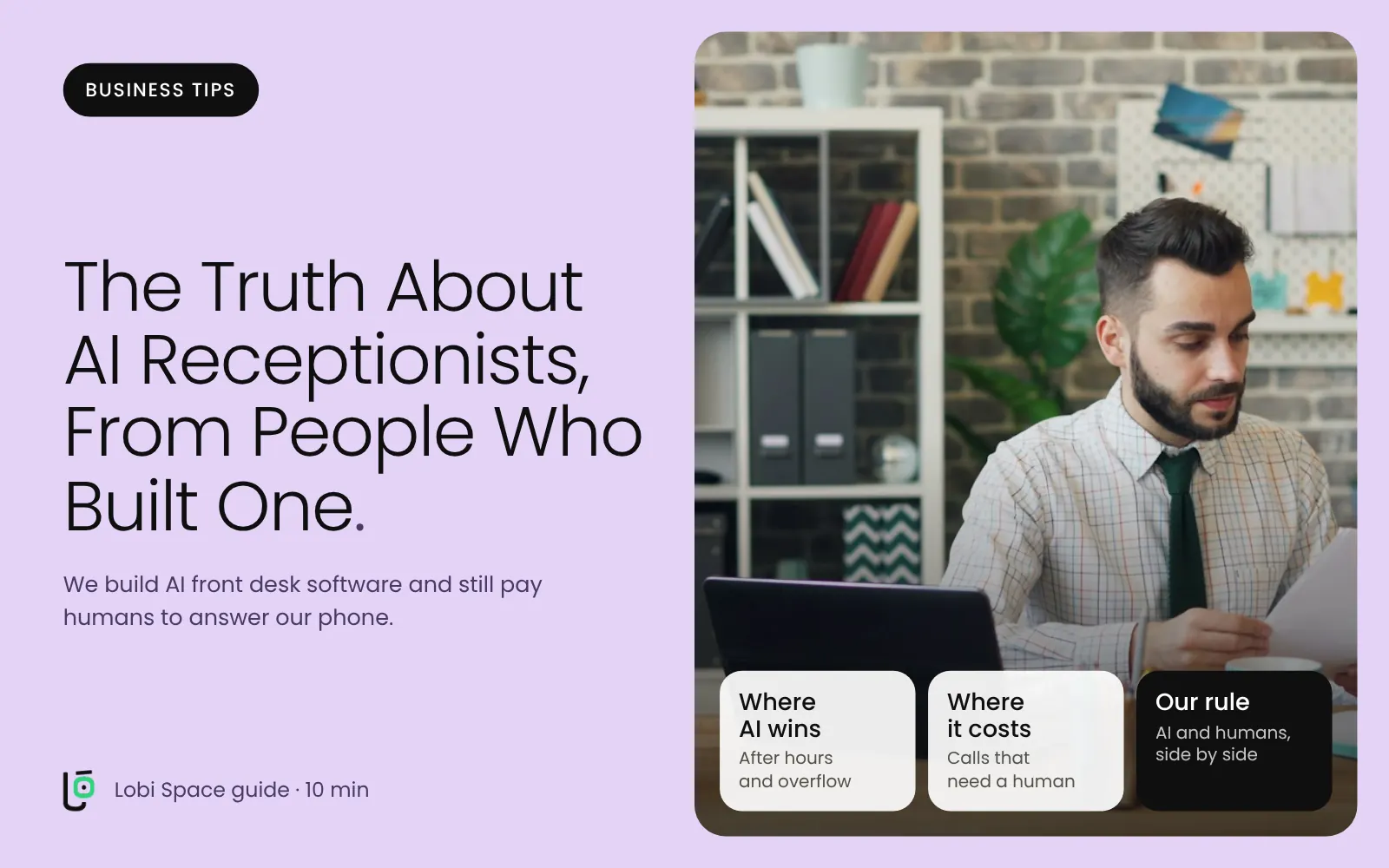
We build AI front desk software. We also pay humans to answer our phone.
That combination confuses people, so let's start there. Lobi Space is a technology-driven company: we've built our own system that handles member questions automatically, and we sell it. We've also used a live human receptionist service since 2019 and have no plans to stop.
Both of those things are true because they're solving different problems. Most of the advice you'll read about AI receptionists is written by companies that only sell one of them.
"We're very technology driven. But authentic human connection is the key to any business, and to any customer service."
Patrick P, Founder Lobi Space
This is what we've learned from testing a lot of these systems, building one ourselves, and watching both run against real customers.
Two disclosures. We're an Alliance Virtual Offices partner and earn a commission on referrals, and we sell our own AI front desk product. Also (and we'd rather say this than have you wonder), parts of this article were researched with AI. That's exactly the point we're making: AI is a genuinely good research and drafting tool. It's a worse first impression.
What AI receptionists are actually good at
Start with the honest case for them, because it's real and it's bigger than skeptics admit.
The voices have gotten very good. Not good-for-a-robot. Good. If you haven't tested one recently, your mental model is out of date.
And for a specific class of call, they're better than a human: faster, always available, never annoyed by the fifteenth identical question.
Lookups. Here's a real example from our own building. A member calls and asks: *did I get mail today?* Our system checks what's been logged, tells them yes or no, and asks what they'd like done with it. No hold music, no message taken, no callback. That question gets asked dozens of times a day and the answer is sitting in a database. A human doing that job is a human being wasted.
Reservations and scheduling. Booking a room, confirming a time, rescheduling. Structured, rule-based, no judgment required.
Never missing the call. This is the one that matters most for small businesses. An AI that catches a call at 9pm and takes a proper message beats a voicemail that never gets returned. If your alternative is *nobody answers*, AI wins easily.
Overflow. When three calls land at once, something answering is better than two people hearing a busy signal.
The common thread: AI is excellent when the caller already knows what they want, and the answer is a fact rather than a judgment.
Where it goes wrong, and why it's expensive
Now the part the vendors skip.
The instant answer is the tell
"The voice has gotten very good. But an instant, prompted answer makes you look like you don't really want the customer."
Patrick P, Founder Lobi Space
This is the thing we noticed that surprised us most, and once you hear it you can't unhear it.
A human receptionist pauses. They think. They say "let me check that for you." An AI fires back a polished, complete answer in under a second. That speed sounds like a feature, but it reads to the caller as a wall. It signals that your business has arranged things so it doesn't have to deal with them.
Speed is not the same as service. Sometimes the willingness to take a moment *is* the service.
People know, and they mind more than they used to
The research is consistent and the direction is the story:
- 79% of Americans still prefer a human when contacting a business
- 59% find AI agents frustrating during service calls, up from 54% the year before
- 31% would hang up on reaching AI, up from 29%
- 71% say humans show more empathy
- 41% say customer service has gotten worse since AI became widespread
Frustration rose. Hang-ups rose. As AI answering became more common, tolerance for it went *down*, not up. That's the opposite of how people usually adapt to new technology, and it should give you pause before putting one on your front door.
The airline problem
Everyone has had this experience. You call an airline. You need one specific thing. And you spend several minutes navigating prompts designed by someone who never imagined your situation, pressing buttons, saying "representative" with increasing hostility.
The system worked exactly as designed. You still came away thinking less of the company.
That's the risk you take when AI is the only door. Not that it fails at the common case. It handles that fine. That it fails at *your* case, and there's nowhere to go.
Where our own line sits
We know exactly which questions our AI should not touch.
Someone asking what our podcast room includes. Someone asking which address plan includes a signed agreement. Someone weighing whether to reserve space. Those aren't lookups. They're conversations, with follow-up questions and a decision at the end.
A trained live receptionist handles them well because they have access to the same information *and* they can tell when something's unclear. Then they do the thing no AI can: reach a manager, live, while the caller is still on the phone. That single capability (escalate now, not later) resolves more situations than any script.
"Don't make AI your first contact salesperson."
Patrick P, Founder Lobi Space
If your business runs on sales or on explaining something complicated, use AI to make sure you never miss a call. Don't use it to make the first impression.
What we've used, and what it cost us to learn
We've tested a lot of these services. Some were genuinely good.
Abby was one we liked, a solid virtual phone service that did the job well. It was also expensive enough that the value stopped making sense for us at our volume.
Alliance Virtual Offices is where we landed, and in 2019 we became close partners. They handle after-hours routing and pick up when our team can't reach the phone in time. Five-plus years of watching a service perform with your own members as the callers teaches you more than any trial period.
That's the honest arc: we didn't start with a philosophy about humans versus machines. We tried things, kept what worked, and built the AI layer ourselves for the jobs where it genuinely helps.
The rule we'd give any business
Here's the practical version, and it's simpler than the debate suggests.
Let the caller choose. Immediately.
"Let them decide in the first few seconds of the call, not three minutes into prompting and clicking."
Patrick P, Founder Lobi Space
Most systems get this exactly backwards. They funnel everyone into automation and make you fight your way out. Reverse it. Offer the choice at the top: talk to the assistant, or talk to a person. Then honor the answer.
This costs you almost nothing. The callers with a simple question will happily take the fast automated path: they *want* speed. The caller with a complicated situation, or the prospect deciding whether to spend money with you, picks the human and feels respected for it.
You capture the efficiency and skip the resentment. The resentment is the expensive part.
Three more things worth doing
Automate intake and outreach, not judgment. Lead capture, qualification questions, appointment booking, follow-up sequences. AI is genuinely strong here and it scales in a way people don't.
Use AI as the safety net, not the storefront. After hours, overflow, the fourth simultaneous call. Anywhere the realistic alternative is voicemail.
Never hide it. If a caller asks whether they're talking to a person, the answer is immediate and honest. Getting caught pretending costs more than any efficiency it bought.
AI and humans, side by side
| The call | Best handled by | Why |
|---|---|---|
| "Did my mail arrive?" | AI | The answer is a database lookup |
| "Book me the room Thursday" | AI | Structured, rule-based |
| After-hours message | AI | Beats voicemail every time |
| Fourth simultaneous call | AI | Beats a busy signal |
| "What does the podcast room include?" | Human | Follow-up questions, judgment |
| "Will this address work for my license?" | Human | Consequences if it's wrong |
| An unhappy customer | Human | Empathy isn't a feature you ship |
| A prospect deciding whether to buy | Human | This is a sales conversation |
The pattern: automation for people who already are customers, humans for people who might become customers.
What this costs, realistically
An AI voice agent runs roughly $0.03 to $0.50 per interaction. A human runs $3 to $6. That gap is why the whole industry is moving.
But run it through your own numbers before deciding. If you take 100 calls a month, going all-AI saves you around $400. Now apply the conservative end of that hang-up statistic: roughly three in ten callers reaching AI decide to leave. What's a single lost client worth to your business?
For most of the businesses we work with (attorneys, contractors, agencies, brokers), one client is worth many multiples of $400 a month. The savings are real. The risk is also real. They are not the same size.
The blended approach costs slightly more than pure automation and dramatically less than staffing humans around the clock. That's usually the right answer, and it's the one we run ourselves. A live receptionist service like Alliance starts around $125 a month, meaningfully less than the roughly $4,300 to $4,900 a month a Chicago front desk hire costs fully loaded.
Frequently asked questions
Are AI receptionists any good in 2026?
For the right calls, genuinely yes. The voices are convincing and they're excellent at lookups, scheduling, after-hours coverage and overflow. They're poor at complex questions, sales conversations, and anything requiring empathy or judgment. Callers notice quickly.
Will customers know they're talking to AI?
Almost always, and quickly. That's not necessarily a problem. It becomes one when they can't reach a person. If they ask, tell them the truth. Getting caught pretending damages more than the automation saved.
Should I replace my receptionist with AI?
Not as your only option. Use AI to catch calls you'd otherwise miss, and keep a human path for prospects and complicated situations. Full replacement makes sense only if every call is transactional and you never sell anything over the phone.
What does an AI receptionist cost versus a human?
AI runs roughly $0.03–$0.50 per interaction against $3–$6 for a human. A live receptionist service starts around $125/month, while hiring a Chicago receptionist costs roughly $4,300–$4,900/month fully loaded. Most small businesses do best blending AI with a live service.
What's the best setup for a small business?
Offer the choice in the opening seconds: automated assistant or live person. Let AI handle lookups, bookings, after-hours and overflow. Route sales conversations and complex questions to a human who can escalate to a manager on the same call.
Is it bad to use AI in customer service at all?
No. Used behind a human option, it removes real friction and catches calls that would otherwise be lost. The failure is making it the only door, especially the first door a prospective customer walks through.
Where we've landed
AI paired with human judgment isn't optional anymore. Any business trying to compete without automation is leaving speed and coverage on the table, and any business automating its front door is quietly losing the customers who needed a conversation.
Use both. Automate intake, outreach, lookups and after-hours. Keep a human on the calls where money and trust are being decided. And give the caller the choice in the first few seconds, before frustration has anywhere to build.
If you want the human layer without hiring, that's what live receptionist services do. We've used one since 2019. If you want to see the automated side, that's ReMe, the front desk system we built for exactly the lookups described above.
*Disclosure: Alliance Virtual Offices has been a Lobi Space partner since 2019 and we earn a commission on referrals through our links, which doesn't change what you pay. We also sell ReMe, our own AI front desk product. Parts of this article were researched with AI assistance and reviewed by our team. Sources: AnswerConnect and published industry research on AI and human customer service preference; PayScale and Glassdoor for Chicago receptionist pay; Alliance published pricing.*
Follow @lobispace
Guides, Chicago business news and studio work, every week.