Part of our guide to the Business Suite. More guides on this topic
A caller decides what kind of business you are in about four seconds.
Not from your website. Not from your logo. From what happens after the second ring: whether a person picks up, whether that person sounds like they were expecting the call, and whether they can actually help.
Most small businesses lose that moment without knowing it happened. The call goes to voicemail. Or it's answered on the third try, from a car, over road noise. Or, increasingly, it's answered by something that isn't a person at all.
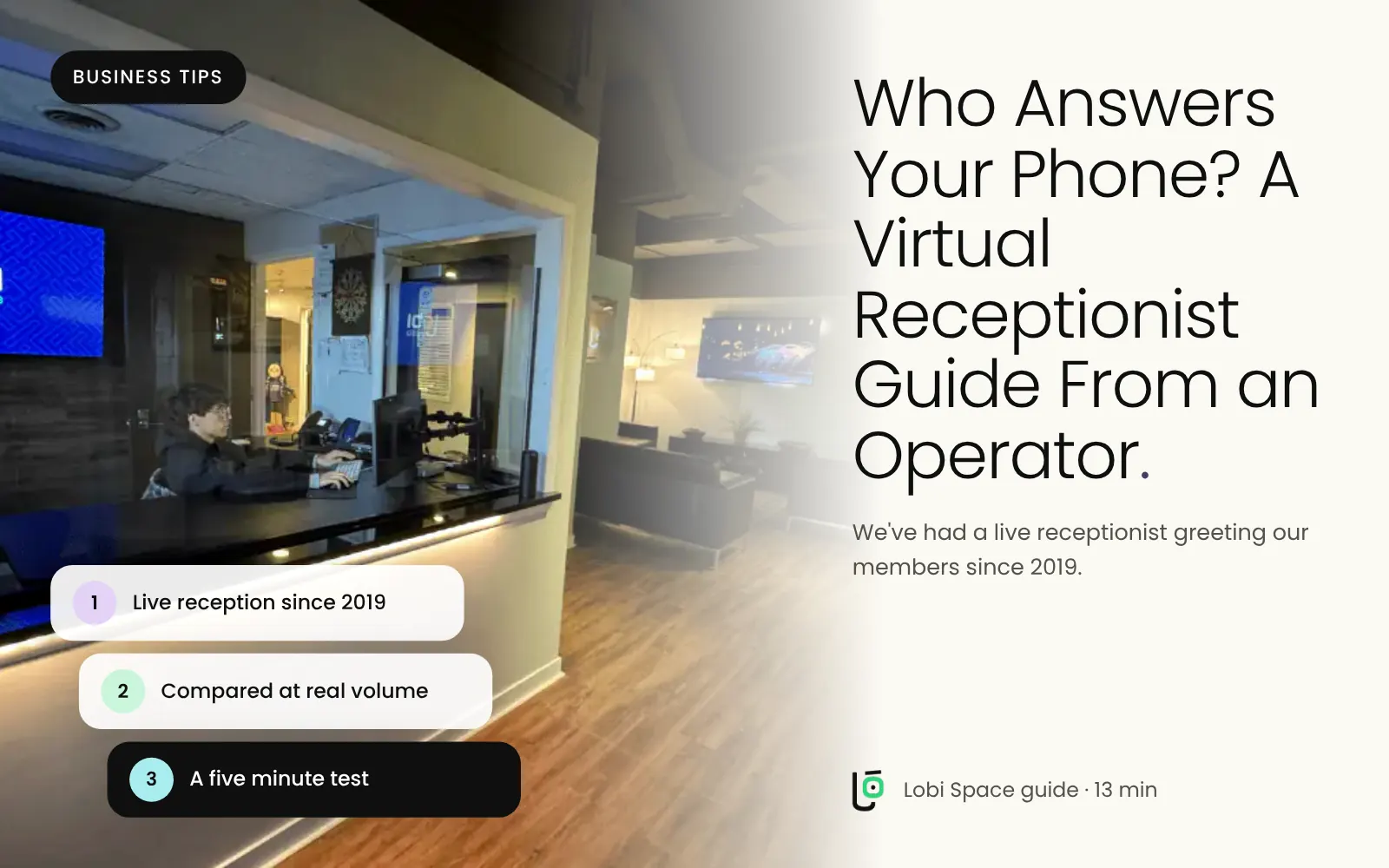
We run a workspace in Pilsen. We've had a live receptionist service greeting our members since 2019, which means we've watched one of these companies perform every business day for years, with our own members as the callers. This is what we learned, what it costs, and what we'd tell you to do.
Disclosure first, because you should read everything below knowing it. Alliance Virtual Offices has been our partner since 2019. We also earn a commission if you sign up through our links. That's a real bias. What we can promise: every price here is from the providers' own published 2026 pricing, and we'll tell you plainly where Alliance is the wrong answer for you.
What we use, and the part you can't get from a review site
We use Alliance Live Receptionist. Not because we compared feature sheets once in 2019, but because we've been watching it run ever since.
That distinction matters more than it sounds. Anyone can read a review site. What almost nobody has is years of watching a service perform with real stakes attached. The callers are your own paying members, and every failure comes straight back to you within the hour.
"Alliance has been greeting Lobi members for over five years. They let our members into the space, guide them to our services, just like our front desk staff."
Patrick P, Founder Lobi Space
Read that again, because it's a bigger claim than it first appears. These receptionists don't just take messages. They function as an extension of our front desk: letting members in, directing them, answering questions about our services. Our members frequently don't distinguish between "Lobi staff" and "the receptionist," which is the highest compliment the arrangement can earn.
If that service were mediocre, we'd know within a week. Small business owners are not shy about telling you when someone handled their client badly.
The thing that actually decided it
Here's the part that doesn't show up in any comparison chart, and it's the reason we've never seriously shopped this again.
I've met Alliance's executive team in person. They're genuinely passionate about helping entrepreneurs grow. Not in a mission-statement way, in a they-still-talk-about-individual-customers way. And most of them have been with the company a long time.
That last detail is the one I'd weight heaviest if I were you. In a services business, executive tenure tells you something the marketing never will. Leadership that stays has usually built something worth staying for, and it means the people setting the standards today are the same people who set them years ago. Companies where the leadership churns every eighteen months tend to churn their service standards too. You feel it as a slow decline nobody announces.
You're not buying software here. You're buying a group of humans who will speak to your customers on your behalf, indefinitely. Who runs that company, and whether they stick around, is a legitimate part of the decision.
What we watch for, and what we see
Running a workspace means we see the failure modes up close:
- Pickup speed. A receptionist who takes six rings has already lost the caller's benefit of the doubt.
- Script rigidity. The tell of a bad service is a receptionist who can't handle a question slightly off-script.
- Handoff quality. Messages that arrive fast, complete, and with the right context.
- Consistency. Not one great call. Two hundred consistent ones.
- Operator turnover. The one most people never ask about. Ask to speak with the agent who will handle your calls. If that isn't possible, turnover is probably high, and your callers will meet a different person learning your business each time. More on that in our answering service guide.
Our members stay. When someone leaves Lobi Space, it's because they outgrew the room or moved cities, not because their phone was answered badly. Reception is a service you only hear about when it goes wrong. We don't hear about it.
What Alliance costs
| Plan | Price | Overage | Setup |
|---|---|---|---|
| 50 minutes/mo | $125 | $1.75/min | None |
| 100 minutes/mo | $175 | $1.75/min | None |
| 200 minutes/mo | Available | $1.75/min | None |
Receptionists answer Monday to Friday, 8am to 9pm ET, and Saturday 9am to 7pm ET. That is well past a standard business day, and into Saturday, which competitors don't match at this price.
Plans adjust at any time as volume changes. That matters more than it reads: small business call volume is seasonal and lumpy, and being able to move tiers without renegotiating is the difference between a service that fits and one you resent by August.
See Alliance Live Receptionist plans
Where Alliance is the wrong answer
We'd rather say this plainly than have you discover it after signing.
- You need 24/7 coverage. Their staffed window is generous but not overnight. If your customers call at 3am, this isn't your answer.
- Brand prestige on the phone is a competitive weapon. If you're a firm where a single client is worth five figures and the phone is part of how you signal that, Ruby's reputation is a real asset. Take Ruby.
- You need deep appointment-scheduling built into the receptionist product. Look at Davinci's scheduling tier before deciding.
- You need a physical body at a desk. No phone service signs for packages or greets walk-ins. Hire someone.
The question underneath all of this
This is the part worth thinking hardest about, because the whole industry is moving and the cheap direction isn't the right one.
The cheapest call is the one nobody wanted to make
AI voice agents have gotten genuinely good, and they are dramatically cheaper. Industry figures put AI at roughly $0.03 to $0.50 per interaction against $3 to $6 for a human. That's not a small gap. It's a different order of magnitude, and it's why every provider is racing to add an AI tier.
If you only look at cost per call, the argument ends before it starts.
Your caller already knows
They know within a sentence. And the research on how they feel about it isn't ambiguous:
- 79% of Americans still prefer a human when they contact a business
- 59% find AI agents frustrating during service calls, up from 54% the year before
- 31% would hang up if they reached AI when calling a business, up from 29%
- 71% say humans show more empathy than AI
- 41% say customer service has gotten worse since AI became widespread
Read the trend lines, not the levels. Frustration up. Hang-ups up. As AI answering became more common, people got less tolerant of it, not more.
Thirty cents a call, unless they hang up
Run it honestly. Say AI saves $4 per call and you take 100 calls a month: $400 saved. Now apply the conservative end of that hang-up figure to your inbound calls. Three in ten prospects reaching an AI decide to leave.
What's one lost client worth to you? For the attorneys, contractors, agencies and brokers we work with, a single client is worth vastly more than $400 a month. The savings are real and the risk is real, and they are not the same size.
Where AI actually earns its place
This isn't an argument that AI is useless. It's an argument about sequence.
AI is genuinely good at overflow, after-hours triage, appointment reminders, FAQ deflection and routing. Nobody needs a human to confirm a Tuesday appointment. Behind a human layer, AI takes real load off.
The failure mode is using it as the front door, the first voice a prospect who has never met you hears. That's the interaction where empathy, judgment and handling an odd question actually matter, and where a bad experience costs most.
The rule we use: a human answers people who might become customers. Automation handles people who already are.
We could route member calls to an AI agent tomorrow and cut that line item to nearly nothing. We haven't, and it isn't sentiment. Our members are business owners whose own callers judge them in four seconds. A receptionist who says the wrong thing to their client is our problem too.
The alternatives, honestly
Answering it yourself
Where almost every business starts, and for a while it's correct. You know the answers, you care more than anyone you could hire, and the phone rings four times a day.
It stops working in three ways. You miss calls: not deliberately, but you're on a site, in a meeting, driving; and most people don't leave messages, they call the next business on the list. You never learn it happened, which is what makes it dangerous. You answer badly: half your attention, and callers hear it. You lose the day to interruptions: ten calls isn't ten minutes, it's ten restarts.
Right if: you're early, volume is low, and every call needs your context. Don't pay for a receptionist to take five calls a month.
Hiring someone
In Chicago, receptionist pay averages $17.88 an hour (PayScale), and Glassdoor puts a front desk receptionist near $41,944 a year. Add payroll taxes, benefits, equipment and management time (employers typically budget 1.25 to 1.4 times base) and the real cost lands around $4,300 to $4,900 a month.
Then the practical limits: one person covers eight hours, not twelve. They take holidays, get sick, and eventually leave. Your phone coverage has exactly one human being's availability.
Right if: you need someone physically present: visitors, deliveries, paper, running the room. If the job is the front desk, hire the person. If the job is phones, you're buying hours you don't need.
Ruby
The best-known name in the category, and the brand is earned: long track record, US-based receptionists, deeply trusted by law firms. They also bundle chat: Ruby 10 at $99, Ruby 30 at $249, Ruby 50 at $399.
Pricing is $250 for 50 minutes, $395 for 100, $720 for 200, $1,725 for 500. That is roughly $5.00 a minute at entry, improving to about $3.45 at the top tier.
Right if: a single client is worth five figures and phone brand perception is a competitive weapon. Plenty of firms are exactly there, and we'd tell them to take Ruby without hesitating.
The catch: at $250 for 50 minutes, a two-person contractor taking 40 calls a month is paying premium rates for a job the alternatives do comparably.
Davinci
A large, established player with a broad product line. Live receptionist starts at $129 for 50 minutes, rising to around $319 for 100 minutes with appointment scheduling. Overage is $1.75/min on Business plans, $2.50/min on Premium. There's a $95 one-time setup fee.
Right if: you want scheduling bundled into the receptionist product, or you're already a Davinci customer and value one invoice.
The catch: the setup fee is friction neither competitor charges, and the jump from $129 to $319 is steep for what amounts to a doubling of minutes.
The comparison, at a realistic volume
At 100 minutes a month, where most small businesses actually land:
| Option | Monthly | Setup | Per minute | What you get |
|---|---|---|---|---|
| Answer it yourself | $0 | None | n/a | Missed calls, interruptions |
| Hire someone | ~$4,300–$4,900 | Recruiting | n/a | A body at a desk, 8 hrs/day |
| Alliance | $175 | None | $1.75 | Live receptionists, Sat coverage, flexible tiers |
| Davinci | up to $319 | $95 | up to $3.19 | Scheduling bundled |
| Ruby | $395 | None | $3.95 | Premium brand, chat available |
Ruby costs more than double Alliance for the same nominal minutes: about $2,640 more a year.
But notice the bigger number. The spread between the cheapest and most expensive service is roughly $220 a month. The spread between any service and hiring is about $4,000 a month. Choosing between providers is a $220 decision. Choosing a service instead of hiring is a $50,000-a-year decision, and most owners never run it.
How to choose, in five minutes
1. Count your calls for one week. Multiply by four, then by average length. Most small businesses land at 40–120 minutes a month and are surprised it's that low.
2. Body or voice? Deliveries and walk-ins mean hire. Phones mean service.
3. Check the hours you actually need. If customers call at 8pm, confirm coverage. At 3am, none of these three is your answer.
4. Compare cost per minute at your volume, not the headline price.
5. Call each service's own number before signing. You're buying the experience they give you as a prospect. Slow or scripted with you is your customers' future.
Frequently asked questions
How much does a live receptionist service cost?
Entry plans run about $125 to $250 a month for roughly 50 minutes. At 100 minutes, Alliance is $175, Davinci runs up to $319, and Ruby is $395. Overage is typically $1.75 to $2.50 a minute. Compare cost per minute at your real volume, not the advertised starting price.
Is a virtual receptionist better than hiring someone?
For phones alone, almost always: $125 to $395 a month against roughly $4,300 to $4,900 fully loaded for a Chicago front desk hire. Hiring wins when you need someone physically present for visitors, deliveries and paperwork, which no phone service can do.
Should I use an AI receptionist instead?
AI is far cheaper: roughly $0.03 to $0.50 per interaction versus $3 to $6 for a human. But 79% of Americans prefer a human, 59% find AI frustrating, and 31% say they'd hang up on one. Our rule: humans for people who might become customers, automation for people who already are.
What's the difference between Alliance, Ruby and Davinci?
Alliance is lowest cost at every comparable tier, with no setup fee, Saturday coverage, and tiers you can change anytime. Ruby is the premium brand at premium pricing, strongest with law firms. Davinci bundles appointment scheduling and charges a $95 setup fee.
Do live receptionists work for businesses without an office?
Yes. That's the common case. Callers reach a receptionist answering in your company name, who takes messages, screens and routes calls wherever you are. Paired with a virtual office or business mailbox, you get an address and a phone presence without renting space.
Can I change plans if my call volume changes?
With Alliance, yes. Plans adjust at any time. Worth confirming with any provider, because call volume is seasonal for most small businesses and a plan you can't move is one you'll overpay on half the year.
What we'd do in your position
If you're answering your own phone and it works, keep going. Come back when you start missing calls.
If you need a person at a desk, hire a person. No service signs for packages.
If you need your phone answered well by a human at a price that makes sense for a small business, that's Alliance, and it's what we've used for our own members since 2019. We've watched it perform for years, and we've met the people running the company.
And if you're a firm where the phone is a competitive weapon and budget isn't the constraint, take Ruby. We'd rather tell you that than sell you the wrong thing.
*Disclosure: Alliance Virtual Offices has been a Lobi Space partner since 2019, and we earn a commission on referrals through our links, which does not change what you pay. Pricing is as published by each provider in 2026 and may change. Verify current rates before purchasing. Sources: Alliance Virtual Offices, Ruby and Davinci published pricing; PayScale and Glassdoor for Chicago receptionist pay; AnswerConnect and published industry research on AI and human customer service preference.*
Follow @lobispace
Guides, Chicago business news and studio work, every week.