Part of our guide to the Business Suite. More guides on this topic
Every answering service publishes a starting price. Almost none of them publish the number that actually matters.
That number is cost per minute at the volume you'll really use. Once you calculate it, the rankings change completely. A service advertising $125 can be more expensive than one advertising $325, depending on how much you use it.
We've used a live answering service since 2019 and tested several others before settling. Below is every provider's published 2026 pricing, converted to the comparison that matters.
Disclosure: Alliance Virtual Offices has been our partner since 2019 and we earn a commission on referrals. We'll be specific about where other services beat them, because on some dimensions they clearly do.
The comparison, with the math done
| Service | Entry plan | At ~100 min | Per minute | Hours | Setup |
|---|---|---|---|---|---|
| Alliance | $125 / 50 min | $175 | $1.75 | M–F 8a–9p ET, Sat 9a–7p | None |
| AnswerConnect | $325 / 200 min | n/a | $1.63 | 24/7/365 | n/a |
| Davinci | $129 / 50 min | up to $319 | up to $3.19 | Business hours | $95 |
| PATLive | $235 / 75 min | n/a | $3.13 | 24/7 | None |
| Abby Connect | $329 / 100 min | $329 | $3.29 | Business hours | n/a |
| Ruby | $250 / 50 min | $395 | $3.95 | Business hours | n/a |
| Smith.ai | $292.50 / 30 calls | n/a | $9.75 per call | Business hours | n/a |
Two things in that table surprise people.
AnswerConnect has the lowest per-minute rate in the set, and it's 24/7. At $325 for 200 minutes, that's $1.63 a minute with round-the-clock coverage. If your volume is genuinely at that level, it's the strongest value here and we'd say so plainly.
The cheapest entry price is rarely the cheapest service. Davinci's $129 looks like the bargain until you add the $95 setup fee and follow the tiers upward, where it roughly doubles.
What each one is actually best at
Alliance: best for business-hours coverage on a small budget
$125 for 50 minutes, $175 for 100, overage at $1.75/min, no setup fee, and coverage weekdays 8am–9pm ET plus Saturday 9am–7pm ET.
The evening and Saturday hours are unusual at this price. So is the ability to move tiers whenever volume changes, which matters because small business call volume is seasonal and a plan you can't adjust is one you overpay on half the year.
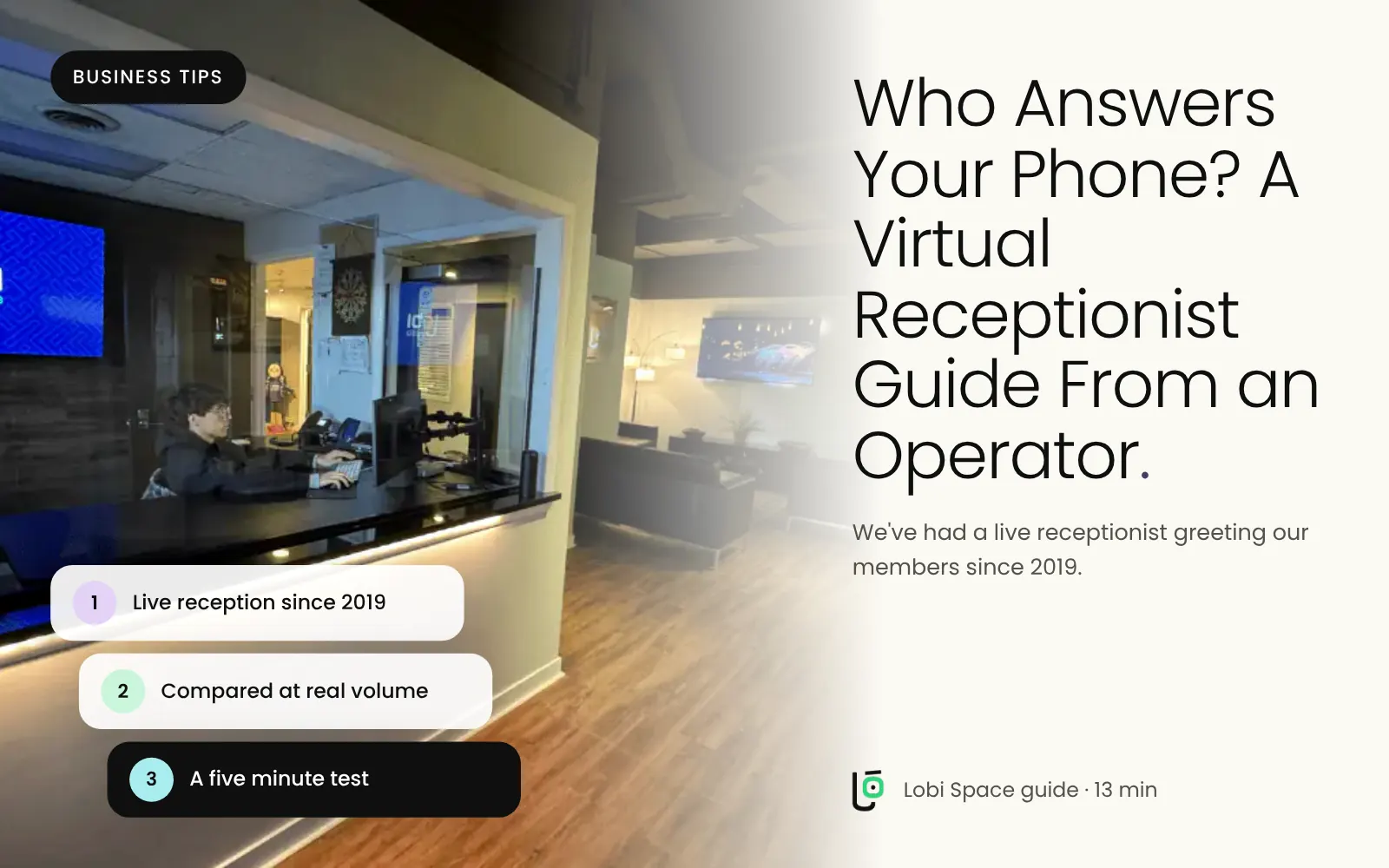
This is what we use for our own members, and we've watched it perform for years with our members as the callers. That's a longer evaluation than any trial period gives you.
Not for you if: you need overnight coverage, or you want appointment scheduling built into the receptionist product.
AnswerConnect: best if you need genuine 24/7
$325 a month for 200 minutes, answered around the clock, every day of the year.
If your customers call at 2am (emergency services, property management, medical, anything where a missed night call means a lost job), this is the honest recommendation. The per-minute rate is the best in this comparison and the coverage is complete.
Not for you if: your volume is low. At 40 minutes a month you're paying for 200.
PATLive: 24/7 at a lower entry point
$235 for 75 minutes, 24/7, no setup fee, $2.49/min overage.
Cheaper monthly entry than AnswerConnect for round-the-clock coverage, at a higher per-minute rate. If you want 24/7 but your volume is modest, PATLive gets you there for $90 less a month.
Ruby: best when the phone is a brand asset
$250 / 50 min, $395 / 100, $720 / 200, $1,725 / 500. That's roughly $5.00 a minute at entry, improving to about $3.45 at the top tier.
The best-known name in the category, and the reputation is earned. Law firms in particular trust them, and if a single client is worth five figures, the premium is genuinely noise against your revenue per client.
Not for you if: you're a small operator with modest volume. At $250 for 50 minutes you're paying premium rates for a phone that gets answered.
Davinci: best if you want scheduling bundled
$129 for 50 minutes, rising to around $319 for 100 with appointment scheduling. Overage $1.75–$2.50/min. $95 setup fee.
Worth it if appointment booking inside the receptionist product genuinely saves you a separate tool.
Not for you if: you just want calls answered. The setup fee and the tier jump make it expensive for the basic job.
Abby Connect: premium service, and an AI tier
$329 for 100 minutes live, with AI receptionist plans from $99 to $690 and additional minutes at $2.99.
We used Abby and genuinely liked the service. It was also expensive enough that the value stopped making sense at our volume. That's exactly the calculation you should run rather than taking our conclusion.
Their AI tier is worth a look if you want both layers from one vendor.
Smith.ai: best if your calls run long
$292.50 a month for 30 calls, which works out to $9.75 per call.
The per-call model is the important difference. Everyone else bills by the minute; Smith.ai bills by the conversation. If your calls typically run eight or ten minutes, per-call pricing can beat per-minute substantially. If your calls are ninety seconds, it's poor value.
They're also strong with law firms and offer AI-plus-human hybrid plans.
The math nobody does for you
Before choosing, work out three numbers.
1. Your actual monthly minutes. Count calls for one week, multiply by four, multiply by average length. Most small businesses land between 40 and 120 minutes and are surprised how low it is.
2. Your real per-minute cost. Monthly price divided by included minutes. Then check the overage rate, because that's what you pay for everything above the plan.
3. Whether you need after-hours at all. 24/7 costs meaningfully more. If your customers only call during business hours, you're buying insurance against a risk you don't have.
That third question moves more money than the choice of provider. A business paying $325 for 24/7 coverage that only ever receives weekday calls is paying $150 a month for nothing.
Per-call versus per-minute
Worth understanding because it changes the ranking based on how you actually talk to people.
Per-minute (Alliance, AnswerConnect, PATLive, Ruby, Davinci, Abby) rewards short calls. Message-taking, routing, quick questions.
Per-call (Smith.ai) rewards long calls. If your receptionist runs a genuine intake conversation, per-call can be dramatically cheaper.
Rough rule: if your average call runs over about five minutes, price out the per-call option before assuming per-minute wins.
What we'd actually tell you
Business hours, small budget, want the phone answered well: Alliance. It's what we use.
Genuine 24/7 need: AnswerConnect for the per-minute rate at volume, PATLive if you want round-the-clock at a lower monthly entry.
Phone is a brand asset and budget isn't binding: Ruby.
Long intake calls: price Smith.ai's per-call model.
Want scheduling bundled: Davinci.
None of the above. You just need to stop missing calls: any of these beats voicemail. Pick on hours and price, and move on.
One more thing worth saying: don't put an AI agent on your front door as the only option. We build AI front desk software and still pay humans to answer our phone. The reasoning is in our piece on AI receptionists. The short version is that 79% of people still prefer a human and 31% will hang up on a bot, and the savings don't cover the lost customers.
Ask to meet the person who will actually answer
Here's the buying question nobody tells you to ask, and it matters more than the per-minute rate.
Don't just interview the sales team or the leadership. Ask to speak with the agent who will handle the bulk of your calls.
If the answer is "that's not something we can arrange," you've learned something important. It usually means turnover is high. High turnover means a rotating cast of people answering your phone, each one learning your business from scratch.
Your caller doesn't experience that as a staffing detail. They experience it as a company that doesn't seem to know itself. Someone asks a straightforward question about what you do and gets a hesitant, hedging answer from a person reading a script for the first time.
"Interview the people who'll answer your phone: not just the leadership, the agent handling most of your calls. If they tell you that's not possible, turnover is probably high," says Patrick P, Founder Lobi Space
We're not speculating about this. It has happened to us with a previous service, and it's the reason we now treat operator turnover as a first-order question rather than a detail.
What low turnover actually buys you
This is the specific reason Alliance stayed our answer.
Their staff are well trained, which most services claim. The part fewer can claim is low turnover among the operators themselves. We know our operator. She knows our business: what we do, who our members are, which questions have a nuanced answer.
That accumulated knowledge is invisible until you lose it. A receptionist in year three answers questions a new hire would have to escalate. She recognises a member's voice. She knows which enquiries are worth interrupting us for and which can wait.
"We know our operator. She knows our business. That's a bigger deal than it sounds," says Patrick P, Founder Lobi Space
Add these to your evaluation list:
- Can I speak with the agent who'll handle my calls?
- How long has that person been with you?
- What's your average operator tenure?
- If they leave, how does the next person learn my business?
A service confident in its retention will answer all four without hesitating. A service that deflects has told you what you needed to know.
It was never about the cents
We've spent this whole article doing per-minute math, so let's be clear about what that math is for.
Cost per minute tells you whether you're being overcharged. It does not tell you whether the service is worth having. Those are different questions, and confusing them is how businesses end up with a cheap phone answering service that quietly costs them customers.
If price is genuinely your binding constraint, here's the honest advice: don't buy a cheap human service. Build an AI receptionist or a decent auto attendant instead. A well-configured automated system beats an indifferent human one, and it's a fraction of the price. Do that deliberately rather than paying for a bad version of the good thing.
But if you're paying for a human, you're not buying minutes. You're buying conversion, brand and authority.
"Sales and marketing start with the first hello. How can I help you today?" says Patrick P, Founder Lobi Space
That's the entire argument. Every dollar you spend on advertising, on your website, on getting found terminates in a moment where someone speaks to a person representing you. If that person is confident, informed and glad to hear from them, the spend worked. If they're hesitant and unfamiliar, it didn't.
Saving twenty cents a minute on that moment is not a saving.
Frequently asked questions
How much does an answering service cost for a small business?
Entry plans run $125 to $329 a month for roughly 50 to 100 minutes. Per-minute rates range from about $1.63 to $3.95 depending on provider and volume. Smith.ai bills per call at $9.75. Compare cost per minute at your real volume, not the advertised starting price.
What's the cheapest answering service?
Alliance has the lowest entry price at $125 for 50 minutes with no setup fee. AnswerConnect has the lowest per-minute rate at $1.63 if your volume reaches 200 minutes. Cheapest depends entirely on how much you use.
Do I need 24/7 answering?
Only if customers genuinely call outside business hours. Round-the-clock coverage costs meaningfully more: AnswerConnect at $325 and PATLive at $235 versus Alliance at $125 for weekday coverage. Check your actual call times before paying for nights.
Is an answering service cheaper than hiring a receptionist?
Substantially. A Chicago front desk hire costs roughly $4,300 to $4,900 a month fully loaded, against $125 to $395 for an answering service. Hiring only wins when you need someone physically present for visitors and deliveries.
What's the difference between per-call and per-minute pricing?
Per-minute charges for time used and suits short calls. Per-call charges a flat rate per conversation and suits long ones. If your average call exceeds about five minutes, per-call pricing is worth pricing out.
How many minutes does a small business actually use?
Most land between 40 and 120 minutes a month. Count your calls for one week and multiply. Nearly everyone overestimates before measuring.
The bottom line
The gap between the cheapest and most expensive service here is a few hundred dollars a month. The gap between using one and hiring someone is about $4,000 a month.
Work out your minutes. Decide whether you need nights. Then pick on per-minute cost, not the headline price.
If Chicago business hours are your requirement, Alliance is what we've used since 2019, and our full comparison of the human options is here.
Disclosure: Alliance Virtual Offices has been a Lobi Space partner since 2019 and we earn a commission on referrals through our links, which doesn't change what you pay. Pricing as published by each provider in 2026. Verify current rates before purchasing.
Follow @lobispace
Guides, Chicago business news and studio work, every week.