Part of our guide to the Business Suite. More guides on this topic
Hundreds of small businesses run out of this building: freight brokers, attorneys, bookkeepers, ecommerce sellers, contractors, nonprofits. From the front desk you can watch which marketing actually moves the needle, because you hear about it: the phone that started ringing, the month that finally covered rent.
You can also check the folklore against data, and the data this year is blunt. BrightLocal's 2026 Local Consumer Review Survey (1,002 US consumers) found 97% of people read reviews before choosing a local business, 68% now require at least a 4-star rating (up from 55% a year earlier), and 47% will not even consider a business with fewer than 20 reviews. Meanwhile the discovery landscape moved under everyone's feet: Google's share of local business discovery fell from 83% to 71%, and AI tools jumped from 6% to 45% as a discovery channel, now the #3 way people find local businesses, ahead of Yelp.
Here is what the growing businesses in this building do about all of that, and the four myths the struggling ones share.
Four myths the struggling ones share
"Organic reach will carry us." Posting into the feed and hoping is not a channel anymore; platforms show your content to a sliver of your own followers. Organic still matters (as proof you are alive when someone checks you out), but it is a shop window, not a doorbell.
"Post more, stay relevant." Frequency without a point trains people to scroll past you. One genuinely useful post a week beats a daily filler habit, and the businesses here that grew all publish less than the ones that stalled.
"We need every new tool." The marketing stack does not fix a message problem. If the offer is unclear, automation just delivers the unclear offer faster. (The same discipline applies to AI tools generally: fewer, deeper.)
"We need to go viral." A local business does not need a million strangers. It needs three hundred nearby people who trust it. Viral is a lottery ticket; the strategies below are a payroll.
The five that work
1. Win the review box first
The BrightLocal numbers turn this from advice into arithmetic. If 97% of consumers read reviews, 68% require four stars, and 47% skip anyone under 20 reviews, then a business with twelve reviews and a 4.8 rating is invisible to nearly half its market *regardless of how good it is.*
The playbook, in order:
- Get the profile right: complete, verified, identical name/address/phone everywhere. Our verification guide covers doing this properly, including from a virtual address.
- Build a review habit, not a review blitz. BrightLocal found 32% of consumers now only trust reviews from the last two weeks. Recency beats volume. One ask per completed job, every week, forever.
- Respond to everything. 80% of consumers say they are more likely to use a business that responds to all its reviews. Responding is free and half your competitors do not bother.
2. Build an audience you own
Email and SMS lists survive algorithm changes; follower counts do not. The businesses here that weathered slow seasons all had a list to pull on. The ones that had outsourced their audience to a feed algorithm had nothing to pull.
Collect contacts from day one: a "join the list" at checkout or booking, a genuinely useful lead magnet built from the things you already explain weekly (a price guide, a checklist, a template), and a monthly note that is 80% useful and 20% offer. The list does not need to be big. Three hundred locals who open your emails outperform ten thousand strangers who follow you.
3. Short-form video with a point
Not dancing. Answering. The questions customers ask you weekly, answered in sixty seconds by the actual owner, posted where your customers scroll. It works because it is proof of competence, not performance, and because answering real questions is exactly what feeds the AI-discovery channel too.
Members film theirs in the studio upstairs; a phone and decent light work fine to start. The sustainable cadence is the one you can hold. One good answer a week beats a daily grind that dies in March.
4. Partnerships over ads
The cheapest customer is the one referred by a business that already serves them: the bookkeeper who refers the attorney, the contractor who refers the designer, the freight broker who refers the customs consultant. Formalize it. An actual conversation with five adjacent businesses about sending each other work, revisited quarterly, beats a quarter of boosted posts.
This is half of why membership here works in practice; the building is the referral network. Chambers and neighborhood business associations do the same job at city scale.
5. Be citable by AI assistants
This is the strategy the BrightLocal data just promoted from "emerging" to "urgent": 45% of consumers now use AI tools to discover local businesses, up from 6% a year earlier. When someone asks an assistant "who does virtual offices in Chicago" or "best podcast studio near Pilsen," the businesses that get named are the ones with clear, factual, published answers: real prices, real address, plain-language pages the models can quote confidently.
Practically, that means: publish your prices, answer the common questions in actual sentences on your site, keep your name/address/phone consistent everywhere, and skip the marketing fog. A model cannot cite "solutions that elevate your journey." Publishing honest, specific content is no longer just SEO. It is how machines decide you exist.
The order of operations
If you are starting from zero: profile and reviews first (arithmetic says nothing else works until this does), then the list, then one video channel done consistently, then partnerships. Ads last. They amplify a machine that already converts; they cannot build one. Spending to send traffic to a page with nine reviews and no prices is the most common money fire we see from the front desk.
Frequently asked questions
Why is nobody seeing my posts?
Because the platform is not showing them. Organic reach on business accounts has been throttled for years and it is not coming back. Stop treating the feed as distribution. Treat it as a portfolio for people who already found you, and put the effort into reviews, search and your list, where the BrightLocal numbers say decisions actually get made.
Do I really have to make TikToks?
You have to answer customer questions where customers look, and increasingly that is short video. But "answering questions on camera once a week" is a very different job from "becoming a content creator." Do the first. Skip the second guilt-free.
Is going viral worth chasing?
For a local business, almost never. A million views from everywhere converts worse than three hundred neighbors who trust you, and 47% of consumers will still skip you if you have fewer than 20 reviews, no matter how many views the video got. Chase repeatability, not the lottery.
How many reviews do I actually need?
The 2026 BrightLocal survey gives a concrete floor: 47% of consumers will not consider a business with fewer than 20 reviews, 68% require at least 4 stars, and 31% now demand 4.5 or higher. And because 32% only trust reviews from the last two weeks, the habit matters more than the total: one ask per completed job, forever.
How much should a small business spend on marketing?
Common guidance runs a mid-single-digit percentage of revenue, but the sequence matters more than the ratio: free-but-slow foundations first (profile, reviews, list), paid amplification only after something demonstrably converts. Spending to amplify a page that does not convert is renting traffic for a store with no door.
What actually gets customers in Chicago?
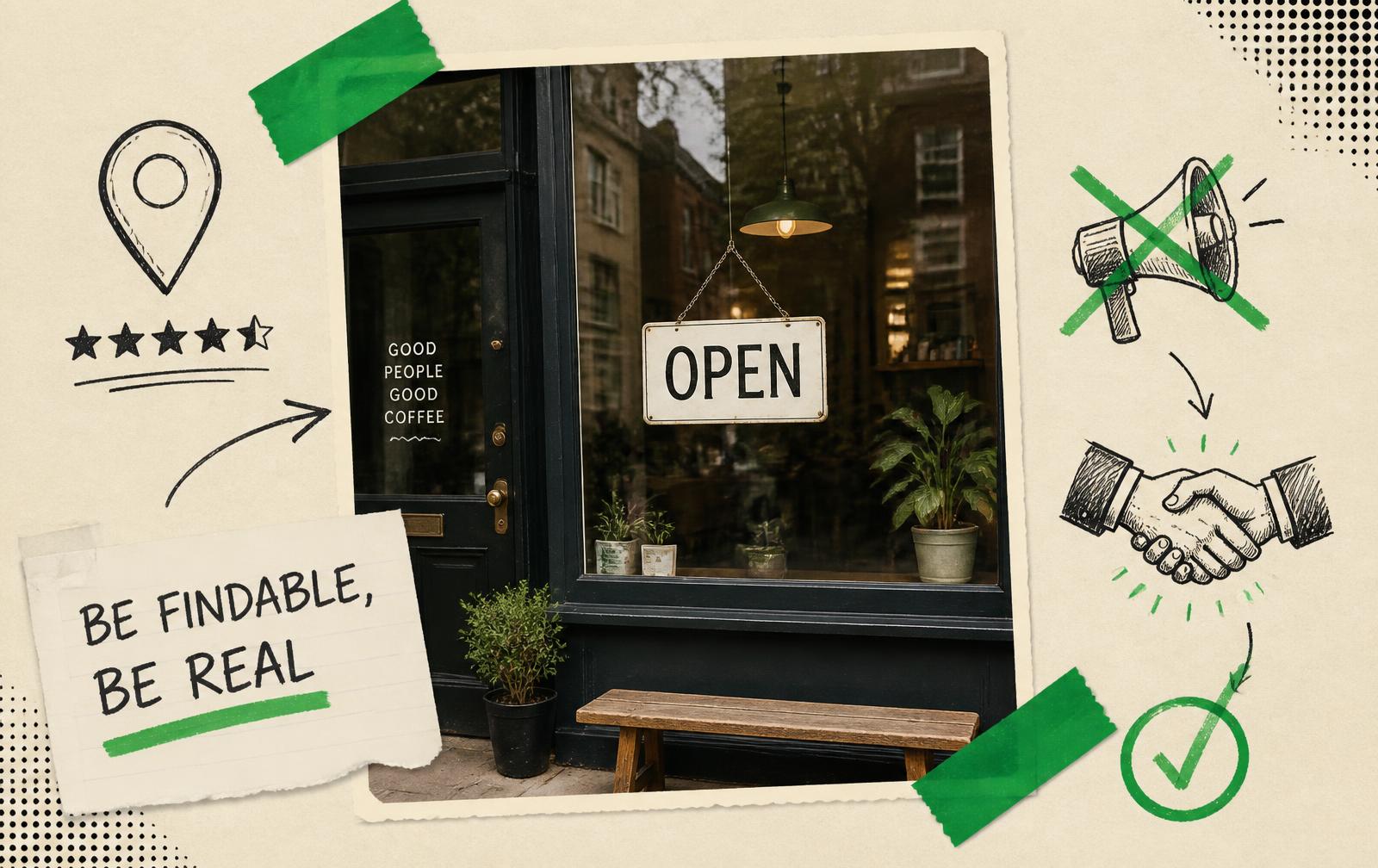
For the businesses in this building: the map pack, reviews, referrals from adjacent businesses, and being findable when AI assistants get asked. That last channel just went from 6% to 45% of local discovery in a single year. The boring answer is the true one: be findable, be credible, be recommendable.
When should I hire a marketing agency?
After you can state your offer in one sentence, know your customer acquisition cost even roughly, and have a page that converts visitors. An agency multiplies clarity; it cannot manufacture it. Handing an agency a fuzzy business is renting someone else's guesswork.