Part of our guide to the office space for rent in Chicago. More guides on this topic
Every "best coworking spaces in Chicago" list you have read was probably sorted by who paid for the placement.
That is the quiet part of this category. Directories charge for the top slot, affiliate links pay per signup, and the write-up you are reading was often assembled by someone who has never sat in any of the rooms they ranked.
We run a workspace in Pilsen. That makes us one of the 342 options in this city, not a neutral referee. So we are going to be upfront about it, list the places we would genuinely send you to instead of us, and give you the questions that actually matter when you tour.
The market changed, and it changed in your favor
Chicago added 64 coworking locations last year, a 24% jump and the largest location gain of any major U.S. market, according to CoworkingCafe's national coworking report. The city now sits at roughly 9.2 million square feet across about 342 locations, the second-largest coworking footprint in the country.
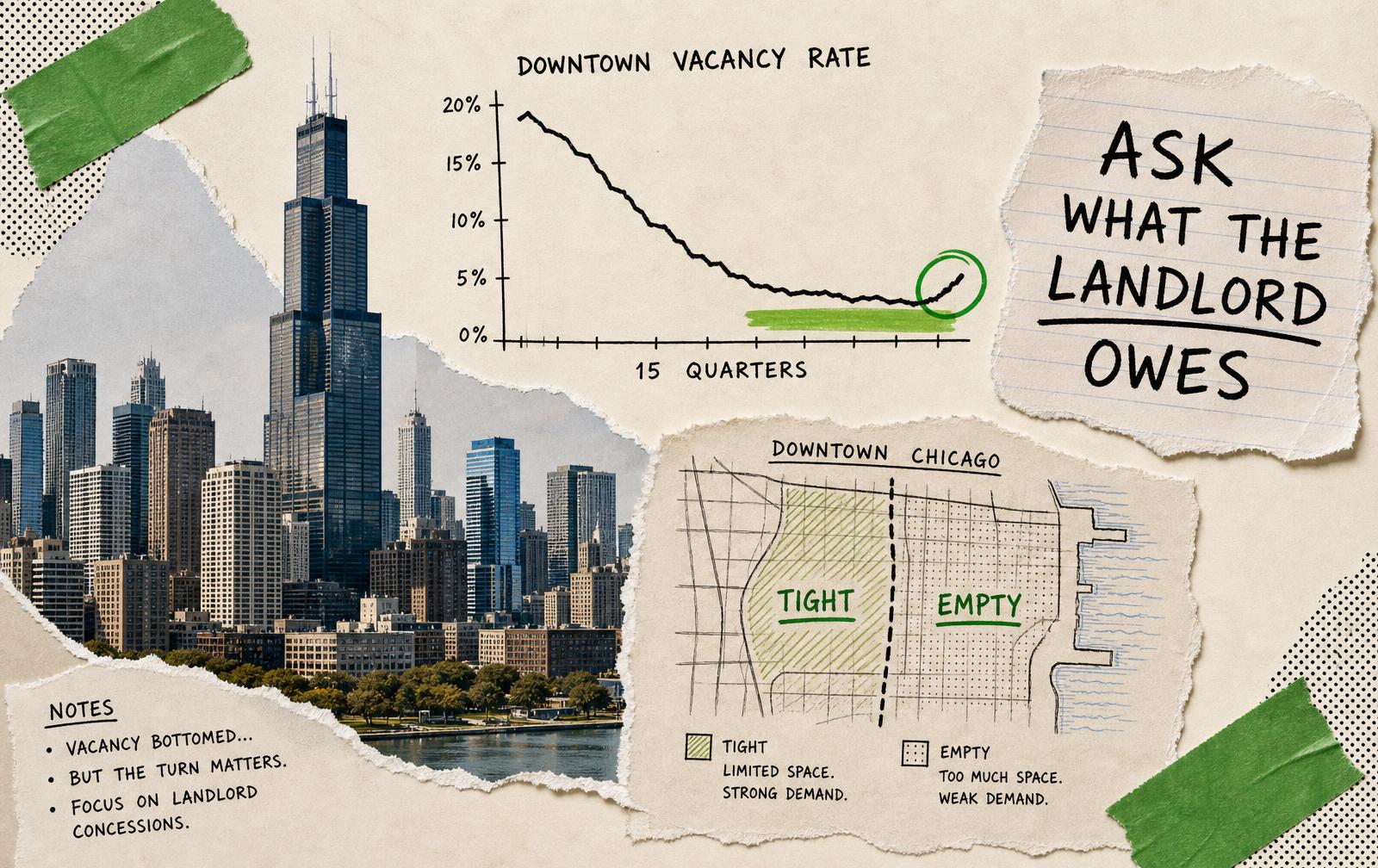
Meanwhile, downtown office vacancy is hovering around a quarter of all space, per Colliers' Chicago downtown office report.
Why this matters: more supply and emptier towers means you have leverage you did not have three years ago. Month-to-month terms are normal now. Free trial days are normal. If an operator pressures you into a twelve-month commitment on your first visit, that is a choice they are making, not a market condition.
What to actually check before you sign
Most roundups compare amenities. Amenities are the least useful thing to compare, because every space lists the same six: fast wifi, coffee, printing, meeting rooms, events, 24/7 access.
Here is what separates a space you will still be happy with in month eight:
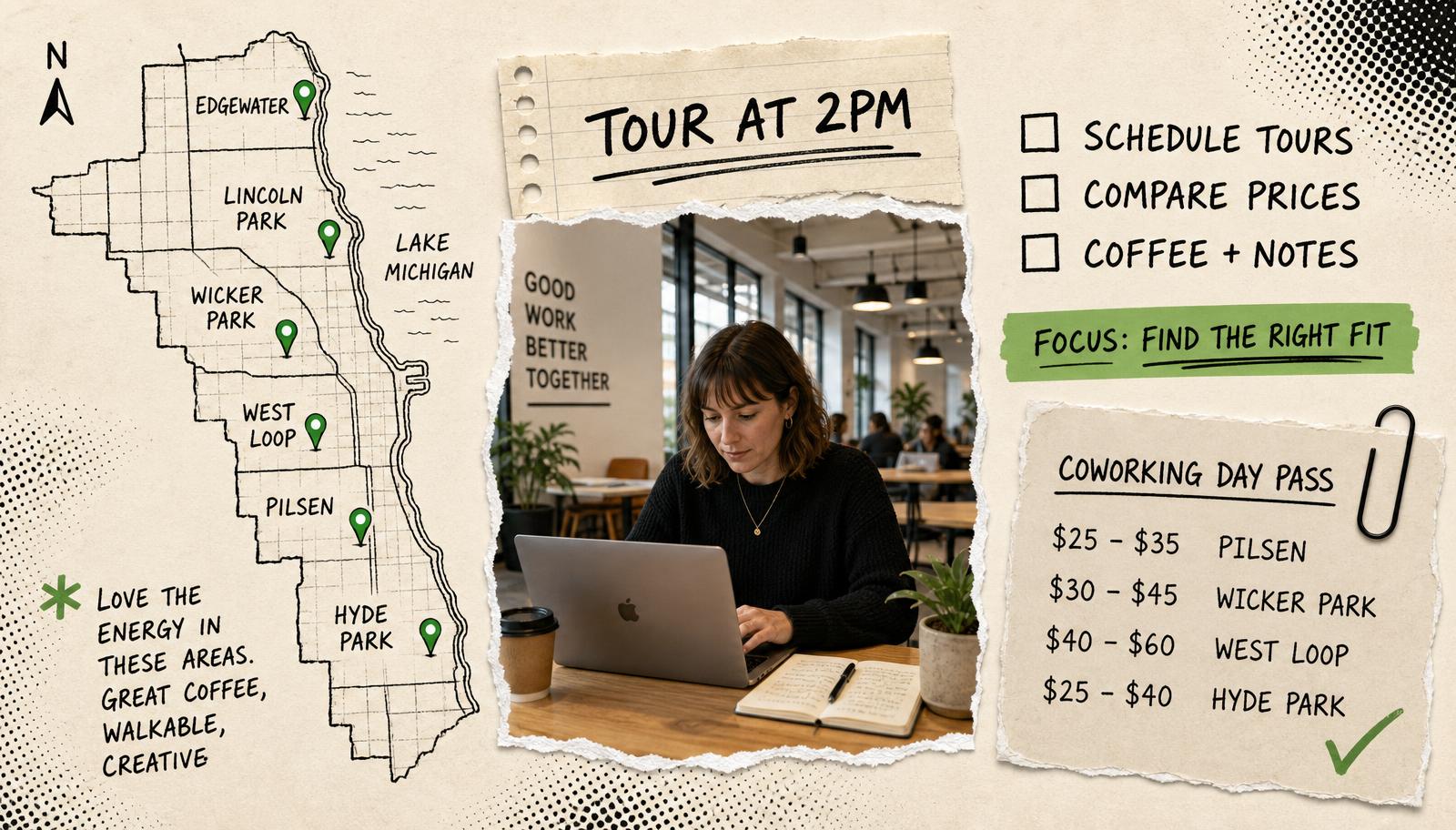
- The 2pm noise test. Tour at 2pm on a Tuesday, not at 10am on a quiet Friday. Ask to sit for twenty minutes.
- Meeting room math. How many hours are included, and what does the eleventh hour cost? Included hours are where the real price hides.
- Whether the address works for your paperwork. A desk membership is usually not a legal business address. If you need one for an LLC filing, a business license, or Google verification, that is a separate product with a signed agreement attached.
- Who is actually there. A room full of enterprise satellite teams feels different from a room of solo founders. Neither is wrong. One of them is your people.
- What happens when you grow. Ask what a private office costs today. If moving up means renegotiating from scratch, you will end up moving out instead.
What Chicago coworking actually costs in 2026
Published pricing in this category is unusually slippery, so here is the honest range rather than a single number.
| What you are buying | Typical Chicago range | Notes |
|---|---|---|
| Day pass | ~$25–$50 at most operators | Aggregators list some access from around $14/day; a Regus location on Ravenswood posts $35/day |
| Hot desk membership | ~$200–$400/mo | Shared space, business hours, no assigned seat |
| Meeting room, hourly | Wide spread by neighborhood | Reported medians run near $90/hr, with Fulton Market at the top end and outer neighborhoods well below |
| Private office | Varies sharply by submarket | Downtown towers command a premium; neighborhood buildings do not |
Two things to take from that table. First, "coworking day pass Chicago" pricing varies more than threefold depending on whether you are in Fulton Market or Jefferson Park. Geography is most of your bill. Second, almost nobody publishes private office pricing on their website, which is itself information about how the sales conversation will go.
The spaces worth knowing
Grouped by the job you are hiring a workspace to do, because ranking them one through ten implies a single winner and there isn't one.
If you want the big-brand network
WeWork and Industrious both run multiple Chicago locations with the polish and predictability that comes with scale. If you travel and want the same experience in six cities, this is the trade you are making: consistency in exchange for premium pricing and a sales process.
Regus and Spaces cover the widest geographic spread in the metro, including suburbs the boutique operators skip. Read the escalator clauses in a multi-year agreement carefully.
If you want Chicago's startup gravity
1871, in the Merchandise Mart, is the city's best-known tech incubator and has been for over a decade. You are not buying a desk there so much as buying proximity to mentors, investors, and other founders. mHUB plays the same role for hardware and manufacturing startups, with prototyping equipment most coworking spaces cannot offer.
If your business needs that specific network more than it needs a quiet room, go there. We will happily tell you so.
If you want the Financial District
Serendipity Labs sits in the Loop and sells to the professional-services crowd: attorneys, consultants, finance. Downtown address, downtown price.
If you want a neighborhood, not a tower
This is the fastest-growing slice of the market, and it is where the price gap lives. Pilsen, Ravenswood, Logan Square and Bridgeport all have independent operators running real rooms in real buildings, at a fraction of Loop pricing, usually with parking.
Lobi Space is one of them. We are at 1655 S Blue Island Ave in Pilsen, ten minutes from the Loop, with free parking, meeting rooms, a podcast and video studio, and private offices that start well below what an equivalent room costs downtown. We also run a business mailbox and virtual office out of the same building, which is the actual reason most of our members find us. They needed a professional address and discovered there was a room attached.
If what you need is a desk in the middle of the Loop three days a week, we are the wrong answer, and one of the operators above is the right one.
The questions to ask on every tour
Bring these five. They surface more than an hour of small talk:
1. What is my all-in monthly cost, including the fees that are not in the membership price?
2. How many meeting room hours are included, and what does the next one cost?
3. Can I use this address on a business license or state filing? (If the answer is vague, it is no.)
4. What is the notice period to leave, in writing?
5. Can I sit here for an hour before I decide?
Any operator confident in their room will say yes to number five without hesitating.
The bottom line
There is no best coworking space in Chicago. There is the one that matches how you actually work, where you actually live, and what your business actually needs the address to do.
Start with geography, since it drives most of your cost. Narrow to two or three. Tour all of them at 2pm on a weekday. Ask the five questions. Then pick the room where you can imagine being on a bad day, not a good one.
If Pilsen is on your list, book a room or a day office or come take a look. No tour required, no sales call, and we will tell you honestly if another space on this page fits you better.
Frequently asked questions
How much does a coworking space cost in Chicago?
Day passes generally run about $25 to $50, hot desk memberships tend to land between $200 and $400 a month, and private offices vary widely by neighborhood. Downtown submarkets like Fulton Market and the Loop sit at the top of every range, while neighborhood buildings are meaningfully cheaper for a comparable room.
Can I use a coworking space address for my LLC?
Usually not with a standard desk membership. Registering a business, applying for a city license, or verifying a Google Business Profile generally requires a signed agreement tied to a real street address, which is a separate product from a coworking membership. Ask the operator directly and get the answer in writing before you file anything.
Do Chicago coworking spaces offer day passes?
Many do, and aggregators like Deskpass and CoworkingCafe list day-pass availability across dozens of Chicago locations. It is the cheapest way to test a room before committing. Lobi Space does not sell a day pass; we rent private offices by the day, week or month and rooms by the hour.
Is coworking still growing in Chicago?
Yes. Chicago added 64 coworking locations in the past year, the largest location gain of any major U.S. market, bringing the city to roughly 342 locations and about 9.2 million square feet. That is the second-largest coworking footprint in the country.