Houzz wanted to film real customers. Not actors. Real developers, furniture store owners, and people who actually shop on the site.
That is harder than it looks.
Professional talent knows how to hit a mark, find a light, and repeat a line until the producer is happy. Real customers do none of that. They arrive on time, sometimes nervous, sometimes still thinking about the job they stepped away from to sit in your chair. Your job is not to direct them like a performer. Your job is to make the room disappear so the conversation can happen.
Houzz planned a full week of testimonial interviews in Chicago. The team flew gear from California. They hired a production crew. They rented our studio at 1655 S Blue Island Ave in Pilsen for five full days.
They chose the space for the same reason most production teams do: it is built for workload. Multiple interview setups in one room. A green room where guests can settle in. A makeup room. Kitchen access. Reserved parking on site. The Loop is ten minutes away, but Pilsen gives you room to park trucks, load cases, and breathe without a downtown loading-zone clock running down.
Why a studio beats a hotel room or office corner
A lot of brands try to film testimonials in their own office or a rented hotel suite. It seems cheaper until you count the hidden costs. Office hallways have echo. Hotel rooms have windows that fight the lighting. Neither was designed for sound, power, or the movement of a crew. You spend the first half of every day solving problems that a real studio has already solved.
Our studio is a controlled room. The lights stay where you put them. The audio is clean. The background is consistent from day one to day five. For a project like Houzz, where every interview needed to match the others, that consistency is not a luxury. It is the difference between usable footage and reshoots.
The day before the first interview
The team arrived the afternoon before the first guest. Cases came through the freight door. Lights, cameras, stands, audio gear, monitors, cables, and the small boxes of adapters every production team secretly runs on. We cleared the studio floor, marked power locations, and walked through the flow of the week: where guests park, where they check in, where they wait, where the crew resets between interviews, and where the producer reviews footage on the fly.
That walk-through is where a multi-day shoot gets saved or lost. If a guest has to cross a live set to reach the bathroom, the day gets interrupted. If the crew has no place to stage cases, the room gets cluttered. If parking is not set aside, the first interview of the morning starts late. These are not glamorous details. They are the ones that decide whether the footage is usable.
The crew behind the camera
Houzz brought their own production crew, and we worked alongside them through the week. For teams that need a full crew supplied locally, we partner with Golden Scope Media. They know the room, they know the gear, and they have shot everything from brand testimonials to product launches to podcast series in this exact space.
That local crew knowledge matters. A freelance shooter who has never been in the building will spend an hour figuring out where the circuit breakers are, how the HVAC noise affects the mic, and which door is best for loading. A crew that knows the building skips those hours and gets straight to the work.
A schedule with humans in it
A testimonial shoot is not a room with lights. It is a schedule with humans in it. Each guest gets a window. Some run early. Some run late. Some need fifteen minutes to calm down before they can open up on camera. Some have a question they forgot to ask. Some bring a colleague who also needs to be mic'd. If your space cannot absorb that variability, the whole day slips by lunch.
Our staff greeted guests at the door, showed them where to park, and kept the day moving without making anyone feel rushed. The Houzz crew knew their gear. We knew the room. Together the week stayed on track.
Food showed up every day. Tacos from local spots. Groceries from La Casa de Pueblo. Los Kamales. Coffee, water, and snacks that do not look like an afterthought. When someone is about to be on camera, a banana, a real cup, and a calm check-in matter more than most producers admit. Hungry guests look tired on camera. Tired guests do not tell good stories.
The small things keep a shoot on its feet.
How the week broke down
Day one was mostly crew setup, lighting tests, and a few softer interviews to dial in the look. Day two and three carried the bulk of the customer sessions. Day four picked up anyone who needed a reshoot, captured additional B-roll, and let the crew adjust lighting for different subjects. Day five wrapped early, cases packed, drives checked, and the team headed back to the airport with everything they came for.
By the end, the interviews were done. The clients left having had a good experience. Houzz left with footage.
That is the outcome you want. Good footage and guests who do not regret saying yes.
What happens after the last interview
The shoot does not end when the last guest leaves. Cases have to be packed. Drives have to be checked and backed up. The room has to be reset for the next booking. On a multi-day project, we keep that workflow organized so the production team can confirm they have everything before they head out.
For teams that need post-production, we can connect you with editors who work with the footage the same day. Color correction, audio cleanup, captioning, and rough cuts can all move in parallel so the weeks that follow the shoot are not lost to logistics.
That speed matters for brands running a campaign launch. The faster the edit loop, the sooner the testimonial becomes a real asset.
The part no one sees in the final cut
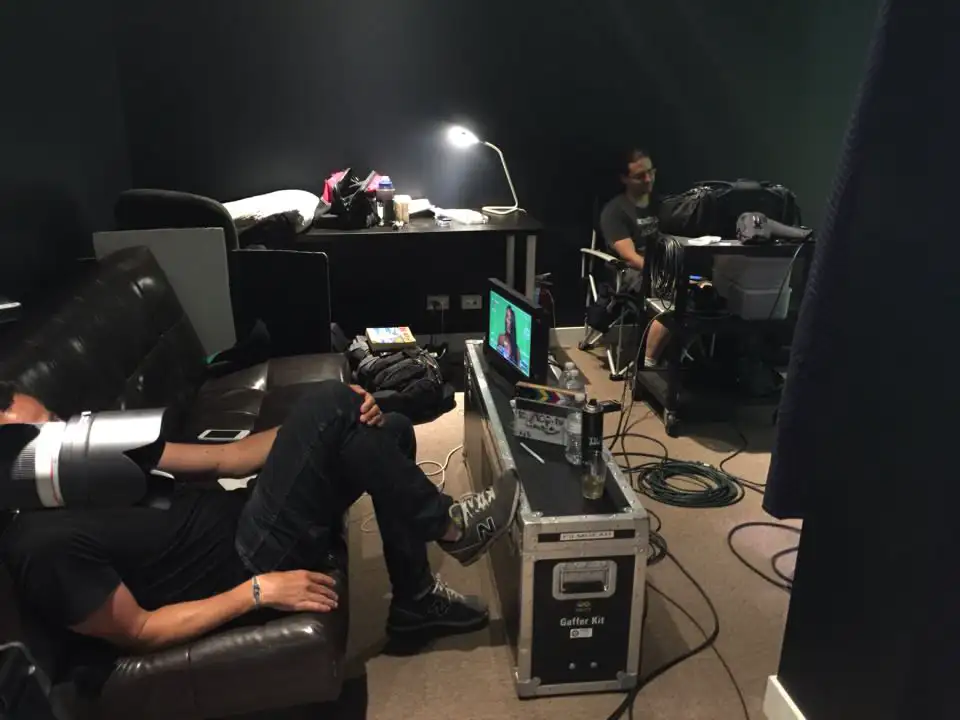
The photo above is from the production room during a quiet moment between takes. A crew member sits back. Monitors show the live feed. Cables run across the floor. Gaffer cases hold the gear that makes the image look simple. This is the work that does not make the final edit: the reset, the wait, the check, the breath before the next guest walks in.
It is also the part of the job a bad studio makes harder. Low ceilings, no green room, unreliable power, and no parking turn those quiet moments into friction. The guests feel it. The crew feels it. The footage shows it.
What makes a testimonial shoot actually work
After a week of watching Houzz run a tight schedule, the pattern is clear:
- A room that can hold the gear and the people without fighting the space
- A crew that knows the room, so setup is repeatable and resets are fast
- A host team that treats guests like guests, not props on a call sheet
- Food, parking, and small comforts that keep energy up across long days
- A schedule with buffer built in, because real people do not run like talent
Who this setup suits
The same combination works for anyone filming real people rather than actors:
- Brands filming customer stories
- Founders recording a podcast series in batches
- Course creators filming multiple modules back-to-back
- Teams shooting product or recruitment video
- Agencies running client content days
- Nonprofits capturing donor or beneficiary interviews
Book the studio
Full equipment, a crew who knows the room, and support spaces that make guests comfortable.
See the studio, rates and booking, or talk to us about a multi-day shoot.