The stairwell of the John Hancock Center is not glamorous. Concrete steps. Painted handrails. A number stenciled on the wall at every landing, counting up.
Ninety four floors. One thousand six hundred and thirty two steps.
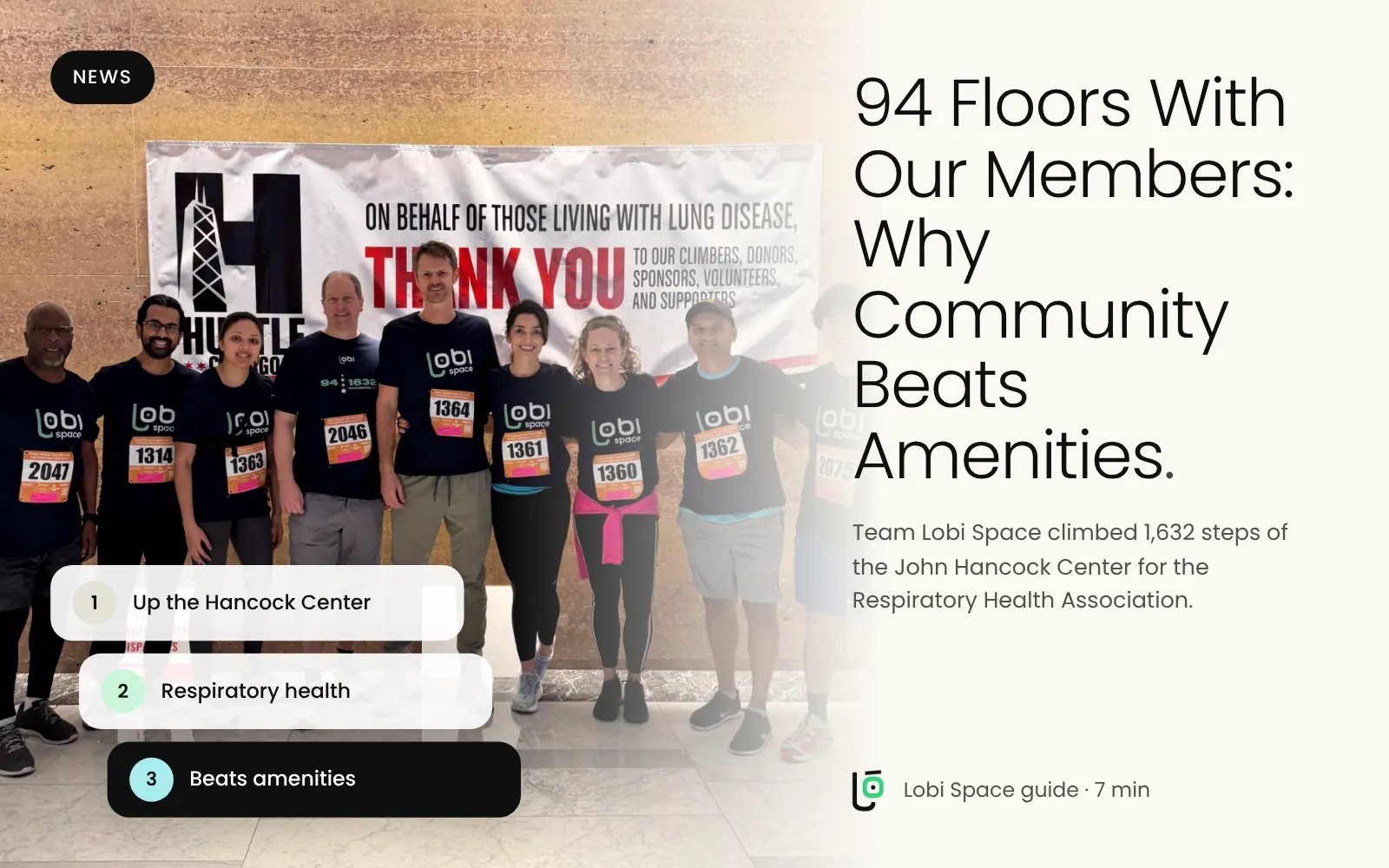
Nine of us went up it together in Lobi Space shirts, bibs pinned on, for Hustle Chicago, the annual stair climb that funds the Respiratory Health Association. Some of us trained for weeks. Some of us signed up eleven days out and hoped for the best. Everybody finished.
People sometimes ask why a small coworking room in Pilsen fields a team for a stair climb. The honest answer is that it never felt like a decision. Somebody mentioned it at the coffee machine. Two people said they were in. By the end of that week there were nine.
That is the whole story of how our community works, compressed into one sign up sheet.
A different kind of coworking space
Lobi Space sits at 1655 S Blue Island Ave, in Pilsen, on the near south side. We are not a floor in a tower with a national logo on the glass. We are one building, one team, one front desk, in a neighborhood that has its own opinions about newcomers.
That scale changes what a workday feels like.
You see the same faces every morning. You learn what people do, then you learn what they are actually good at, which is usually a different thing. You find out whose kid is starting kindergarten and whose contract just fell through. None of that is on a feature list. All of it is why people renew.
WeWork sold community as a product line. Beer taps, neon signs, a slogan about doing what you love. Then it scaled, and the thing it was selling turned out to be the one thing that does not scale. You cannot manufacture familiarity across four hundred locations. You can only let it happen in one room, slowly, between people who keep showing up.
We are the small room. That is the entire strategy.
If you want the practical version of what we offer, it lives on our coworking space in Chicago page. This piece is about the part that does not fit in a pricing table.
Eight hours a day is a long time
Think about how much time you spend with the people you work near.
Eight hours a day. Often more. Five days a week. That is more waking time than most people give their closest friends, and far more than they give their neighbors. Where you spend it matters more than the square footage suggests.
In a big flexible office, that time is anonymous by design. Badge in, headphones on, badge out. The amenity list is long and the conversation is short.
In a room our size, the opposite happens whether you plan for it or not. You overhear a member on a sales call and realize you know somebody who buys exactly that. You get stuck on a landing page headline, spin your chair around, and get an answer in ninety seconds from a marketer who has written four hundred of them. Somebody brings in food. Somebody stays late helping somebody else move a desk.
Here is what that produces in a normal month at Lobi Space:
- Referrals that close. Members send each other work constantly. Not through a portal. Through a hallway.
- Free counsel from expensive people. An attorney, an accountant and a video producer all work here. So does a founder who has raised money and a founder who deliberately never did.
- Shared vendors. When one member finds a good insurance broker or a reliable printer, the whole room finds out.
- Second opinions before mistakes. The best thing about a small room is that somebody will tell you your idea is bad before you spend money on it.
- Events people actually attend. Because they know who else is coming.
None of that appears in a comparison chart against WeWork or Regus. It is the reason members stay anyway.
Why we climbed
The Respiratory Health Association has been a Chicago organization since 1906. It started as the Chicago Tuberculosis Institute. Today it works on asthma, COPD, lung cancer, clean air and tobacco policy, in this city, for people who live here.
Air quality is not an abstraction on the near south side. Anyone who has spent a summer in a neighborhood ringed by expressways and industry can tell you that. Our members are raising kids here. Some of them are managing asthma at home right now.
So when the cause is local, the cause is ours. That is the filter we use.
Hustle Chicago sends thousands of people up 94 floors of a building that defines the skyline. Firefighters climb in full gear. Lung transplant recipients climb. Kids climb. You stand in the lobby at seven in the morning and the crowd tells you exactly who this city is.
What the climb was actually like
The first twenty floors feel like a warm up. This is a lie the building tells you.
Around floor thirty the stairwell narrows in your head. You stop looking at the numbers because the numbers are not helping. Your quads make the case for stopping. The air feels thinner than it has any right to feel.
Then somebody in your group says something stupid at floor fifty and everybody laughs, and laughing costs oxygen you do not have, and it is still worth it.
We climbed at our own paces and regrouped at the top. That is the part nobody tells you about a team stair climb. The middle of it is solitary. You are alone with your breathing and a stranger's shoes two steps above you. The team part happens at the finish, when the person who came up fastest is standing at the rail waiting for the person who came up slowest, and cheering harder than anyone.
Then you get to the observatory, and the whole city is laid out under you, and the lake goes on forever, and you can see the general direction of the neighborhood you work in. You are wrecked and grinning and somebody is taking a photo.
That photo is at the top of this page.
Nonprofit work is part of how we operate
We do not treat this as marketing. It is closer to overhead, in the good sense.
Chicago nonprofits are chronically short of two things: money and meeting space. We cannot do much about the first at our size. We can do quite a lot about the second.
So our meeting rooms get donated to local organizations for board meetings and volunteer trainings. We host neighborhood events. We sponsor teams like this one. We have written before about why a Chicago nonprofit chose an office here, and the reasoning has not changed.
The return is not a tax line. It is that a business embedded in a neighborhood gets to keep operating in that neighborhood. Pilsen has watched a lot of businesses arrive, extract and leave. We would like to be counted differently, and the only way to be counted differently is over years, in public, doing unglamorous things.
What this means if you are looking for space
Most coworking tours sound the same. Fast internet. Coffee. Phone booths. Twenty four hour access. All of it true here too, and none of it a reason to choose one place over another.
Ask different questions on your next tour.
Ask who the members are and what they do. Ask when the last member event was and how many people came. Ask whether anyone at the front desk knows your name after a week. Ask whether the space has ever done anything for the neighborhood it sits in.
A room where the honest answers are thin will still be a fine place to answer email. It will not be a place that changes what your business can reach.
We are a small operation with a real front desk, a mail room that logs every item the day it lands, private offices, meeting rooms, a podcast studio and a group of members who show up for each other. If you want the address without the desk, our virtual office does that. If you want the desk, come see the room.
The amenities get you in the door. The people are why you stay four years. Every good operator learns that eventually. We started there.
Patrick P, Founder Lobi Space
Join us next year
Registration for Hustle Chicago opens in the winter. We will field a team again, and we would rather it be bigger.
You do not have to be a member to climb with us. You do not have to be fast. Nobody in that lobby cares about your time, including the people with the good times.
Come take a tour of the space in Pilsen, or rent an office for the day and see what a Tuesday feels like here. If the room fits, the rest of it comes free.
Ninety four floors is a long way up. It is shorter with eight other people doing it beside you. That happens to be true of running a business too.
Follow @lobispace
Guides, Chicago business news and studio work, every week.