Part of our guide to the Lobi Capital. More guides on this topic
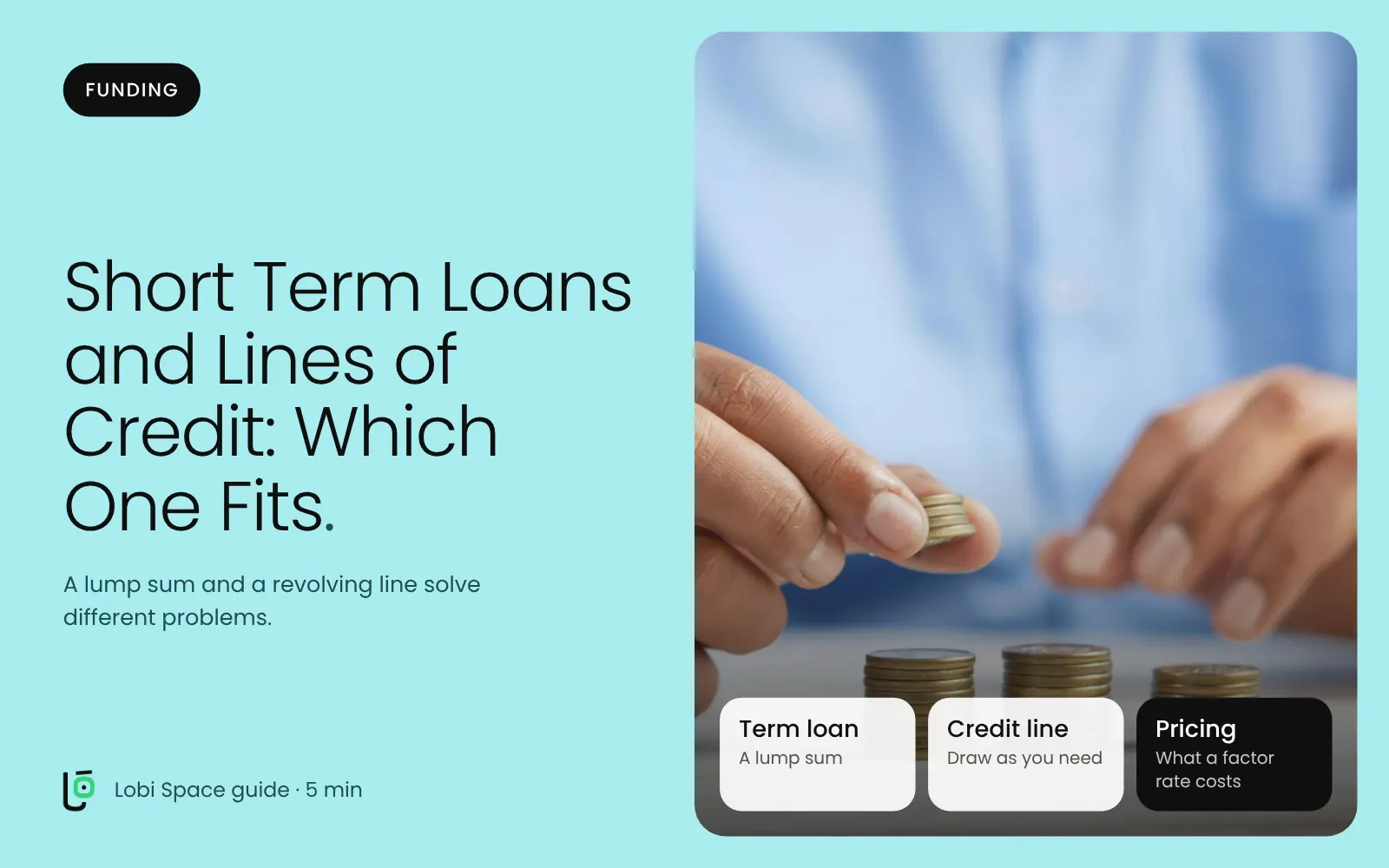
You can borrow a fixed amount and repay it on a schedule. Or you can open a line, draw what you need, and pay for only that.
Those are different tools. Owners get into trouble by treating them as the same thing with different paperwork.
Lobi Space is not a lender. This is background so you can read an offer properly. For the wider view, start with how small business funding works.
The term loan
A lump sum arrives. You repay it over a set period, often with equal payments, and the schedule does not change because your month was slow.
Use it when the amount is known and the purpose is one time. A build-out. A bulk inventory buy. A specific project with a start and an end.
Short-term versions compress that repayment into months rather than years. The payment size goes up accordingly, and many are collected weekly or daily rather than monthly.
The line of credit
A limit is approved. You draw against it when you need cash and repay as money comes in. Interest applies to the balance you are actually carrying.
Use it when the need is recurring and unpredictable. Slow-paying customers. Seasonal swings. A payroll week that lands before a big deposit.
The discipline problem is real. A line that never returns to zero has quietly become a term loan with no end date.
How the pricing is quoted
Here is where offers stop being comparable.
- Interest rate. Applied to the outstanding balance. A line usually quotes this way.
- Factor rate. A multiplier on the borrowed amount. Borrow with a 1.2 factor and you repay 1.2 times the principal, no matter how quickly you pay it off. Early repayment does not reduce it unless the contract says so.
- Fees. Origination, draw fees, maintenance fees, late fees. They are part of the cost even when they are not part of the rate.
Run the factor rate through once and you will never mistake it for an interest rate again. Take $50,000 at a 1.2 factor over six months of daily debits. You repay $60,000, so the money cost $10,000 for half a year of use, which annualizes past 40% before you account for the debits themselves. And you should account for them, because every daily payment hands part of the $50,000 back early, so you never actually hold the full amount for those six months. The true cost of what you did hold runs meaningfully higher than even the 40%. "1.2" was doing a lot of work to sound like 20%.
Several states now require commercial financing offers to carry an annualized cost disclosure for exactly this reason. Wherever you are, the test travels well: ask the provider to state the cost as an annual rate. One that will not is telling you something.
Always convert an offer to two numbers: total dollars repaid, and dollars taken per week. Those two decide whether the money helps you.
What daily and weekly payments do
Monthly payments are forgiving. Daily and weekly payments are not.
If a provider debits your account every business day, your cash flow has to survive the slowest week of your year, not the average one. Owners rarely model that before signing. Plenty of businesses with profitable years have failed on payment timing alone.
Before you accept a short payback, take your worst recent month and subtract the payments. If that month goes negative, the offer is too big or too fast.
What approval usually hinges on
- Time in business, often measured in months of operating history.
- Average monthly deposits and how consistent they are.
- Personal credit of the owners, especially for smaller amounts.
- Existing debt, including other advances. Stacking gets applications declined.
- A personal guarantee in most cases.
On that stacking point, it is worth knowing how the second lender finds out. Most funders file a UCC-1 financing statement with the Secretary of State when they fund you, and those filings are public. Anyone can search Illinois UCC records and see every lien against your business, which is precisely what the next underwriter does before approving you. Search yourself first. If an old, paid-off loan still shows a live filing, get it terminated in writing before you apply, because to a lender reading the record, a stale lien and a current one look the same.
They will also look you up on the state's business entity search to confirm you exist and are in good standing. That check is free, so run it on yourself before they do.
Questions to ask before signing
1. What is the total repayment amount in dollars?
2. Is there a discount for repaying early, or is the cost fixed?
3. How often is payment taken, and can I change the day?
4. Are there fees to draw on the line or keep it open?
5. What counts as default, and what happens on one missed payment?
If a provider will not answer those in writing, that is your answer. And if a provider has already treated you badly, misrepresented a cost or debited what the contract does not support, that is not just a bad experience, it is reportable: the FTC's small business fraud pages explain the common schemes and take complaints, and so does the Illinois Attorney General.
Getting ready
Providers verify your business before they fund it. A consistent Chicago street address across your filings, your bank and your application removes one reason for delay. That is what our virtual office is built for.
When Lobi Capital opens, you will be able to describe the shape of your request in one place and continue with a participating provider. Join the launch list to hear when it does.
Frequently asked questions
Is a line of credit cheaper than a term loan?
Not automatically. A line often costs less in total because you borrow less and repay quickly, but rates vary by provider and by borrower. Compare total dollars repaid, not the headline rate.
What is a factor rate?
A factor rate is a multiplier applied to the amount you borrow. A 1.2 factor on 50,000 dollars means 60,000 dollars repaid. Unlike interest, it usually does not shrink if you repay early.
Can I get a line of credit as a new business?
It is harder. Most providers want operating history and steady deposits. Newer businesses are more often approved for smaller amounts, secured products or a business credit card first.
Does taking a second loan while one is open cause problems?
Often yes. Multiple overlapping advances, sometimes called stacking, is a common reason applications are declined and can breach the terms of the loan you already have.
Follow @lobispace
Guides, Chicago business news and studio work, every week.