Part of our guide to the Lobi Capital. More guides on this topic
You did the work. You sent the invoice. Payment terms say sixty days. Your suppliers do not care about your payment terms.
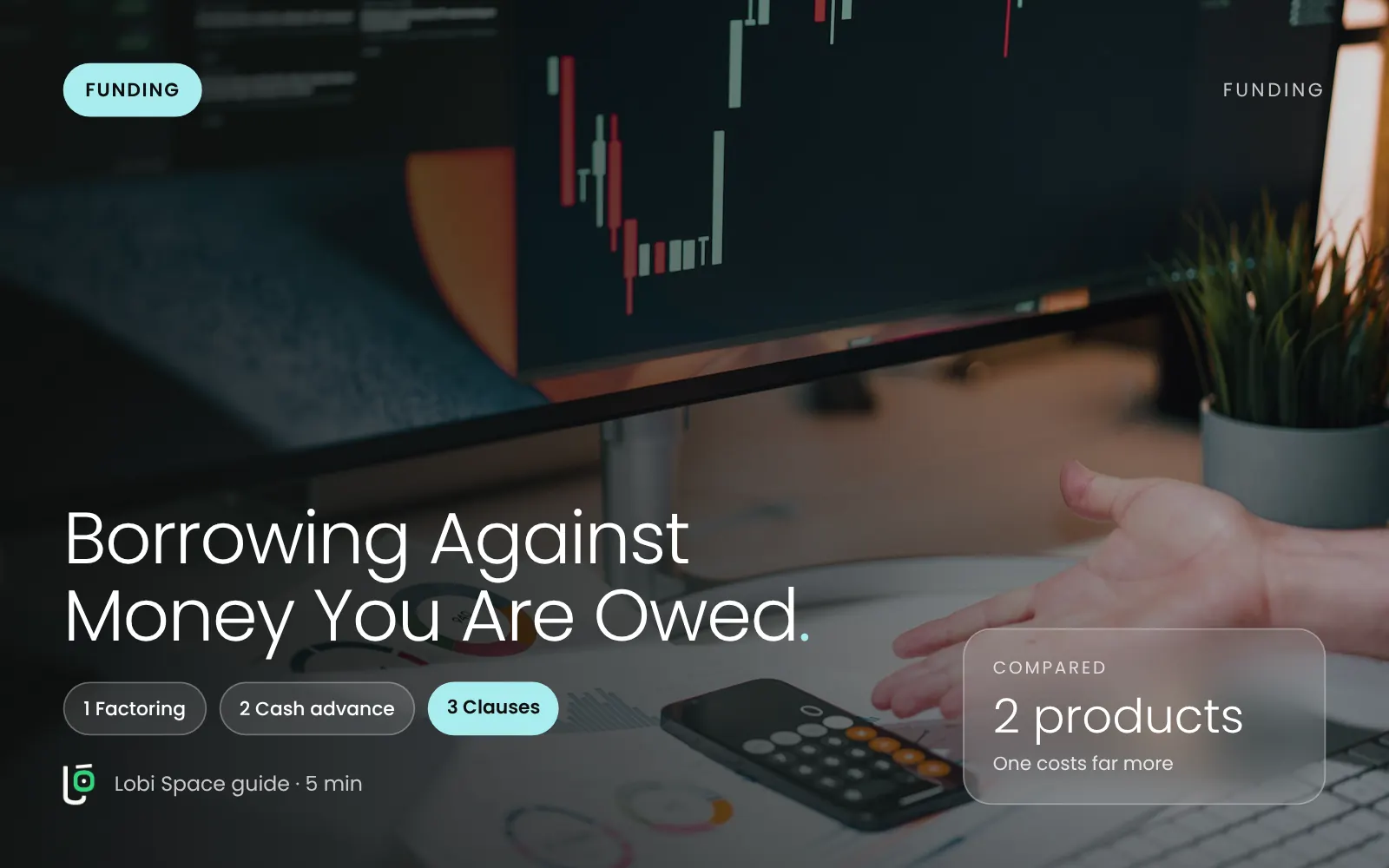
That gap is a timing problem, not a profitability problem, and there are two common products sold to fix it. They get mentioned in the same breath. They are not the same thing.
Lobi Space is not a lender. This is a plain comparison so you can tell them apart. The wider picture is in how small business funding works.
Invoice factoring
You sell an unpaid invoice to a factoring company at a discount. They advance most of the face value now, collect from your customer later, and release the rest minus their fee.
The part they hold back has a name you will meet again in the contract: the reserve. When your customer pays, the factor takes its fee out of the reserve and releases the remainder to you. Where the reserve reappears later in the paperwork, in release timing and minimums, is where the real price of a factoring deal tends to hide.
The factor is underwriting your customer as much as you. If you invoice creditworthy businesses, factoring can be available even when your own credit is thin.
Two versions matter:
- Recourse. If your customer never pays, you buy the invoice back. Cheaper, and the risk stays with you.
- Non-recourse. The factor absorbs certain non-payment risk. More expensive, and the exceptions are the whole story. In most contracts, non-recourse covers your customer going insolvent and not much else. A disputed invoice, a short shipment, a warranty claim, a customer who simply decides the bill is wrong: those usually come straight back to you, and they are the most common reasons invoices actually go unpaid. Read the definition of the covered event before you pay the premium for it.
There is also the question of notification, and it has a name in the paperwork: the notice of assignment. That is the letter telling your customer the invoice now belongs to the factor and payment goes to a new address. In many arrangements it is mandatory. Decide how you feel about your customers receiving one before you sign, because it touches the relationship, and once sent it is not easily unsent.
Merchant cash advance
An advance company buys a slice of your future revenue. You receive cash now and repay through a fixed daily or weekly debit, or a percentage of card sales, until the agreed total is delivered.
It is fast and widely available. It is also, in practice, the most expensive money in this guide. Pricing is usually a factor rate, so the cost does not shrink when you repay quickly.
An advance is generally treated as a purchase of receivables rather than a loan, and that classification is not paperwork trivia. It is the business model. A purchase generally sits outside the interest rate caps and most of the protections that attach to lending, which is exactly why the agreement does not read like a loan agreement: legally, it is not one. Read it as a contract, not a rate, because the contract is all there is. If an advance provider misrepresents a cost or debits what the contract does not support, the FTC's small business fraud guidance describes the schemes it has taken action against and takes complaints, and so does the Illinois Attorney General.
The honest comparison
- What is being funded. Factoring uses invoices you have already issued. An advance uses revenue you have not earned yet.
- Who is judged. Factoring leans on your customers. An advance leans on your sales volume.
- Cost. Factoring fees are typically a percentage of invoice value over time. Advance pricing is typically a factor rate on the full amount, and is usually higher.
- Cash flow impact. Factoring converts one invoice. An advance takes money every day until it is done.
- Best fit. Factoring suits B2B businesses with real payment terms. Advances are sold hardest to card-heavy retail and restaurants.
Read these clauses before you sign
1. Total repayment in dollars, not the rate.
2. Frequency of debit, and whether it changes with sales volume.
3. Recourse terms, reserve amounts, and when the reserve is released.
4. Minimum volume commitments and how long the contract runs.
5. Termination terms and any exit fee.
6. Whether the agreement bars you from taking other funding.
That last one matters. Stacking advances is a fast way to break a contract you already signed and to get declined everywhere else. It is also more visible than owners expect, because both products usually arrive with a UCC-1 filing against your receivables, and those filings are public. The next funder searches the Illinois UCC records before approving anyone, which is how stacking gets caught. Search yourself while you are at it: a paid-off arrangement whose filing was never terminated looks identical to a live debt on that screen, and it will quietly cost you an approval someday.
A cheaper question first
Before either product, ask whether the timing problem can be fixed without buying money.
- Invoice the day work is delivered, not at month end.
- Ask for deposits on larger jobs.
- Offer a small discount for payment in ten days.
- Chase late invoices on a schedule instead of when you notice.
Sometimes the answer is still funding. Often it is process.
When Lobi Capital opens, you will be able to describe what you need and compare paths in one place. Join the launch list to hear when it does.
Frequently asked questions
Is a merchant cash advance a loan?
It is generally structured as a purchase of future receivables rather than a loan, which is why the paperwork and disclosures differ. Practically, you receive cash now and repay more later, so compare total repayment.
Will my customers know I am factoring invoices?
Often yes. Many factoring arrangements send your customer a notice of assignment directing payment to the factor. Non-notification arrangements exist but are less common and usually require a stronger business.
Which is cheaper, factoring or a cash advance?
Factoring is usually cheaper for businesses that invoice other businesses. Advances are typically the most expensive option, because a factor rate on the full amount does not shrink with fast repayment.
Can I use factoring if my own credit is poor?
Sometimes. Factors weigh your customers' ability to pay heavily, so businesses with weak owner credit but strong commercial customers are sometimes approved. Terms still vary by provider.
Follow @lobispace
Guides, Chicago business news and studio work, every week.